State of the Industry
State of the Meat and Poultry Industry 2017: Veal
Veal production stabilizes, challenges remain
When asked to describe the past year, the American Veal Association president uses the word “stability.”
“It’s been stable this past year,” says Dale Bakke, a Wisconsin-based veal industry leader. “Feed prices went up a little bit at about the same time calf prices came down marginally. The result has been a stable cost of operation. “That’s pretty unusual for us,” he adds.
A year ago, the veal industry was recovering from record-high feed ingredient costs. Holstein bull calves, the predominant breed for the veal industry, had peaked in price the year before amid a shrinking U.S. beef cattle herd. With stable prices for feed ingredients like whey powder, whey protein concentrate, and skim milk powder, Bakke says there should be healthy veal industry growth taking place.
But it’s not.
Trade inequities stymie growth
“The economics of veal production here in the U.S. were pretty favorable two years ago,” Bakke says. “We would have seen increased growth in domestic production in the past year if not for the EU imports. It has put a damper on growth here in the U.S. We don’t believe the EU is being held to the same production standards as U.S. producers.”
The Netherlands was given the go-ahead for importing to the U.S. last year over the veal industry’s objections. France is now exporting to the U.S., too, and others could be on the way. About 700 U.S. famers produce about 48 million pounds of veal every year. The Netherlands is planning to export about 22 million pounds per year to the U.S. The Netherlands slaughters about 1.4 million veal calves per year, which is roughly six times the production in the U.S.
One point of contention for U.S. veal producers involves the use of animal health products. Bakke says the EU allows the use of about 50 products that are not allowed to be used in the U.S. – some of them not allowed to be used in any animal grown for food.
“We feel it places us at a disadvantage,” Bakke says.
Another issue of concern is the very definition of veal. In the Netherlands, Bakke says any bovine younger than 12 months old can be called veal. Most Dutch veal comes from animals between 26 and 32 weeks old compared with 22- to 24-week-old animals in the U.S., Bakke says.
Another differentiation centers on feed formulation. Milk-fed veal calves in America are fed primarily milk-based solids supplemented with grain. Dutch veal calves are fed equal amounts of milk and grain solids, Bakke says.
“It creates a very different eating experience for the consumer,” Bakke says. “When you compare the maturity of the calf and the effect diet has on the end product, it can really make a difference. We have extremely high standards for quality, safety and animal stewardship here in the U.S. It is not the same in the EU.”
It is possible for U.S. producers to export veal, but it’s difficult.
“If we want to ship veal to the EU, we would need a segregated production system that is audited by a third party to assure no hormones are ever used, even though it is illegal to use hormones here in the U.S.,” Bakke says. “If they have that restriction on the U.S., the USDA ought to require the same thing of veal producers shipping here.”
Strict quotas imposed on the amount of beef the EU will accept from America also hampers veal exports. The U.S. Trade Representative is working to change that, Bakke says.
“The numerous subsidies European Union veal farmers and processors have long enjoyed continues to create pricing inequities for the American milk-fed industry that is so important to the U.S. economy,” says Anthony Catelli, CEO of AVA member Catelli Brothers. “We must work together to press the federal government to work with the EU to bring about fair trade practices.”
Group housing goal nears reality
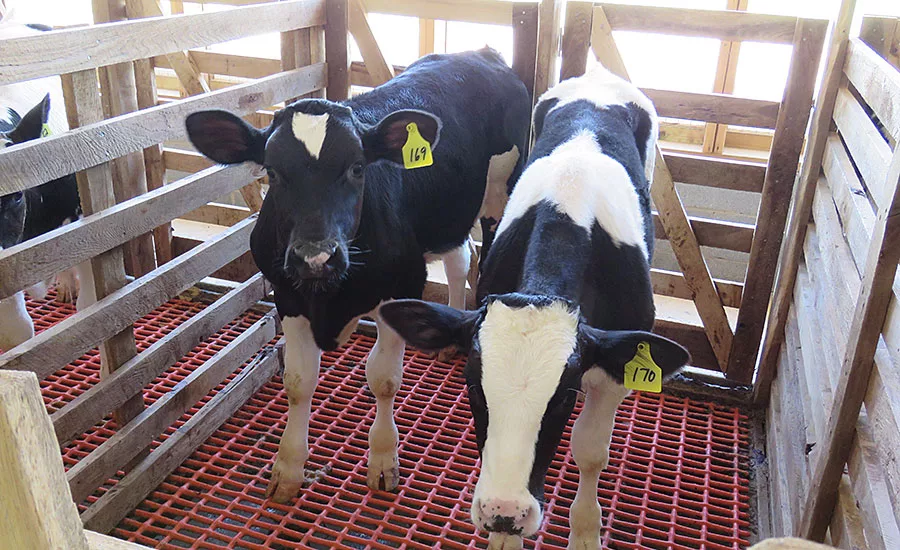
The veal industry took the high road and pledged in 2007 to move completely to group housing over a 10-year period. By the end of 2017, AVA leaders are confident the goal will be realized.
“We are proud that the family businesses and local veal farmers of the AVA have achieved our committed goal of 100 percent group housing and untethered calves by end of 2017,” Catelli says.
There’s been some trial and error within the industry in making the transition, Bakke says, but he notes the process has been smooth in recent years as individual producers identified the housing systems that work best for them.
Expressing natural behavior is among the Five Freedoms of Animal Welfare and group pens allow calves to stand, stretch, lie down, groom themselves and socialize with other animals. A variety of different systems house calves in groups ranging from as few as two up to groups of 10.
“We really believe this transition has improved the well-being of the animals,” Bakke says. NP
Veal tour showcases group housing
AVA hosted two online journalists for a tour of farms and processing facilities last spring in Pennsylvania and Indiana. Dr. Janeal Yancey is a University of Arkansas meat scientist and creator of the "Mom at the Meat Counter" blog. Dairy farmer Krista Stauffer’s blog can be found at "The Farmer’s Wifee."
Among Yancey’s observations: "This tour was such an eye-opening experience. The veal I ate while on the tour was absolutely delicious. I am planning to buy some veal to serve to my family and will definitely order veal if I see it in a restaurant. I know that the animals are raised in good conditions and well cared for. I’m confident that the harvest and processing met my standards of humane animal treatment and food safety."
Stauffer notes: "I am happy to report from my firsthand experience that these calves were very well cared for. They had a clean environment, high-quality feed and lived in well-lit and ventilated barns. I was very impressed with all the changes they have made since the '70s."
AVA as an organization continues to see strong involvement by its growing membership. Like the memberships Web site www.AmericanVeal.com, a new brochure produced this year provides a variety of resources to learn more about the U.S. milk-fed veal industry. Today's U.S. milk-fed industry is not what it used to be. Stauffer, who toured veal farms and plants, summed it up with this headline: "The veal industry has changed; so should the public’s perceptions."
State of the Industry 2017 Segments
Looking for a reprint of this article?
From high-res PDFs to custom plaques, order your copy today!