Grinding and stuffing equipment: Stepping up to meet demand
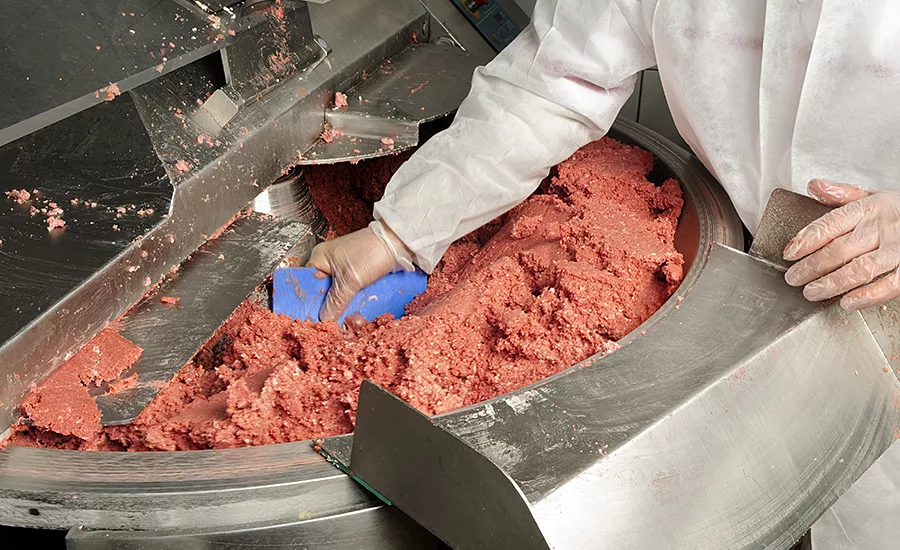
With the COVID-19 pandemic, U.S. consumer purchase behavior has shifted to more retail and less foodservice, and ground products have been go-to-products for people sheltering in place. In turn, increased demands to meet production needs are challenging processors to keep grinding and stuffing equipment highly operational at top speeds.
For major beef packers stuffing large chubs, such as 10 pounds of either course or fine ground, the challenges at that scale in stuffing relate to equipment function and maintenance because it’s a very automated process, says Jacob Nelson, facilities manager and meat processing specialist at Oklahoma State University’s Robert M. Kerr Food and Agricultural Products Center, in Stillwater. “If the equipment fails, then the whole process fails.”
Additionally, the very nature of grinding beef changes the food safety category of the product, which includes having a Hazardous Analysis Critical Control Point (HACCP) plan that’s driven by regulatory implications, Nelson says.
Hitting consistent net weight and portion controlling at high volume also is required. As such, larger grinding operations also have continuous measurements of the product’s fat content coming out of the grinder, which is a great advantage because processors can have a much better gauge of what’s in the blender, says Edward Mills, associate professor of meat science in the College of Agricultural Sciences at Pennsylvania State University, in University Park. For example, a processor could have a couple of 2,500-pound lines feeding into a 5,000-pound unit downstream. “You’ve got to have a pretty good knowledge of what the fat content is in each of those feeding in in order to keep your equipment at full capacity,” he explains.
Maintaining a consistent lean-to-fat ratio and product color also remains imperative, Nelson says. With regard to consistency, the matter of sourcing the correct raw material that will produce something close to the finished product a processor wants coupled with the art of blending raw materials to get that lean target point are skills that industry has mastered and are quite effective doing, he says.
One of the greatest challenges to overcome in grinding and stuffing is sourcing good qualified labor, which is a challenge across all areas of production. Grinding and stuffing equipment in larger plants nowadays tend to have touch-screen computer controls that are intuitively designed, which is easier for operators to learn, Mills says. In smaller plants, with the industry’s labor shortage, processors are fortunate if they have two operators who know how to disassemble, clean and reassemble, he says.
Upgrading advantages
With continuous improvements in automated grinding and stuffing equipment, equipment manufacturers have made the process easier for portioning quality stuffed product at high speeds, Nelson says. Many of the processes that required multiple pieces of equipment also have been streamlined. For example, to make a patty, equipment such as a grinder, conveyor, former and some type of assembly to collate and stack patties into packs are being integrated into one machine to create efficiency. Additionally, fewer people are needed to operate integrated machinery. Product also is more contained, which aids in food safety because of reduced product handling, Nelson says.
With processors moving product through systems rapidly, upkeep and maintenance is crucial to the business’s success. Skilled and knowledgeable maintenance workers are required to keep these machines running, Nelson says. “Down time is always a dagger that hurts the profitability of a business,” he says.
Therefore, it’s important to maintain the sharpness of the knives that perform the cutting in these grinding systems. It’s also important to keep product cold, which not only affects food safety but product quality and appearance.
“Machinery that can address those challenges will succeed because you put out a better product, and you do it more efficiently,” Nelson says.
Today, most grinders have some kind of computer tracking data such as how long a particular grinder head has been in place, what kind of back pressures are present and if there is any temperature rise. “There are some interesting opportunities to collect information and refine your system,” Mills says.
The area of stuffing systems also has advanced quickly, Mills says, especially in weight-control operations. “We can change the design on the stuffing operation and up the speed that we’re moving product through,” Mills says. “… Systems now have figured out how to portion things on a continuous flow basis and do the clipping in motion.”
In regard to food safety, many operations use a bone-removal head of some sort on their grinder in addition to particle, bone and metal detection systems, Mills says. Whereas processors used to use one bone-removal head for all their products, this did not prove efficient. For example, if a processor ran turkey on the same system as beef, the yield on turkey would decrease based on the loss of product through the bone recovery slots, Mills explains. Having the right equipment for the particular product a processor is running is imperative for particle removal, he says.
Additionally, if a processor is cranking up the grinding speed without maintaining or improving the grinding edge on the grinding equipment, a processor is more likely to end up with metal particles in the product. More surfaces and corners on the grinder heads translate to an increased risk of physical hazards and metal particles, Mills says. “Certainly, we have metal detectors in line that are going to protect packages,” he explains. “They’re going to reject packages that have those items in there, but I’d rather not have them in there to begin with then have to depend on the metal detector to exclude them.
“We’ve got to ensure that we keep those blades sharply maintained that we don’t put ourselves in the position that we have to crank the grinder head down tighter than we should,” Mills continues. “If you let a blade get a little bit dull, you make up for that by putting more pressure on it. Well, that additional pressure translates into additional heat and translates into higher likelihood of damage of actually having some fracturing of some sort of metal particles in products. Keeping close track of how many hours you have on a grinder plate is a real important part of it.”
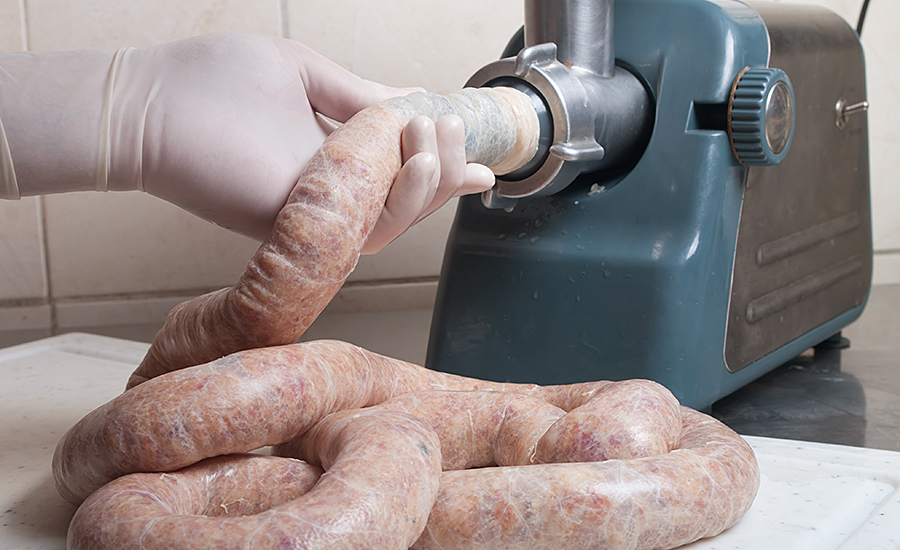
In the realm of maintaining stuffing systems, most stuffing systems today have vacuum systems to remove air. Maintaining seals around the vacuum systems becomes imperative, so air is not introduced into the finished product, Mills says.
Improving food safety
As the construction of the equipment continues to improve, the sanitation and cleanability of equipment improves as well.
“The easier and faster you can clean something, the easier you can maintain it,” Nelson says. “All of those things contribute to product quality and product safety and that comes with knowledge and knowledge comes with experience.”
Research also is being conducted at OSU by Ravi Jadeja, a food-safety specialist and assistant professor. Jadeja’s research focuses on methods and technologies to clean and sanitize grinding equipment in between batches or lots that improve the efficiency of the whole process. Processors would be able to implement a cleaning step that does not require a full disassembly or traditional cleaning steps.
Having an equipment design system that is easy to disassemble and clean is more important today with production demands, Mills says. New equipment manufacturers have given much thought to the ease of cleanability, maintenance and providing the best food-safety conditions. “That’s not something there with older equipment, and that could be a real value,” Mills says. “It can be a real important part on why it’s worth paying money to upgrade.” NP
Looking for a reprint of this article?
From high-res PDFs to custom plaques, order your copy today!