Provisioner logo
Provisioner logo
search
cart
facebook twitter linkedin youtube
  • Sign In
  • Create Account
  • Sign Out
  • My Account
Provisioner logo
Provisioner logo
  • NEWS
    • Industry News
    • Supplier News
    • Case Studies
    • Recalls
    • Regulations
    • New Consumer Products
  • EXCLUSIVES
    • Newsletters
    • Source Book
    • Sponsored Insights
    • Events
    • Webinars
    • Classifieds
    • White Papers
    • Provisioner Store
    • Market Research
  • MEAT PROCESSING
    • SUSTAINABILITY
    • Processing
    • Packaging
    • Ingredients
    • Formulation
    • Food Safety
    • Special Reports
    • Commentary
  • PROFILES
    • Processor Profiles
    • Processor of the Year
    • Top 100 Processors
  • MEDIA
    • Videos
    • Podcasts
  • DIRECTORY
  • MIHOF
  • INDEPENDENT PROCESSOR
  • EMAG
    • eMagazine
    • ARCHIVE ISSUES
    • Contact
    • Advertise
  • JOIN!
Meat and Poultry ProcessingPackagingExpert Commentary

Tech | Meat Science Review

Understanding metmyoglobin reduction pathways to limit meat discoloration
By M.A. Scott, M.L. Denzer, G.G. Mafi and R. Ramanathan
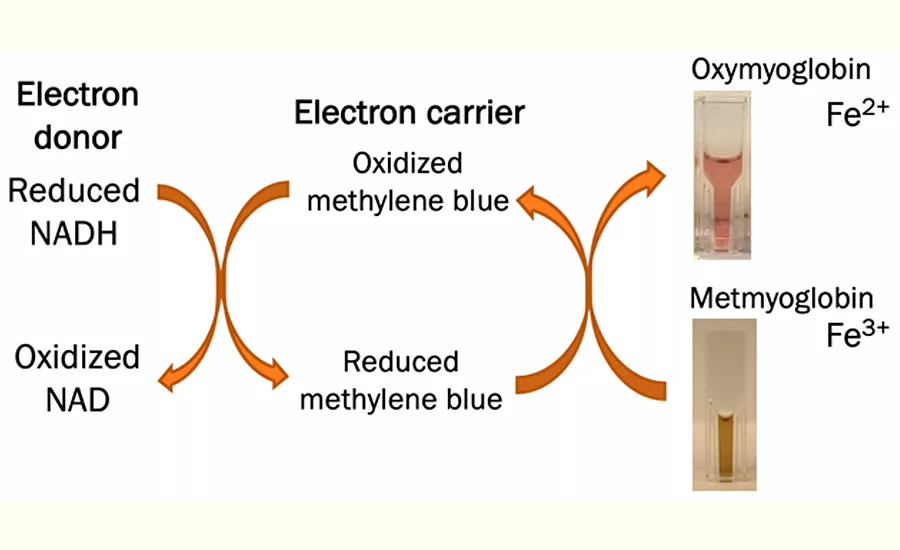
Figure 1

Figure 1: Nonenzymatic mechanism determined by Brown and Snyder (1969)

December 11, 2020

Food waste affects every American consumer. The United States wastes more than 84 million tons of edible food a year, and meat contributes 22 percent of the total food loss (Dou et al., 2016). Consumers typically prefer a bright cherry-red meat color when purchasing meat products, and discoloration has a negative impact on buying decisions, which in turn can lead to food waste.

Myoglobin is the heme protein primarily responsible for meat color. Depending on the iron valence state and the ligand attached, myoglobin occurs in three different forms: deoxymyoglobin, oxymyoglobin and metmyoglobin. Deoxymyoglobin imparts a purplish dark red while oxymyoglobin gives a bright red color. Discoloration occurs by the oxidation of deoxy-/oxymyoglobin, forming metmyoglobin and brown surface color.

Oxidation is the loss of electrons from the heme in myoglobin from Fe2+ to Fe3+ and can occur more readily in common retail settings where meat is exposed to light and oxygen (O2). However, meat has an inherent ability to reduce the brown pigment and form reduced myoglobin through metmyoglobin reducing systems such as enzymatic, non-enzymatic, and mitochondria-mediated pathways.

The non-enzymatic metmyoglobin-reducing pathway occurs when inherently present electron donors and carriers interact with metmyoglobin to form ferrous myoglobin. For example, nicotinamide adenine dinucleotide (NADH; an electron donor) and methylene blue (an electron carrier) can interact with metmyoglobin to form reduced deoxy-/oxymyoglobin, as represented in Figure 1. But limited knowledge is available on the impact of light on non-enzymatic reduction. The objective of this study was to evaluate the effect of light and dark storage conditions on non-enzymatic metmyoglobin reduction in vitro. 

Solutions of ascorbate and NADH were used as the electron donors, and cytochrome c and methylene blue as the electron carriers. Equine metmyoglobin solution at pH 5.6 was combined with different electron donors and carriers in a 96-well plate. To evaluate lighting effects, the well plate was kept under LED lighting, and readings were taken every five minutes for 25 minutes using a spectrophotometer set to 582 nm. The same combinations were evaluated in dark storage with the previously mentioned method. The experiment was replicated three times, and the data were analyzed using the Mixed Procedure of SAS. There was a significant treatment ´ lighting effect on the metmyoglobin reduction. The combination of NADH and methylene blue had an increase (P < 0.0001) in metmyoglobin reduction in light conditions compared to dark storage. There were electron donor and carrier-specific effects on non-enzymatic metmyoglobin reduction. In the presence of light, NADH + methylene blue + EDTA had an increase (P < 0.0001) in metmyoglobin reduction when compared with dark storage. The metmyoglobin reduction was limited in the presence of NADH + cytochrome c in both lighting conditions compared with NADH and methylene blue. Metmyoglobin reduction was significantly higher in the presence of cytochrome c and ascorbate compared with cytochrome c and NADH for light and dark conditions. In addition, metmyoglobin reduction increased with the presence of light and the combination of ascorbate and methylene blue (P < 0.001). 

In conclusion, the current in-vitro research demonstrates inherently present electron donors and carriers can contribute to non-enzymatic metmyoglobin reduction in retail light settings and meat pH. When considering the practical implications of this study, electron donors and carriers could be utilized in a post-harvest enhancement technology, which may lead to an extension in color stability. Additionally, active packaging coupled with the cofactors of non-enzymatic metmyoglobin reduction ability has the potential to limit discoloration and increase the shelf life of meat products. Finding a way to limit the amount of metmyoglobin on the meat surface will be advantageous to the consumer, producer and environment. NP

Resources

Z. Dou, J.D. Ferguson, D.T. Galligan, A.M. Kelly, S.M. Finn, and R. Giegengack. 2016. Assessing U.S. food wastage and opportunities for reduction. Global Food Security. 8:19-26.

KEYWORDS: myoglobin oxidation red meat

Share This Story

Looking for a reprint of this article?
From high-res PDFs to custom plaques, order your copy today!
The authors are with the Department of Animal and Food Sciences, Oklahoma State University, Stillwater, OK 74078, USA. For more information, contact ranjith.ramanathan@okstate.edu


Recommended Content

JOIN TODAY
to unlock your recommendations.

Already have an account? Sign In

  • Double Charburger

    Premiumization drives burger category

    Shoppers seek out premium meat offerings to fulfill...
    Burgers
    By: Sammy Bredar
  • JJS Adult Pekin duck

    Poultry Report 2025: Convenience propels poultry at retail

    Despite continued economic pressures, the poultry...
    Turkey
    By: Sammy Bredar
You must login or register in order to post a comment.

Report Abusive Comment

Manage My Account
  • eMagazine Subscriptions
  • Manage My Preferences
  • Newsletters
  • Online Registration
  • Subscription Customer Service
  • Connect with The National Provisioner

More Videos

Sponsored Content

Sponsored Content is a special paid section where industry companies provide high quality, objective, non-commercial content around topics of interest to the The National Provisioner audience. All Sponsored Content is supplied by the advertising company and any opinions expressed in this article are those of the author and not necessarily reflect the views of The National Provisioner or its parent company, BNP Media. Interested in participating in our Sponsored Content section? Contact your local rep!

close
  • A smiling man carrying a grocery basket is reaching down to pick up a package of meat in a grocery store.
    Sponsored byPIC

    The Green Light: New Data Shows 12-to-1 Support for Pork from PRRS-Resistant Pigs

  • Close up of a grocery cart full of groceries, a cropped image of a couple pushing the cart and a blurred background of the vegetable aisle.
    Sponsored byPIC

    New Market Research Finds Consumers in Eight Key Pork Markets Are Likely to Purchase Pork from Gene-Edited Pigs

  • Close up of a young pig with a blurred background.
    Sponsored byPIC

    New Research Forecasts Significant Economic and Market Impacts with PRRS-Resistant Pig Adoption

Popular Stories

JBS USA logo

JBS USA closing pair of processing facilities

New products include ready-to-heat proteins, flavor-forward lunchmeats and additions to the brand’s bacon portfolio.

Applegate Farms expands portfolio across deli, refrigerated and breakfast categories

New World Screwworm fly

USDA confirms presence of New World screwworm in US

2026 Top 100 Meat & Poultry Processors Report

Events

July 16, 2026

Strengthening Food Safety Plans for Modern Processing Operations

The live webinar will explore the latest technologies, emerging risks, and practical strategies shaping food safety programs across meat and poultry processing operations. Attendees will hear from industry experts on key challenges impacting processors today, along with approaches for strengthening and updating food safety plans across their facilities.

January 1, 2030

Webinar Sponsorship Information

For webinar sponsorship information, visit www.bnpevents.com/webinars or email webinars@bnpmedia.com.

View All Submit An Event

Products

Food Crime: An Introduction to Deviance in the Food Industry

Food Crime: An Introduction to Deviance in the Food Industry

See More Products
From Fresh to Frozen in 3 Minutes Flat: Unlocking the Secrets to Temperature Control Webinar Sponsored by Air Products

Related Articles

  • Burger King to limit sodium in kids meals

    See More
  • Thermo Fisher ASF

    China approves Thermo Fisher Scientific’s African Swine Fever Virus workflow to help limit spread of disease

    See More
  • S. Korea: Beef age limit to be kept until concerns subside

    See More

Related Products

See More Products
  • GlobalData_logo_blue_header.png

    Frozen Meat (Meat) Market in the United States of America - Outlook to 2023...

  • GlobalData_logo_blue_header.png

    Fresh Meat (Counter) (Meat) Market in the United States of America - Outlook to 2023...

  • GlobalData_logo_blue_header.png

    Chilled Raw Packaged Meat - Processed (Meat) Market in the United States of America - Outlook to 2023...

See More Products

Related Directories

  • Smokehouse Limited Inc.

    We supply pneumatic oven door gaskets for smokehouses, brine chillers and other processing equipment.
×

Stay ahead of the curve. Unlock a dose of cutting-edge insights.

Receive our premium content directly to your inbox.

SIGN-UP TODAY
  • RESOURCES
    • Advertise
    • Contact Us
    • Directories
    • Store
    • Want More
  • SIGN UP TODAY
    • Create Account
    • eMagazine
    • Newsletter
    • Customer Service
    • Manage Preferences
  • SERVICES
    • Marketing Services
    • Reprints
    • Market Research
    • List Rental
    • Survey/Respondent Access
  • STAY CONNECTED
    • LinkedIn
    • Facebook
    • YouTube
    • X (Twitter)
  • PRIVACY
    • PRIVACY POLICY
    • TERMS & CONDITIONS
    • DO NOT SELL MY PERSONAL INFORMATION
    • PRIVACY REQUEST
    • ACCESSIBILITY

Copyright ©2026. All Rights Reserved BNP Media, Inc. and BNP Media II, LLC.

Design, CMS, Hosting & Web Development :: ePublishing