January red meat exports below year-ago levels amid transportation, labor challenges

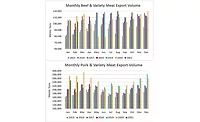
U.S. beef and pork exports opened 2021 below the large volumes posted a year ago, according to January data released by USDA and compiled by USMEF.
Beef exports totaled 105,047 metric tons (mt) in January, down 2% from a year ago, while value slipped 3% to $653 million. The decline was due mainly to lower beef variety meat shipments, as muscle cut exports were steady with January 2020 at 81,398 mt, valued at $584.4 million (down 1%) and accounted for a larger share of production than a year ago.
January pork exports totaled 248,656 mt, down 9% from a year ago but slightly above USMEF’s projections. Export value was down 13% to $642.8 million. Pork muscle cut exports were down 11% in volume (208,234 mt) and 15% in value ($551.3 million), while pork variety meat shipments trended modestly higher than a year ago.
USMEF President and CEO Dan Halstrom said January represented a fairly solid start to 2021, but cautioned that exports still face COVID-related obstacles and significant transportation and labor challenges.
“As key destinations for U.S. red meat roll out COVID vaccination programs, the outlook for 2021 is optimistic, with retail meat demand remaining strong and the expectation that foodservice will rebound in more and more regions,” Halstrom said. “But transportation challenges are currently a dominant concern, particularly the congestion and container shortages at our West Coast ports where shorthanded crews are handling record-large cargo volumes. Labor is also at a premium in processing plants, which affects the industry’s ability to fully capitalize on demand for certain labor-intensive cuts and variety meat items.
“Although the global foodservice sector still has a long recovery ahead, international demand for U.S. red meat remains impressive and resilient,” Halstrom added. “But a range of logistical challenges must be overcome in order to fully satisfy this demand.”
Korea shines for U.S. beef exports; momentum continues to grow in China
January beef exports equated to $311.78 per head of fed slaughter, up 3% from a year ago. Exports accounted for 13.3% of total beef production and 11% for muscle cuts only, above the January 2020 ratios of 13.1% and 10.6%, respectively.
Beef exports to South Korea opened 2021 on a very strong note, climbing 20% from a year ago in volume (21,355 mt) and 22% in value ($158.7 million). On Jan. 1, U.S. beef received another tariff reduction under the Korea-U.S. Free Trade Agreement. The rate is now 13.3% – about one-third of the pre-FTA rate of 40% – and will decline to zero by 2026. The U.S. has a tariff advantage compared to Australia (18.6%) and Canada (21.3%) in 2021, and tariffs do not phase to zero for Australia and Canada until 2028 and 2029, respectively, under their free trade agreements with Korea.
January was another big month for U.S. beef exports to China, which were up nearly 800% from a year ago in both volume (7,862 mt) and value ($58.1 million). In September, the U.S. overtook Australia as China’s largest grain-fed beef supplier. In January Australia’s grain-fed exports to China were 3,345 mt, down 49% from 2020.
Japan remained the leading volume market for U.S. beef at 22,018 mt, down 13% from a year ago, but slipped to second place in value (behind Korea) at $138.1 million (also down 13%). Most of Japan’s major cities have been under a COVID-related state of emergency since early January that includes reduced hours for restaurants and cafes. Restrictions were recently eased in some areas but remain in place in the Tokyo metropolitan area. Japan’s imports of U.S. beef have also been impacted by the U.S.-specific safeguard, which is likely to trigger in March even as importers have slowed volumes in an effort to avoid reaching the safeguard threshold. If the safeguard is triggered, the duty on U.S. beef muscle cuts will increase from 25.8% to 38.5% for 30 days.
Other January highlights for U.S. beef exports include:
- Following a big rebound in December, beef exports to Mexico eased to some degree to 18,045 mt (down 18% from a year ago) valued at $87.8 million (down 25%). However, exports remained well above the low levels posted in mid-2020 during the height of Mexico’s foodservice restrictions and high U.S. prices resulting from supply challenges.
- After setting a fifth consecutive volume record in 2020, exports to Taiwan trended lower in January at 3,833 mt (down 27% from a year ago) valued at $38.7 million (down 11%). The outlook for U.S. beef remains very positive in Taiwan, based on strong retail and foodservice demand.
- Beef exports to Canada continued to gain momentum in January, climbing 5% from a year ago in both volume (9,905 mt) and value ($61.8 million).
- Following a down year in 2020, beef exports to the Middle East rebounded to 6,847 mt, up 6% from a year ago, while value jumped 20% to $20.4 million. Beef variety meat exports to mainstay market Egypt were steady with last year, while muscle cuts posted impressive growth in the United Arab Emirates, Kuwait and Saudi Arabia.
Pork exports led by growth in Japan, Central America, Philippines and Caribbean
January pork exports equated to $57.14 per head slaughtered, down 9% from a year ago. Exports accounted for 28.2% of total pork production and 25.4% for muscle cuts only, down from 29.8% and 27.4%, respectively, in January 2020.
As expected, pork exports to China/Hong Kong were well below last year’s very large volumes but still reached 76,202 mt (down 21% from a year ago) valued at $173.3 million (down 29%). While USMEF expects exports to the region to remain below 2020 levels throughout the year, China still has a pressing need for imported pork. January exports included a mix of frozen cuts, bone-in hams and boxed carcasses. Carcass export volume was 5,923 mt, the largest since June.
Despite the continued 25% retaliatory duty on U.S. pork and pork variety meats, China’s demand for pork variety meat remains strong, with January exports of pork variety meat to China/Hong Kong increasing 18% from a year ago to 24,475 mt.
Pork exports to Japan opened 2021 on a positive note, increasing 2% from a year ago in both volume (32,332 mt) and value ($134.6 million). Demand for chilled U.S. pork remains very strong in Japan’s retail sector and the U.S. industry has reclaimed market share for ground seasoned pork since the U.S.-Japan Trade Agreement (implemented in January 2020) slashed the duty rate and eliminated a severe tariff disadvantage. Japan’s duty rate on ground seasoned pork will notch down again on April 1 to 6.6%, compared to the pre-trade agreement rate of 20%.
Coming off a record year in 2020, pork exports to Central America continued to shine in January at 11,023 mt, up 56% from a year ago, valued at $26.9 million (up 43%). January export volume was the fourth largest on record and significantly above the usual seasonal trend, as exports more than doubled to Panama and posted impressive growth in Honduras, Guatemala, Nicaragua and Costa Rica.
Other January highlights for U.S. pork exports include:
- Exports to the Philippines nearly doubled from a year ago, increasing 98% to 4,739 mt valued at $11.3 million (up 99%). Philippine officials are currently considering a temporary tariff rate quota increase and tariff rate reductions on imported pork in an effort to bolster supplies and stabilize prices, which could open additional opportunities for U.S. pork.
- Led by strong growth in the Dominican Republic and the Bahamas, exports to the Caribbean increased 33% from a year ago to 6,361 mt, with value up 27% to $15.4 million.
- Pork exports to Colombia slumped in 2020 but showed improvement late in the year. This momentum continued in January as exports reached 6,624 mt, up 6% from a year ago, valued at $15.2 million (down 2%). Led by continued growth in Chile, January exports to South America increased 3% from a year ago to 10,472 mt, though value was down 4% to $26.7 million.
- Following a very strong fourth quarter performance, exports to Mexico trended lower in January at 63,757 mt, down 10% from a year ago, while value fell 18% to $110.5 million.
Lamb export volume trends higher on strong variety meat demand
U.S. lamb exports climbed 7% in January to 1,027 mt but value fell 43% to $1.2 million, as volume growth was driven by lamb variety meat demand in Mexico and Canada. Lamb muscle cut exports trended higher than a year ago to Bermuda and Japan.
Complete January export results for U.S. pork, beef and lamb are available from USMEF’s statistics Web page.
Source: USMEF
Looking for a reprint of this article?
From high-res PDFs to custom plaques, order your copy today!