The Poultry plant of the future
The first industrial revolution emerged through mechanization primarily of agricultural tools such as the combine harvester and the cotton gin, and more broadly of mass transportation such as rail. It also initiated the transition from agriculture to manufacturing as a primary economic engine. The second industrial revolution was driven by enabling innovations in energy and communications such as the use of electricity and oil to power automotive transportation and broad industrial electrification. Communication technologies such as the telegraph and telephone began the process of connecting people, enabling business on a much larger geographic scale. The third industrial revolution involved the digitalization of manufacturing and communication with software-driven tools, ubiquitous digital communications, and higher degrees of manufacturing customization. This had a profound impact on brick-and-mortar retail and print journalism, where traditional business models were significantly disrupted.
We are now on the cusp of a rapidly evolving fourth industrial revolution, or Industry 4.0, characterized by the fusion of many different technologies including robotics, artificial intelligence (AI), virtual reality (VR), autonomous systems, nanotechnologies, quantum computing and a completely interconnected internet-of-things. This confluence of enabling technologies has the potential to fundamentally change the definition of work, as it envisions a future manufacturing floor that does not require the physical presence of workers.
The proliferation of high-power cloud computing connected to smart machinery will result in manufacturing systems that can learn and adapt to changing inputs while remaining nimble enough to be rapidly repurposed as output demands dictate. The interconnectivity of manufacturing tools and systems accessible through distributed digital channels will transition labor from “shop-floor” operators to “toll-based” remote supervisors more commonly associated with the “gig economy” labor force. This will undoubtedly result in a shift away from the Ford Model-T dragline manufacturing concepts and toward a digitally driven “lot size of one” production.

With this emerging Industry 4.0 paradigm as a backdrop, one can envision a future poultry processing facility looking quite different 20 years from now. While automation in the poultry industry is considered quite advanced compared to other animal protein manufacturing/processing operations, upon further inspection the core processing activities remain fundamentally unchanged over the past 50 years. They consist of a patchwork of traditional methods and tools that have been retrofitted with modern materials and unit process technologies.
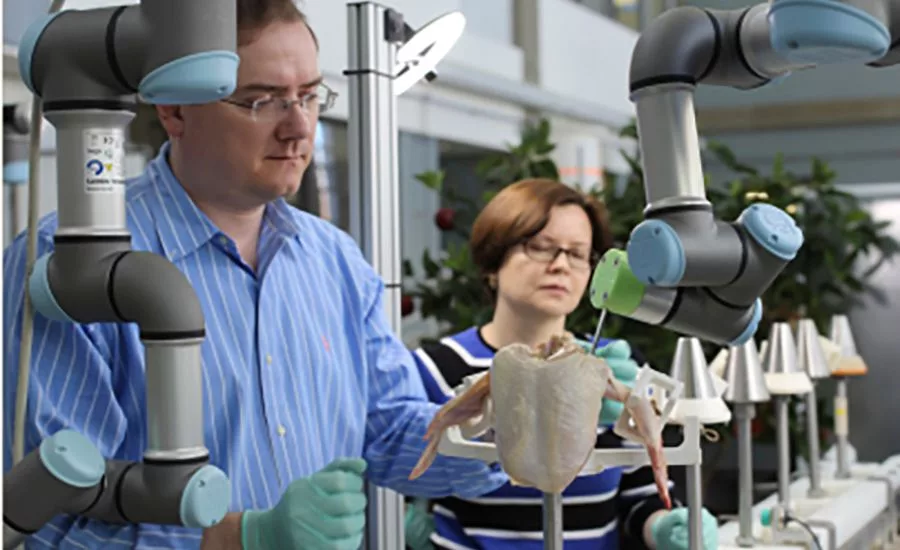
A future processing facility will most likely revolve heavily around the “lot size of one” concept. When compared with traditional manufacturing, the challenges associated with poultry processing have been the natural variability, the flexibility and deformable properties, and the food safety and perishable nature of the product. These have been major obstacles in achieving desired throughput, yield, and quality metrics with automation. However, in the Industry 4.0 paradigm, where each carcass is completely scanned and then processed as a single unit or lot, many of these challenges can be overcome. Consider a network-enabled array of sensors/cameras connected to high-performance cloud computing resources that can, in real time, generate unique cutting trajectories for one specific carcass. This data and information is then fed to a single work cell that contains multiple robots that are coordinated to perform the desired manipulation and cutting tasks on that carcass. The input to the work cell is the carcass, and the outputs are the desired products along with the separated frames and entrails. Furthermore, consider hundreds of these work cells now operating simultaneously (like 3D printers) to produce any variety of products depending on what optimizes quality and yield for those carcasses. Production changes simply become the delivery of new software commands to the robotic work cells based on current output demands. In this fashion, the flexibility of producing products for multiple end customers becomes more of a reality, and scaling of the manufacturing capacity involves just adding or removing work cells on the production floor.
"We are now on the cusp of a rapidly evolving fourth industrial revolution, or Industry 4.0, characterized by the fusion of many different technologies including robotics, artificial intelligence (AI), virtual reality (VR), autonomous systems, nanotechnologies, quantum computing and a completely interconnected internet-of-things. "
Another fundamental shift involves the function and role of labor on the processing plant floor. Through the use of VR tools that are connected to processing plant work cells, it is conceivable to have “employees” virtually operate or support the robotic systems from anywhere. Labor will go virtual, with employees remotely supporting robotic processing work cells to handle only those extremely difficult or challenging operations that the smart technologies cannot address independently.
The Agricultural Technology Research Program (ATRP) at the Georgia Tech Research Institute has been heavily investing in highly transformational technology developments that leverage Industry 4.0 concepts. Our Poultry Plant of the Future strategic initiative includes the development of VR concepts that enable remote operation of robotics; novel paradigms for sensing and processing carcasses in individual work cells; AI-driven robotic solutions for performing cuts and manipulating product in processing; and deploying or developing advanced sensors to perform input product characterization in support of advanced manipulation. These projects form the pieces of a larger integrated puzzle that when completed presents a truly transformed poultry production and processing industry that looks very different than it does today. ATRP’s vision is to be the catalyst that drives this innovation in advanced technologies into the poultry, agribusiness, and food manufacturing industries. It is a fascinating time as together we will get to experience the poultry industry’s metamorphosis through this fourth industrial revolution.
Looking for a reprint of this article?
From high-res PDFs to custom plaques, order your copy today!