Provisioner logo
Provisioner logo
search
cart
facebook twitter linkedin youtube
  • Sign In
  • Create Account
  • Sign Out
  • My Account
Provisioner logo
Provisioner logo
  • NEWS
    • Industry News
    • Supplier News
    • Case Studies
    • Recalls
    • Regulations
    • New Consumer Products
  • EXCLUSIVES
    • Newsletters
    • Source Book
    • Sponsored Insights
    • Events
    • Webinars
    • Classifieds
    • White Papers
    • Provisioner Store
    • Market Research
  • MEAT PROCESSING
    • SUSTAINABILITY
    • Processing
    • Packaging
    • Ingredients
    • Formulation
    • Food Safety
    • Special Reports
    • Commentary
  • PROFILES
    • Processor Profiles
    • Processor of the Year
    • Top 100 Processors
  • MEDIA
    • Videos
    • Podcasts
  • DIRECTORY
  • MIHOF
  • INDEPENDENT PROCESSOR
  • EMAG
    • eMagazine
    • ARCHIVE ISSUES
    • Contact
    • Advertise
  • JOIN!
Meat and Poultry Industry NewsFood SafetyBeef

New assay accelerates E. coli testing process

The new time-saving assay detects an especially severe strain of E. coli in ground beef.
By Industry News
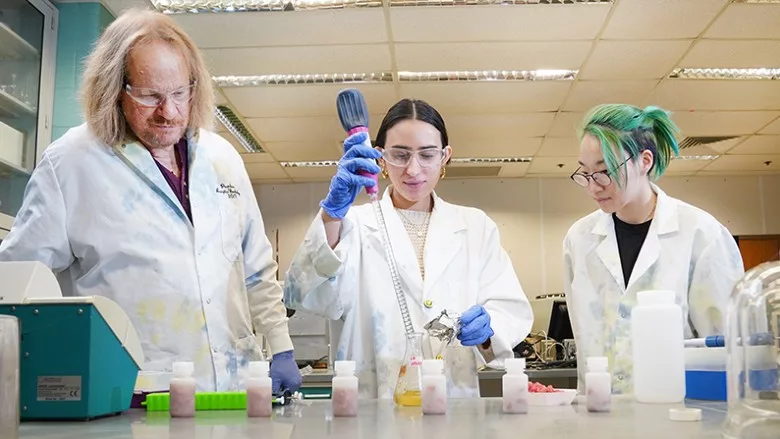
Professor of food science Bruce Applegate works with students to develop a faster testing method for pathogenic E. coli in beef
Purdue Agricultural Communications photo/Tom Campbell
March 3, 2023

A team led by Purdue University’s Bruce Applegate has developed a new time-saving assay to detect an especially severe strain of E. coli in ground beef.

The toxin produced by E. coli accounts for 175,000 illnesses annually in the United States. The U.S. Department of Agriculture’s Food Safety and Inspection Service has maintained zero tolerance for O157:H7, an E. coli strain that can be life-threatening, since 1994. Zero tolerance means that if even one cell of E. coli is detected in a standard 325-gram (11.4-ounce) sample of ground beef, the entire batch is flagged as unfit for consumption.

“The issue is, you need to have a detection technology where you can find one cell in your sample,” said Applegate, a professor of food science. But one E. coli cell is almost impossible to find in a 325-gram sample. “There’s not a technology able to do that unless you do what we call an enrichment.”

The enrichment process entails preparing a special environment that allows E. coli O157:H7 to outcompete all other microorganisms in a food sample before testing.

“Instead of one cell in this 325-gram sample, I will have 10 million to 100 million of these cells in there. I can guarantee I will find it then,” Applegate said.

The assay both enriches the sample and can detect E. coli during the 15-hours-or-more needed to ship samples from a production facility to a testing laboratory of the Food Safety and Inspection Service. Applegate and five co-authors published the details of their assay in the journal Foods.

The new assay saves time by combining enrichment and detection during shipment. See a video about the new assay here.

“Having an accurate reading in a very short amount of time means everything to not just the food industry, but safety as a whole,” said Chuyan Chen, co-lead author of the Foods paper. Chen, who received her master’s degree in food safety and microbiology at Purdue in 2018, now works in the consumer packaged foods industry. Chen noted that this work can be adapted for application to other food pathogens as well.

“We know that O157:H7 isn’t the only microorganism that can get humans sick. There are many others,” she said.

Claudia Coronel-Aguilera, another co-lead author and a former postdoctoral researcher in Applegate’s lab, now works as a research scientist in the dairy industry.

“For us, time to detection is the main problem. The faster you have results, the faster you release the product,” Coronel-Aguilera said. “You’re using enrichment during transportation, so when the product arrives, you can already have a positive or negative result.”

The new assay has promising implications for nations in Africa, South America and elsewhere that have fewer resources than the U.S. to invest in food safety.

“The testing methods that we have in the U.S. are expensive,” Coronel-Aguilera said. But the method described in the Foods paper is a fast, easy and much less expensive version of the highly effective lab methods. “That will be a game changer,” she said.

The system is based on phages — viruses that infect specific bacteria.

“We genetically modified this phage in such a way that it would infect the bacteria and cause it to produce light,” Applegate said.

After infecting E. coli O157:H7, the phage integrates its genome into the bacterial cells’ chromosome. Once integrated into the E. coli O157:H7 chromosome, the phage produces an enzyme that makes light and causes the infected cells to glow. A glowing culture indicates the presence of the pathogen.

“Then you’re making more bacteria glow over time. It’s like shingles in a way,” Applegate explained. “You get chickenpox. You get blisters from the dying cells, but also that virus gets into your cells and then you get shingles later on.”

The talk Chen gave about the work won the Best Oral Presentation Award at the 20th International Symposium on Bioluminescence and Chemiluminescence in 2018 in Nantes, France. The phage, she noted, is specifically evolved to infect only one type of bacterium.

“Our phage is not specific to any E. coli, only to E. coli O157:H7,” she said.

Additional co-authors of the Foods paper include Arun Bhunia, a Purdue professor of food science, and Andrew Gehring and George Paoli of the USDA’s Agricultural Research Service in Wyndmoor, Pennsylvania. Gehring and Paoli’s collaborations with Applegate are part of a long-standing cooperative agreement between the USDA’s Agricultural Research Service and Purdue’s Center for Purdue Food Safety Engineering.

Writer: Steve Koppes

Source: Bruce Applegate, applegab@purdue.edu

KEYWORDS: detection E. coli food safety purdue USDA

Share This Story

Looking for a reprint of this article?
From high-res PDFs to custom plaques, order your copy today!

Recommended Content

JOIN TODAY
to unlock your recommendations.

Already have an account? Sign In

  • Double Charburger

    Premiumization drives burger category

    Shoppers seek out premium meat offerings to fulfill...
    Special Reports
    By: Sammy Bredar
  • JJS Adult Pekin duck

    Poultry Report 2025: Convenience propels poultry at retail

    Despite continued economic pressures, the poultry...
    Turkey
    By: Sammy Bredar
You must login or register in order to post a comment.

Report Abusive Comment

Manage My Account
  • eMagazine Subscriptions
  • Manage My Preferences
  • Newsletters
  • Online Registration
  • Subscription Customer Service
  • Connect with The National Provisioner

More Videos

Sponsored Content

Sponsored Content is a special paid section where industry companies provide high quality, objective, non-commercial content around topics of interest to the The National Provisioner audience. All Sponsored Content is supplied by the advertising company and any opinions expressed in this article are those of the author and not necessarily reflect the views of The National Provisioner or its parent company, BNP Media. Interested in participating in our Sponsored Content section? Contact your local rep!

close
  • A smiling man carrying a grocery basket is reaching down to pick up a package of meat in a grocery store.
    Sponsored byPIC

    The Green Light: New Data Shows 12-to-1 Support for Pork from PRRS-Resistant Pigs

  • Close up of a grocery cart full of groceries, a cropped image of a couple pushing the cart and a blurred background of the vegetable aisle.
    Sponsored byPIC

    New Market Research Finds Consumers in Eight Key Pork Markets Are Likely to Purchase Pork from Gene-Edited Pigs

  • Close up of a young pig with a blurred background.
    Sponsored byPIC

    New Research Forecasts Significant Economic and Market Impacts with PRRS-Resistant Pig Adoption

Popular Stories

JBS USA logo

JBS USA closing pair of processing facilities

Various new Primal snack sticks on a table amongst pencils, apples, a pair of glasses, lunch bags and a water bottle.

Protein demand drives snacking occasions

Several cuts of beef, pork and chicken on a wooden board, cast iron pan and salt.

Validated thermal lethality data and a new tool for ensuring safety of RTE meats

2026 Top 100 Meat & Poultry Processors Report

Events

January 1, 2030

Webinar Sponsorship Information

For webinar sponsorship information, visit www.bnpevents.com/webinars or email webinars@bnpmedia.com.

View All Submit An Event

Products

Food Crime: An Introduction to Deviance in the Food Industry

Food Crime: An Introduction to Deviance in the Food Industry

See More Products
From Fresh to Frozen in 3 Minutes Flat: Unlocking the Secrets to Temperature Control Webinar Sponsored by Air Products

Related Articles

  • woman with a petri dish

    FSIS proposes to expand E. coli testing for non-O157 STEC

    See More
  • Lettuce recall may lead to changes in E. coli testing for beef

    See More
  • News Brief Feature

    Expanded E. coli testing on hold until June

    See More
×

Stay ahead of the curve. Unlock a dose of cutting-edge insights.

Receive our premium content directly to your inbox.

SIGN-UP TODAY
  • RESOURCES
    • Advertise
    • Contact Us
    • Directories
    • Store
    • Want More
  • SIGN UP TODAY
    • Create Account
    • eMagazine
    • Newsletter
    • Customer Service
    • Manage Preferences
  • SERVICES
    • Marketing Services
    • Reprints
    • Market Research
    • List Rental
    • Survey/Respondent Access
  • STAY CONNECTED
    • LinkedIn
    • Facebook
    • YouTube
    • X (Twitter)
  • PRIVACY
    • PRIVACY POLICY
    • TERMS & CONDITIONS
    • DO NOT SELL MY PERSONAL INFORMATION
    • PRIVACY REQUEST
    • ACCESSIBILITY

Copyright ©2026. All Rights Reserved BNP Media, Inc. and BNP Media II, LLC.

Design, CMS, Hosting & Web Development :: ePublishing