Commentary: AMSA
Environmental enrichment minimally impacts meat quality of fresh and processed turkey
Environmental enrichment provides a possible solution to mitigate negative impacts of intensive housing and improve animal welfare.
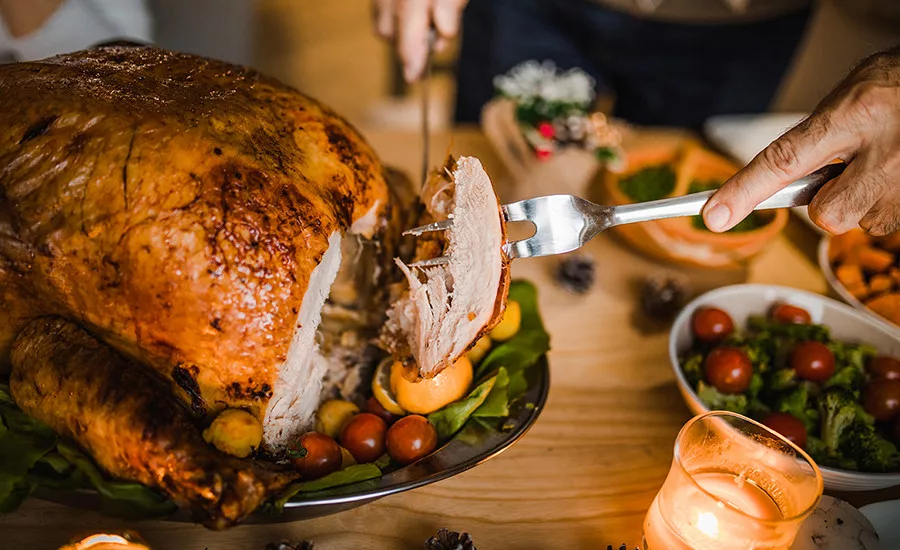
Opening image credit: Getty Images / skynesher / Getty Images Plus
Over the past several years, intensive housing and selective breeding have made it possible to produce heavier poultry in a shorter period of time (Clark et al., 2019; Remigon, 2004). However, this rapid rate in growth sometimes comes at the cost of losing the ability to perform natural behaviors and may have led to various muscle abnormalities (Zampiga et al., 2020; Zampiga, et al., 2019). As a result, consumers have been increasingly concerned about animal welfare, the number of animal welfare certification programs has increased, and more turkeys are being produced for niche markets (Troy and Kerry, 2010; Erasmus, 2018).
Environmental enrichment (EE) is a possible solution to address the negative impacts of intensive housing and improve animal welfare. Sherwin et al. (1999) discovered that access to enrichments, such plywood boards with chains attached or supplemental ultraviolet radiation, can reduce the incidence of injuries caused by wing or tail pecking among male turkeys. Martrenchar et al. (2001) confirmed that access to bales of straw, metal objects, and wood perches resulted in turkeys that displayed fewer pecking-related injuries.
Although the effects of EE on animal welfare have been studied within various avian species, there is very limited information about the effects of EE on fresh or processed meat quality, particularly in turkey. This study attempted to fill the knowledge gap by examining the effect of EE on fresh and processed meat quality of turkeys, with the hypothesis being that EE would positively impact animal welfare to the point of improving fresh and processed meat quality attributes.
This study used commercial turkeys (n=420) randomly assigned to six EE treatments (control [C], pecking block [PB], platform [P], platform + straw bale [PSB], straw bale [SB], and tunnel [T]) across 24 pens (16 to18 turkeys / pen). PB pens had one rectangular pecking block (0.23 m × 0.23 m × 0.18 m), with blocks replaced as they were destroyed. P pens had one wooden platform (0.99 m × 0.61 m) with two ramps (1.22 m × 0.61 m) that were 30-degree angle relative to the ground, with wooden strips 6 cm apart. SB pens had one straw bale (1.02 m × 0.51 m × 0.30 m), with bails replaced when the top collapsed and turkeys were no longer able to stand. PSB pens had one platform identical to P pens and one straw bale identical to SB pens. T pens had one tunnel (0.61 m × 0.61 m × 0.58 m) made of corrugated plastic sheets attached to a wooden frame. Example images of each treatment were published in Dong et al., 2023.
At 19 weeks, turkeys were weighed (LW), and six birds per pen were harvested, a subset (n = 96 carcasses) fabricated into wings, drumsticks, and boneless breasts and thighs. From the breast and thigh, samples were taken for pH and drip loss. From the breast, samples were taken for instrumental color and shear force, with remaining breast portions further processed into boneless turkey breast logs. From each turkey log, slices were taken for packaged purge loss, expressed moisture loss, instrumental color, and texture.
The only live and fresh meat differences were found in the live weight, dressing percentage, and fresh thigh b* (yellowness) values, with all other parameters not significantly impactful. For live weight, SB turkeys were 3.4% lighter than C turkeys, and PB turkeys were 3.2% heavier than C turkeys, with all other EE treatments the same as C turkeys. However, the dressing percentage for PB turkeys was 1.7% less than C turkeys. Therefore, the difference in PB turkey live weight may have been due to feathers that contained a greater amount of dirt or manure, resulting in the greatest live weight and least dressing percentage. A greater amount of dirt or manure accumulated on feathers could also indicate reduced locomotion.
It was expected that thigh color would be impacted more than breast color due to muscle location. The breast muscle has more of a supportive role compared to the thigh muscle, which is used for locomotion, and therefore, could be more heavily influenced by differences in physical activity among the EE treatments. PSB thighs displayed the highest b* values and PB thighs displayed the lowest, meaning that PSB thighs were yellower in color. Other studies have shown comparable results with perching increasing yellowness and redness values of broiler breast meat potentially due to myoglobin content and/or the increased physical activity of the birds with perches (Fletcher, 2002; Akşit et al., 2017). Therefore, it was anticipated that EE treatment would also impact thigh a*, but that was not observed in this study.
Finally, for processed meat characteristics, only L* (lightness) and expressed moisture loss measurements showed impacts due to EE treatments. Control and PB turkeys had a darker color, while all other treatments were lighter. The P turkeys also had a greatest expressed moisture, indicating greater processed water retention. However, no other measurements of water holding showed differences between EE treatments.
This study provided several benchmarks about EE on fresh and processed turkey meat quality. Although some differences were observed for individual quality traits due to EE treatments, the impact of specific EE treatments was not consistent across all meat quality traits. Since this research area is so new, further research needs to be conducted to see if these results change when tested on female or mixed gender turkey groups, as well as different breeds of turkeys. Muscle fiber typing and proximate analysis can be conducted to evaluate specific biochemical or structural differences among the treatment groups. Additionally, further work would need to evaluate these EE treatments in larger commercial facilities in larger scale operations. Though the differences in this study were limited, it is clear EE treatments did not negatively impact fresh or processed meat quality traits, and are still viable methods for producers to improve animal welfare without concerns to end-product quality attributes.
Literature cited
Akşit, M., Z. Kaçamakli Yardim, and S. Yalcin. 2017. Environmental enrichment influences on broiler performance and meat quality: Effect of light source and providing perches. Europ. Poult. Sci., 81, ISSN 1612-9199. https://doi.org/10.1399/eps.2017.182.
Clark, D.L., K.E. Nestor, and S.G. Velleman. 2019. Continual Selection for Increased 16 wk Body Weight on Turkey Growth and Meat Quality: 50 Generation Update. Journal of App. Poult. Research, 28(3), 658-668. https://doi.org/10.3382/japr/pfz017.
Dong, Y., G. Fraley, J.M. Siegford, F. Zhu, and M.A. Erasmus. 2023. Comparing different environmental enrichments for improving the welfare and walking ability of turkeys. PLoS ONE 18(5): e0285347. https://doi.org/10.1371/journal.pone.0285347.
Erasmus, M.A. 2018. 13 - Welfare issues in turkey production. In: J.A. Mench, editors, Advances in Poultry Welfare. Woodhead Publishing Series in Food Science, Technology and Nutrition, p. 263-291. https://doi.org/10.1016/B978-0-08-100915-4.00013-0.
Fletcher, D. L. 2002. Poultry meat quality. World’s Poultry Science Journal, 58(2), 131-145. https://doi.org/10.1079/WPS20020013
Martrenchar, A., D. Huonnic, and J.P. Cotte. 2001. Influence of environmental enrichment on injurious pecking and perching behaviour in young turkeys. Br. Poult. Sci., 42, 161-170. http://doi.10.1080/00071660120048393
Remignon, H. 2004. Production of turkeys, geese, ducks and game birds. In: G. C. Mead, Poultry Meat Processing and Quality, Woodhead Publishing, Duxford, 211–231. http://doi:10.1533/9781855739031.211
Sherwin, C.M., P.D. Lewis, and G.C. Perry. 1999. Effects of environmental enrichment, fluorescent and intermittent lighting on injurious pecking amongst male turkey poults. Br. Br. Poult. Sci., 40, 592-598. http://doi.org/10.1080/00071669986954
Troy, D. J., and J.P. Kerry. 2010. Consumer perception and the role of science in the meat industry. Meat Sci., 86(1), 214–226. https://doi.org/10.1016/j.meatsci.2010.05.009.
Zampiga, M., F. Soglia, G. Baldi, M. Petracci, G.M. Strasburg, and F. Sirri. 2020. Muscle abnormalities and meat quality consequences in modern turkey hybrids. Front. in Phy., 11, 554. https://doi.org/10.3389/fphys.2020.00554
Zampiga, M., S. Tavaniello, F. Soglia, M. Petracci, M. Mazoni, G. Maiorano, A. Meluzzi, P. Clavenzani, and F. Sirri. 2019. Comparison of 2 commercial turkey hybrids: productivity, occurrence of breast myopathies, and meat quality properties. Poult. Sci. 98(5), 2305-235. https://doi.org/10.3382/ps/pey607
Looking for a reprint of this article?
From high-res PDFs to custom plaques, order your copy today!