US Meat Export Federation elects new officers
USMEF chair-elect for the coming year is Dave Bruntz, who raises corn and soybeans and feeds cattle in southeastern Nebraska.
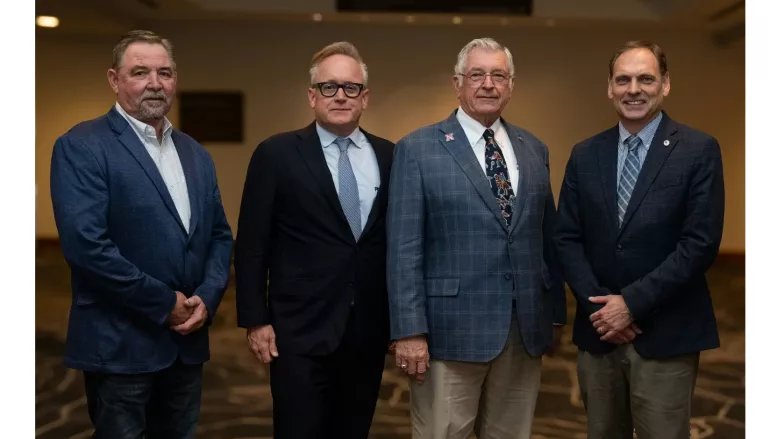
The 2025-2026 USMEF officer team is (left to right) Secretary-Treasurer Ross Havens, Vice Chair Darin Parker, Chair-elect Dave Bruntz and Chair Jay Theiler
The US Meat Export Federation concluded its Strategic Planning Conference Nov. 14, 2025, with election of its new officers. Chairing USMEF for the 2025-2026 term is Jay Theiler, executive vice president of corporate affairs for Agri Beef Co., based in Boise, Idaho.
Theiler recalled his early days with Agri Beef, when the company came to realize that it could not maximize the value of each head of livestock processed by selling product only in the Pacific Northwest, or even in the entire United States.
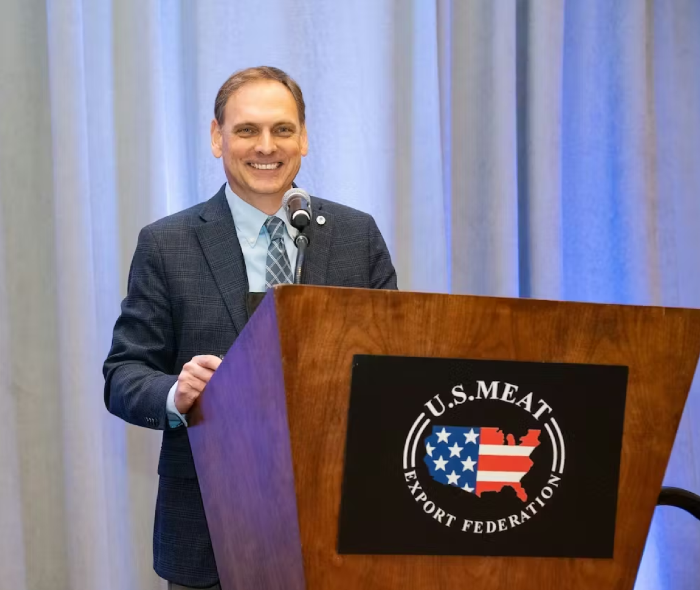
USMEF Chair Jay Theiler
| US Meat Export Federation"To get maximum value, we had to go to the international markets and include them in our sales," Theiler said. "I did a lot of overseas trips in the early 2000s and many subsequent trips that laid the foundation for our success. When we traveled to Japan, Korea, China, Taiwan and Southeast Asia, we would meet with USMEF staff, who would paint a landscape of the distributors in the market and help us set up appointments and meetings.
"USMEF was really an integral part of our company story and our brand story. And I tell you this today because it may serve as an inspiration for others on how to grow your business and how USMEF can help."
Looking forward, Theiler said differentiating the quality of US red meat is essential to continued expansion of the global customer base.
“The world doesn’t just buy US meat because it’s available – they buy it because it’s exceptional,” he said. “Our US red meat brand means something – it is the gold standard for quality, taste, safety, sustainability and reliability. Our beef, pork and lamb is sought out as incomes around the world grow. But we can’t take this for granted and we must continue to invest in international marketing, especially as our global competitors increase their quality and aim to compete with us.”
While emphasizing the need to diversify export destinations, Theiler also noted the importance of defending hard-earned market share with established trading partners. “We cannot take our long-standing partners for granted,” he said. “Markets like Japan, South Korea, Taiwan and Mexico are vital and have been reliable trading partners for decades. We must continue to protect and strengthen those relationships, and we must keep earning their confidence and trust.”
Theiler succeeds Steve Hanson, a rancher and cattle feeder from southwestern Nebraska, as USMEF chair. The USMEF chair-elect for the coming year is Dave Bruntz, who raises corn and soybeans and feeds cattle in southeastern Nebraska. Bruntz is a past president of the Nebraska Corn Board and Nebraska Cattlemen. The USMEF vice chair is Darin Parker, director of Salt Lake City-based exporter/distributor PMI Foods. The newest USMEF officer is Secretary-Treasurer Ross Havens, a cattle producer who serves as marketing coordinator for Nichols Farms in Bridgewater, Iowa.
Friday’s closing business session at the USMEF conference also included a staff panel discussion of opportunities that could emerge as a result of reciprocal trade agreements and frameworks announced by the Trump administration. The session focused mainly on two critical regions ‒ Europe and Southeast Asia (ASEAN). USMEF Vice President of Economic Analysis Erin Borror moderated the panel, which included Jihae Yang, vice president of Asia Pacific, Director of Export and Technical Services Courtney Heller and Jim Remcheck, director of export services.
Borror kicked off the discussion by sharing USMEF estimates of substantial additional export opportunities in the European Union (EU), the United Kingdom (UK) and several ASEAN countries if trade barriers ‒ tariff and non-tariff ‒ are addressed. From there, Borror and the panelists walked the audience through an array of trade barriers that continue to prevent the red meat industry from reaching its trade potential in specific markets within those regions.
“In the EU, we're still working on all of the trade issues that fall outside of the hormone ban that really shut things down back in 1989,” said Heller. “As we began working with the Trump administration, we detailed all the extra requirements that need removed to ease the process inside the packing plant, through labeling and putting product in containers to ship to the EU. And this is product that is raised specifically for the EU or the UK. It's highly specialized and costs at least $100 extra per head, or if we're talking about pork, about $60 more. So it's very difficult to send it anywhere else and get the same return on that investment.”
In the ASEAN region, US beef faces tariff disadvantages because Australia and New Zealand, along with some other suppliers, have free trade agreements throughout the region. The US also faces a host of non-tariff barriers.
“We have to chip away and tackle some of these technical market access barriers to trade that are really hindering our opportunities,” said Remcheck. “The single greatest barrier we face is the facility-by-facility approval and registration process. That's sort of an overarching, cross-cutting issue that we see throughout the region, and the primary thing keeping us from reaching our market potential.”
Yang agreed that protectionism is a serious problem in the ASEAN, and shared an example of how import permit processes can be abused to help protect local producers. Yang also highlighted two other aspects that hinder market development efforts in the region ‒ cold chain infrastructure and limited financial capacities of importers.
Yang also detailed US red meat opportunities and several promotional initiatives that are contributing to the industry’s market development progress in the ASEAN region.
“You may remember that we had only two people on staff 25 years ago, and now we have 12 people in the region. That demonstrates how much we are penetrating into the market and developing our own programs to address market needs. Our strategy is supply chain development, not just in the foodservice sector, but also including distributors, retailers and further processors. The demand is there and our staff is there, working to build close working relationships with key trade partners.
The Nov. 13 general session focused on the upcoming review of the US-Mexico-Canada Agreement (USMCA) and the importance of preserving duty-free access for US pork, beef and lamb entering Mexico and Canada.
Kenneth Smith Ramos, a former lead negotiator for the Mexican government who was deeply involved in the negotiation and ratification of USMCA, detailed the mutual benefits USMCA has delivered for the agricultural sectors in both the United States and Mexico. The agreement has enhanced food security in both countries and bolstered the profitability of many agricultural sectors through free trade.
Smith, who is now a partner in the regulatory and trade consulting firm AGON, outlined the possible outcomes of the USMCA review, ranging from a very limited review to the threat of “rupture” if the agreement is reopened and the United States threatens to withdraw. He anticipates something in between, with portions of USMCA – some of which may be contentious – opened up for renegotiation.
“We see a complex USMCA review, but we do not see a scenario where there is an imminent collapse of the agreement,” he said. “There will be turbulence, but we do not see the plane crashing.”
Smith added that it is critical for the US, Mexican and Canadian agricultural sectors to remain vigilant in explaining the benefits of USMCA and the importance of maintaining it as a trilateral pact.
John Masswohl, a veteran of many agricultural trade negotiations during his long career with the Canadian Cattle Association, struck similar themes as he analyzed USMCA from Canada’s perspective. He stressed the efficiencies that duty-free movement of meat and livestock between the US and Canada have fostered and the importance of maintaining this environment.
“You have to ask yourself, if those [Canadian] cattle weren't coming into the US, what would the reality be?” Masswohl asked. “Would there really be a need for two major packing plants in the Pacific Northwest? Would there be a need for a packing plant in Utah? In some of these areas, some years, up to 30% of the kill is Canadian cattle. If they don’t have those facilities, are livestock producers prepared to ship their animals many hundreds more miles to be processed?”
Masswohl also questioned whether the US truly has an agricultural trade deficit with Canada, citing per-capita consumption figures. He noted that (based on 2023 data) the average Canadian consumes more than $700 per year in US agricultural goods, while Americans average only $118 in consumption of Canadian ag products.
“That tells me the Canadian market is pretty open, and that Canadians like American agricultural products,” he said. “If you scratch into what we are buying, we’re purchasing a lot of high-value US items.”
The Nov. 13 program also included the presentation of USMEF’s Michael J. Mansfield Award to Ted McKinney, former USDA under secretary for trade and foreign agricultural affairs.
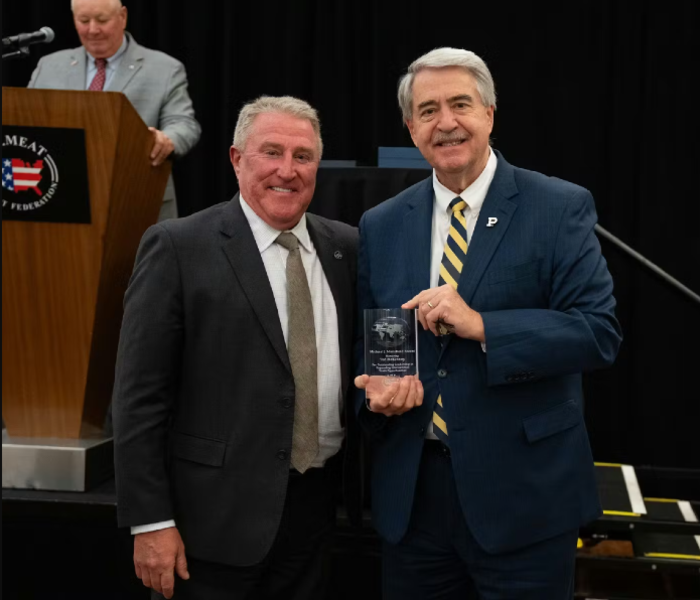 Ted McKinney (right) receives the Michael J. Mansfield Award from USMEF President and CEO Dan Halstrom. Photo courtesy of the US Meat Export Federation
Dr. Dermot Hayes, who recently retired as an Iowa State University professor and continues to serve as a consulting economist for the pork industry, received the USMEF Distinguished Service Award.
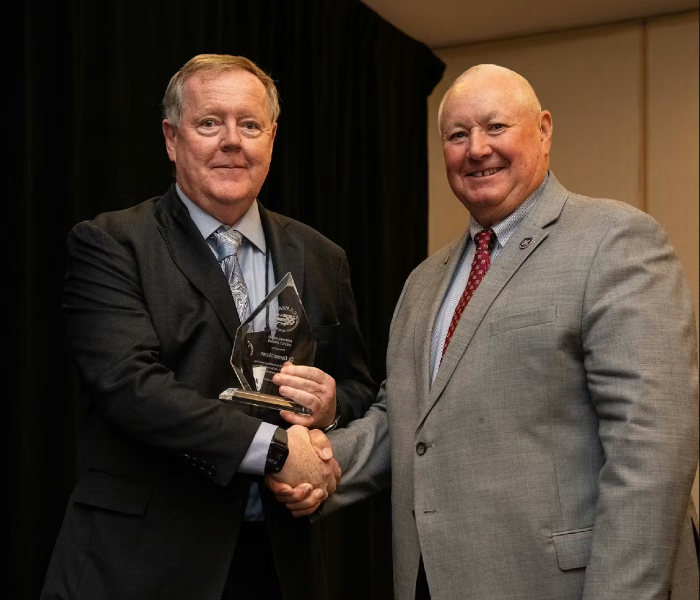 Dr. Dermot Hayes (left) receives the USMEF Distinguished Service Award from outgoing USMEF Chair Steve Hanson. Photo courtesy of the US Meat Export Federation
The next meeting of USMEF members will be at the organization’s Spring Conference in Oklahoma City, May 20-22, 2026.
Source: US Meat Export Federation
Looking for a reprint of this article?
From high-res PDFs to custom plaques, order your copy today!