Commentary: AMSA
Impact of freezing, thawing and refreezing on beef strip loin palatability and thaw loss
Research suggests fabrication state nor frozen storage temperature has a substantial influence on beef palatability.
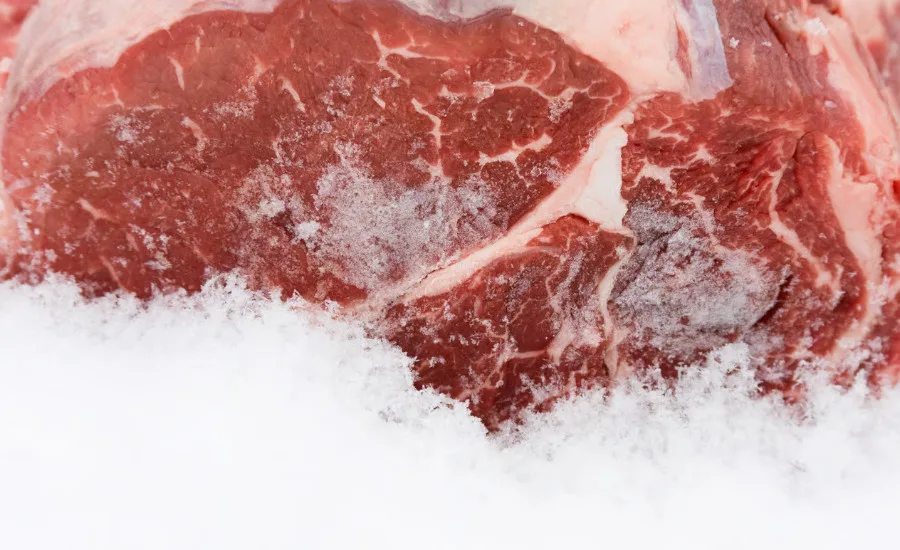
Freezing is an essential intervention in the meat industry because it extends shelf life by inhibiting microbial growth. The application of freezing also provides processors with increased flexibility in storage and transportation, particularly during periods of fluctuating supply and demand.
Despite these logistical advantages, freezing has long been associated with structural alterations in muscle tissue that may negatively influence product yield and quality attributes. Specifically, the formation of ice crystals during freezing has been shown to disrupt muscle fiber integrity and damage cellular membranes, thereby compromising water-holding capacity. Damage to the cellular membrane facilitates the migration of intracellular water into extracellular spaces, increasing purge loss upon thawing compared with fresh, never-frozen meat. This moisture loss represents a direct economic concern for processors and foodservice operators due to decreased product yield and saleable weight. In addition to yield-related concerns, consumers often perceive frozen meat products as less palatable.
Modern meat processing systems frequently require product flexibility to accommodate market variability, potentially involving multiple freezing and thawing cycles. While the effects of a single freeze–thaw cycle on beef quality have been extensively studied, there is comparatively limited literature on the consequences of multiple freezing and thawing cycles, particularly with respect to fabrication state. A study funded by the National Cattlemen’s Beef Association helped to evaluate the effects of frozen versus thawed fabrication and refreezing on palatability traits, thaw loss, and cook loss of beef longissimus lumborum steaks.
Paired USDA Choice beef strip loins (n = 20) were obtained from a commercial beef processing facility. Each loin was individually tagged to maintain identification and ensure matched-pair comparisons throughout the experimental period. Subprimals were vacuum packaged and wet aged for 21 d at 4°C. Following aging, loins were subjected to an initial freezing cycle at −21°C for 14 d. Within each matched pair, loins were randomly assigned to one of two fabrication states: frozen or thawed. Loins designated for thawed fabrication were held at 4°C for 7 d prior to fabrication, while loins assigned to frozen fabrication remained at −21°C until cutting. From each loin, 2.54-cm-thick steaks were fabricated using a bandsaw and subsequently assigned to one of three frozen storage temperatures (−12°C, −18°C, or −21°C) for 180 d. Within each storage temperature, steaks were further assigned to one of three evaluation methods: consumer sensory analysis, trained sensory analysis, or Warner–Bratzler shear force (WBSF) determination. Steaks designated for trained sensory analysis were also used to analyze internal cooked color. Loins were weighed prior to initial freezing and again before fabrication to calculate thaw loss associated with the first freeze–thaw cycle. Steaks designated for sensory evaluation were weighed post-fabrication and prior to cooking to determine thaw loss following the second freezing cycle. Cook loss was calculated by recording steak weights before and after thermal processing.
Results from the consumer sensory panel indicated no differences (P > 0.05) in tenderness, juiciness, flavor liking, overall liking, or off-flavor detection attributable to fabrication state or frozen storage temperature. Similarly, trained sensory panelists detected no differences (P > 0.05) in initial juiciness, sustained juiciness, tenderness, connective tissue amount, beef flavor intensity, or the presence of off-flavors across treatments. Internal cooked color ratings also did not differ (P > 0.05) among fabrication states or storage temperatures, suggesting that freezing practices did not influence visual doneness attributes. Objective tenderness, as measured by WBSF, was affected by fabrication state. Steaks fabricated from thawed loins exhibited lower (P < 0.05) WBSF values compared with steaks fabricated while frozen, representing a 17.2% reduction in shear force. Despite this improvement in mechanical tenderness, all steaks—regardless of treatment—fell below the threshold required for “Certified Very Tender” classification. Importantly, neither trained nor consumer panelists perceived differences in tenderness, indicating that the observed mechanical improvements did not translate to detectable sensory differences. Loins and steaks fabricated after thawing experienced greater thaw loss (P < 0.05) than those fabricated in a frozen state. Frozen storage temperature did not influence thaw-loss outcomes (P > 0.05). Additionally, no differences in cook loss (P > 0.05) were observed among fabrication states or frozen storage temperatures.
Collectively, these findings indicate that neither fabrication state nor frozen storage temperature has a substantial influence on beef palatability traits. From an economic perspective, minimizing moisture loss is critical to maximizing product value in the foodservice and processing sectors. Steaks derived from loins undergoing a single freeze–thaw cycle incurred an estimated $1.64 loss due to purge, whereas steaks subjected to two cycles incurred a loss of $2.02. Fabricating steaks in a frozen state prior to long-term frozen storage effectively reduced moisture loss without compromising palatability. Consequently, processors and foodservice operators are advised to fabricate beef products in a frozen state and delay thawing until final preparation to optimize yield and minimize economic loss while maintaining palatability.
This study was published in the Meat and Muscle Biology journal, and the full article can be accessed free of charge at https://www.iastatedigitalpress.com/mmb/article/id/18932/
Jade E. Edwards, Keayla M. Harr, Morgan Denzer, Morgan Pfeiffer, Gretchen G. Mafi and Ranjith Ramanathan are with the Department of Animal and Food Science at Oklahoma State University, Stillwater, Okla. For questions: Ranjith.ramanathan@okstate.edu or Gretchen.mafi@okstate.edu.
Looking for a reprint of this article?
From high-res PDFs to custom plaques, order your copy today!