Provisioner logo
Provisioner logo
search
cart
facebook twitter linkedin youtube
  • Sign In
  • Create Account
  • Sign Out
  • My Account
Provisioner logo
Provisioner logo
  • NEWS
    • Industry News
    • Supplier News
    • Case Studies
    • Recalls
    • Regulations
    • New Consumer Products
  • EXCLUSIVES
    • Newsletters
    • Source Book
    • Sponsored Insights
    • Events
    • Webinars
    • Classifieds
    • White Papers
    • Provisioner Store
    • Market Research
  • MEAT PROCESSING
    • SUSTAINABILITY
    • Processing
    • Packaging
    • Ingredients
    • Formulation
    • Food Safety
    • Special Reports
    • Commentary
  • PROFILES
    • Processor Profiles
    • Processor of the Year
    • Top 100 Processors
  • MEDIA
    • Videos
    • Podcasts
  • DIRECTORY
  • MIHOF
  • INDEPENDENT PROCESSOR
  • EMAG
    • eMagazine
    • ARCHIVE ISSUES
    • Contact
    • Advertise
  • JOIN!
Meat and Poultry Processing

Ensuring food safety in cook/chill processes
By Lynn Knipe
November 15, 2011
There continues to be a tremendous need in the meat industry for information regarding the production of safe, ready-to-eat (RTE) meat products. This need is based upon avoiding HACCP deviations and/or recalls, as well as the need to meet regulatory requirements for producing safe RTE meat products. In addition to being regulatory compliant and protecting public health, producing safe food products is good for business health.
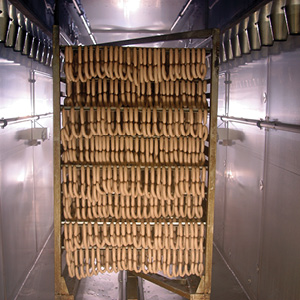
Sausage

To produce safe RTE meat products, processors need to understand how to determine the sufficiency of cooking (lethality), chilling after cooking (stabilization), and post-lethality pasteurization of these products. Regulatory changes have shifted the burden to meat processors to ensure, through scientific justification, that existing, as well as new, processes meet lethality and stabilization performance standards. In particular, the USDA Food Safety Inspection Service’s (FSIS) RTE Final Rule in 2003, inspected meat processors must select an “alternative” approach to producing safe RTE products, and the more desirable alternatives require greater technical expertise on the part of the processors. The most important processes in producing safe RTE meat products may be cleaning and sanitizing equipment and facilities.

To fully understand what is involved in producing safe RTE meat products, employees need a combination of engineering, microbiology and chemistry principles to understand heat transfer, stabilization and sanitation. Whereas the majority of people working in the meat industry have taken meat- or food-science courses, along with HACCP training, microbiological concepts are much more commonly presented in those programs than engineering and chemistry.

Understanding how these three disciplines interconnect is most important to developing programs for producing safe RTE products. For example, one may understand the concepts of lag phase, logarithmic growth and lethality of Listeria monocytogenes from a college microbiology course or industry workshop.

However, heat transfer basics are not typically a topic of discussion in those programs. The mechanisms of heat and mass transfer explain the differences between steady-state and unsteady-state transfer. Knowing whether convection or conduction is more important to your cooking process will help you understand what is happening in your oven, as well as how to improve the cooking process.

Understanding heat transfer coefficients, thermal conductivity, heat capacity, thermal diffusivity and density of meat products is important in being able to produce safe RTE meat products, particularly as changes are made to existing products, in terms of composition (moisture vs. fat content), density, size and shape, and as new products are developed.

Understanding the effects of oven relative humidity on cooking rate, and uniformity of product temperatures is important, in addition to the impact of humidity on lethality of pathogens, such as Salmonella.

Validation of batch and continuous oven operations is very important to producing products of consistent final internal temperatures, and proof that final internal temperatures were taken in the coldest spot in the oven is a regulatory requirement. Understanding the effects of product loading, air (water or oil) movement and speed, cooking times, cooking temperatures, as well as the proper placement and operation of the wet bulb probe are keys to consistency of final internal product temperatures.

Balancing an oven is critical to producing safe meat products and is dependent upon airflow and air handling. Methods for balancing ovens and preventive maintenance checks are important.

Equipment validation issues include: frequency of validation, location and number of thermocouples used, temperature measurement equipment, and time limits for taking product temperature when done manually.

Pathogen growth and lethality modeling programs can be very helpful in supporting HACCP decisions made related to deviations and/or process changes. Understanding which model is most relevant to the process in question is one thing, but equally important is how to interpret the results generated from such modeling programs and lethality equations. Both the selection of the appropriate model and interpreting the results requires an understanding of basic microbiological principles.

Proper sanitation of equipment and facilities may be the most important means of preventing, reducing and/or eliminating Listeria monocytogenes. To me, a good sanitation program makes more sense than a critical control point (CCP) in controlling and preventing L. monocytogenes.

A good sanitation program requires a little engineering background to design facilities and equipment to be cleanable to a microbiological level. The main principles of sanitary design are providingzones of control, keeping the space cold and dry, and arranging equipment for ease of cleaning and sanitizing.

Equally important to facility and equipment design is the chemistry of cleaning and sanitizing. The appropriate cleaners and sanitizers must be selected for the job, and proper concentrations and application procedures must be followed. Even the temperature of the water used to produce sanitizers of the proper concentration is important for some sanitizers.

Some companies have gone to hiring sanitation engineers to manage this important process. However, a food scientist can also manage this with the proper training.


INFORMATION BOX 

The Ohio State University Meat Science’s annual “Thermal Processing of Ready-to-Eat Meat Products Short Course” is scheduled for April 17-19, 2012. Attendees can learn about a good mixture of the disciplines mentioned in this story from speakers throughout the industry. For more information, please contact Lynn Knipe at knipe.1@osu.edu.


KEYWORDS: FSIS haccp ready-to-eat

Share This Story

Looking for a reprint of this article?
From high-res PDFs to custom plaques, order your copy today!


Lynn Knipe is the Extension Processed Meats Specialist and Associate Professor in Food Science and Technology, and Animal Sciences at Ohio State University. He is also a member of The National Provisioner Editorial Board. For more information, contact him at knipe.1@osu.edu or (614) 292-4877.

Recommended Content

JOIN TODAY
to unlock your recommendations.

Already have an account? Sign In

  • Double Charburger

    Premiumization drives burger category

    Shoppers seek out premium meat offerings to fulfill...
    Meat and Poultry Industry News
    By: Sammy Bredar
  • JJS Adult Pekin duck

    Poultry Report 2025: Convenience propels poultry at retail

    Despite continued economic pressures, the poultry...
    Turkey
    By: Sammy Bredar
You must login or register in order to post a comment.

Report Abusive Comment

Manage My Account
  • eMagazine Subscriptions
  • Manage My Preferences
  • Newsletters
  • Online Registration
  • Subscription Customer Service
  • Connect with The National Provisioner

More Videos

Sponsored Content

Sponsored Content is a special paid section where industry companies provide high quality, objective, non-commercial content around topics of interest to the The National Provisioner audience. All Sponsored Content is supplied by the advertising company and any opinions expressed in this article are those of the author and not necessarily reflect the views of The National Provisioner or its parent company, BNP Media. Interested in participating in our Sponsored Content section? Contact your local rep!

close
  • A smiling man carrying a grocery basket is reaching down to pick up a package of meat in a grocery store.
    Sponsored byPIC

    The Green Light: New Data Shows 12-to-1 Support for Pork from PRRS-Resistant Pigs

  • Close up of a grocery cart full of groceries, a cropped image of a couple pushing the cart and a blurred background of the vegetable aisle.
    Sponsored byPIC

    New Market Research Finds Consumers in Eight Key Pork Markets Are Likely to Purchase Pork from Gene-Edited Pigs

  • Close up of a young pig with a blurred background.
    Sponsored byPIC

    New Research Forecasts Significant Economic and Market Impacts with PRRS-Resistant Pig Adoption

Popular Stories

Spam Dog

Hormel rolls out Spam hot dog for foodservice applications

Colorado Premium logo

Colorado Premium acquires Old Hickory Smokehouse

Niman Ranch Uncured Grass-Fed Beef Bacon

Niman Ranch introduces beef bacon

2026 Top 100 Meat & Poultry Processors Report

Events

June 11, 2026

From Fresh to Frozen in 3 Minutes Flat: Unlocking the Secrets to Temperature Control

Join Tony Vacaro, Foods Industry Manager, and Emile Klein, Foods Market Strategy Manager at Air Products and Chemicals, Inc. , as they tackle key questions surrounding heat removal in food processing. 

January 1, 2030

Webinar Sponsorship Information

For webinar sponsorship information, visit www.bnpevents.com/webinars or email webinars@bnpmedia.com.

View All Submit An Event

Products

Food Crime: An Introduction to Deviance in the Food Industry

Food Crime: An Introduction to Deviance in the Food Industry

See More Products
From Fresh to Frozen in 3 Minutes Flat: Unlocking the Secrets to Temperature Control Webinar Sponsored by Air Products

Related Articles

  • sanitizing meat processing equipment

    Top 5 strategies for ensuring hygiene and food safety in meat and poultry processing

    See More
  • reduce waste

    Ensuring food safety should not increase food waste

    See More
  • HRS Heat Exchangers food waste

    Ensuring food safety should not increase food waste

    See More

Related Products

See More Products
  • food safety.jpg

    Food Safety in the Seafood Industry: A Practical Guide for ISO 22000 and FSSC 22000 Implementation

  • food-crime.jpg

    Food Crime: An Introduction to Deviance in the Food Industry

  • Food Plant Sanitation: Design, Maintenance, and Good Manufacturing Practices, Second Edition

See More Products

Events

View AllSubmit An Event
  • July 10, 2025

    Is Your Food Safety Plan Up to Date? Insights & Innovations Shaping Meat and Poultry Safety in 2025

    On-Demand Whether you're a processor, producer, or industry stakeholder, this is your chance to gain insider knowledge that will elevate your food safety practices from compliant to exemplary.
  • April 25, 2013

    Food Plant of the Future: Global Food Safety Impact on Facilities

    On demand SQF 2000, FSMA, ISO 22000/PAS220 and other standards continue to gain traction in an attempt to create safer foods and beverages.
View AllSubmit An Event
×

Stay ahead of the curve. Unlock a dose of cutting-edge insights.

Receive our premium content directly to your inbox.

SIGN-UP TODAY
  • RESOURCES
    • Advertise
    • Contact Us
    • Directories
    • Store
    • Want More
  • SIGN UP TODAY
    • Create Account
    • eMagazine
    • Newsletter
    • Customer Service
    • Manage Preferences
  • SERVICES
    • Marketing Services
    • Reprints
    • Market Research
    • List Rental
    • Survey/Respondent Access
  • STAY CONNECTED
    • LinkedIn
    • Facebook
    • YouTube
    • X (Twitter)
  • PRIVACY
    • PRIVACY POLICY
    • TERMS & CONDITIONS
    • DO NOT SELL MY PERSONAL INFORMATION
    • PRIVACY REQUEST
    • ACCESSIBILITY

Copyright ©2026. All Rights Reserved BNP Media, Inc. and BNP Media II, LLC.

Design, CMS, Hosting & Web Development :: ePublishing