Ingredients & Formulation
Phosphates in meat and poultry: uniquely functional, but under fire
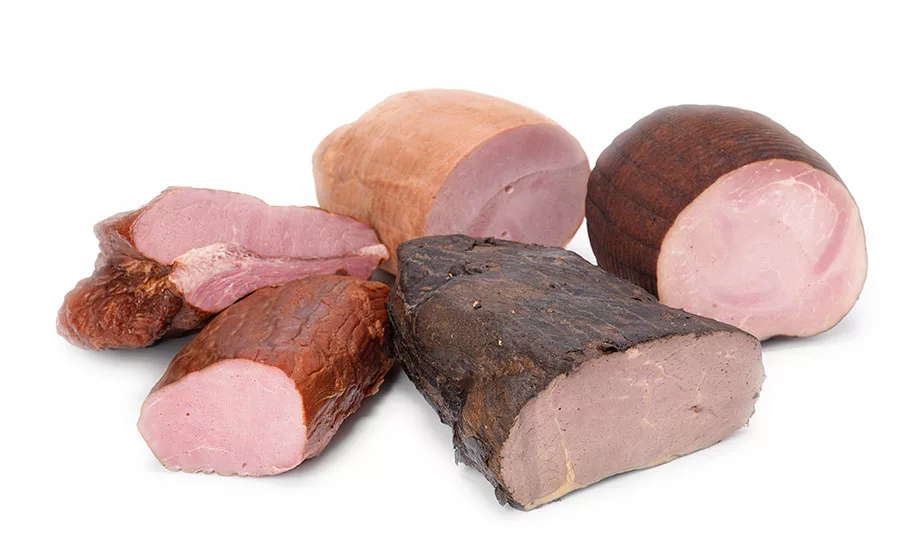
Much of the current interest in the area of phosphates revolves around replacing the ingredient’s numerous functions with clean-label ingredients.

Phosphate alternates such as potassium lactate/diacetate blends, at 30 percent lower dosage, offer greater performance, e.g., better slicing attributes.
Phosphates are very popular ingredients to use in meat and poultry products due to their ability to improve water binding, protein functionality and flavor stability. The use of phosphates in meat and poultry products is advancing, but restricted.
“The agglomerated phosphate blends that are available allow for application-specific phosphates that can be used to maximize quality,” explains Wes Schilling, professor of food science at Mississippi State University in Starkville, Miss. “The possibilities are great, but are not often used due to price. Monophosphates, diphosphate, triphosphates and hexametaphosphates have different functions including buffering capacity, water-holding capacity and chelating metals. Phosphates also function as an antioxidant when color needs to be preserved.”
Much of the current interest in the area of phosphates revolves around replacing the ingredient’s numerous functions with clean-label ingredients.
“Phosphates are not considered natural or organic, so a change to clean label leads to loss of this ingredient,” says Edward Mills, associate professor of meat science at Penn State University College of Agricultural Sciences, University Park, Pa.
No ingredient yet has been found to replace all of the functions of phosphates. In addition, phosphates are difficult to replace when hard water is present, when an acid marinade is used and buffering capacity is needed, or if the phosphate is used as an antioxidant that preserves red color in beef products, Schilling says. Because of the interest in getting phosphates off labels, ingredient companies that have any ingredient that functions in any one functionality area of phosphates, such as water binding, protein functionality and flavor stability, gets touted as a phosphate replacer, Mills says.
Polysaccharide mixes, different fibers and proteins commonly are used to replace phosphates. “These products are good at binding water and are often able to hold nearly as much water in a product as when phosphate is used,” Schilling says.
Carageenan also can be used. A modified food starch, whey protein mix, or an oat and plum fiber mix can offer comparable yields to phosphates as well. Another ingredient that is commonly used is collagen or stock from the product species, Schilling says. Rosemary, green tea, and/or cherry powder extracts can be plated on fibers or protein ingredients to help function as antioxidants or maintain color, but they often do not function as well as phosphates at maintaining color, he says. Another function of phosphates is to increase ionic strength in the product and serve as a buffer in foods.
“This is a difficult function to replace in phosphates,” Schilling says.
Mills adds that, for protein functionality, processors might raise the ionic strength with salt or adjust pH with the salt of an organic acid. For flavor stability, it is common to use natural antioxidants such as rosemary oil, Mills says.
Clean label, natural and organic meat and poultry are embracing clean-label alternatives such as hydrocolloids, whey proteins, fibers, plum extract, sodium gluconate and starch and minimizing the role of phosphates, but also raising the cost of these products, says Kantha Shelke, food scientist and principal of Corvus Blue LLC, Chicago.
“Alternatives for phosphates in processed meats are currently fibers, hydrocolloids such as carrageenan, and starches — each of which is functional to an extent, but far from a slam-dunk replacement for phosphates,” she says. “Each also comes with certain limitation: whey proteins pose an allergen concern, sodium gluconate is good but only as a partial replacement and therefore more expensive, and plum extract, although functional, has yet to be proven in various meat and poultry segments.”
The use of phosphates also is evolving with advances in alternates such as potassium lactate/diacetate blends, she says. At 30 percent lower dosage, potassium lactate/diacetate blends offer greater performance, e.g., better slicing attributes and resistance to pressure and greater saltiness without significantly higher bitterness or sourness at 25 percent reduction in sodium, she says.
“Consumer demand for health and clean label are reducing use of phosphates considerably,” Shelke says. However, she says it’s important to note that the huge and continuing growth in processed poultry products around the world will advance phosphate usage in certain sectors.
Moving forward using phosphates is not without issues even internationally.
“In Europe, where processed meats are part of the cuisine, there is a growing concern regarding the use of phosphates because of indications that high intake of dietary phosphorus may be a public-health issue,” Shelke says. “Some believe overconsumption of phosphates may lead to osteoporosis, damaged blood vessels and impaired kidney function. The U.S. is now beginning to pay heed to these concerns.”
With phosphates being a relatively inexpensive ingredient, the tendency is to use all that a processor is allowed to use because it works so well. Mills emphasizes it is important processors test different concentrations to be sure they are using the smallest effective concentration of phosphate. For example, processors are allowed to use phosphates at a level up to 0.5 percent in their finished products, but many applications only need 0.002 percent.
“There is good reason to spend the time to find out what’s the smallest amount that I need and use that amount,” he says. “The fact that folks are concerned about things is a valid consideration, and if you can say [you’re] using the smallest amount possible or … less than a certain amount, I think that’s a nice claim to make and still be able to realize the benefits of the ingredient.”
Schilling also believes processors need to educate their customers on the important functions of phosphates in meat products.
“Customers often request a clean label, without phosphates,” he says. “However, this will lead to either an inferior product or a product that is too expensive to produce. … There needs to be open communication on what this does to product quality. In addition, sensory testing and shelf-life tests need to be conducted to make sure the product meets the final user’s expectations. In addition, both processors and customers need to realize that for some product applications, they will not be able to replace phosphate and have an acceptable product.” NP
Looking for a reprint of this article?
From high-res PDFs to custom plaques, order your copy today!