Provisioner logo
Provisioner logo
search
cart
facebook twitter linkedin youtube
  • Sign In
  • Create Account
  • Sign Out
  • My Account
Provisioner logo
Provisioner logo
  • NEWS
    • Industry News
    • Supplier News
    • Case Studies
    • Recalls
    • Regulations
    • New Consumer Products
  • EXCLUSIVES
    • Newsletters
    • Source Book
    • Sponsored Insights
    • Events
    • Webinars
    • Classifieds
    • White Papers
    • Provisioner Store
    • Market Research
  • MEAT PROCESSING
    • SUSTAINABILITY
    • Processing
    • Packaging
    • Ingredients
    • Formulation
    • Food Safety
    • Special Reports
    • Commentary
  • PROFILES
    • Processor Profiles
    • Processor of the Year
    • Top 100 Processors
  • MEDIA
    • Videos
    • Podcasts
  • DIRECTORY
  • MIHOF
  • INDEPENDENT PROCESSOR
  • EMAG
    • eMagazine
    • ARCHIVE ISSUES
    • Contact
    • Advertise
  • JOIN!
Supplier NewsPlant Design/ManagementExpert Commentary

Supplier's Perspective

3 steps to improve electrical safety in meat and poultry plants
By Jeff Seabury
Ground Fault Protection
August 20, 2018

Safety is one of the biggest drivers of change in the electrical industry today. Creating a safe working environment is essential to enhancing productivity, reducing downtime and avoiding expenses that were accrued due to an accident — all of which leads to substantially lower costs. Industrial workers interact with electrical hazards in a variety of locations around a facility. According to OSHA, most electrical accidents can be attributed to the following:

  • unsafe environment;
  • unsafe work practices;
  • unsafe equipment or installation.

One of the first steps a plant manager can do to minimize risk is make sure there is an up-to-date safety plan in place. Electrical accidents within a facility can be prevented through a commitment to safe work practices that are routinely documented and reviewed. Start by developing a list of electrical safety issues that need to be addressed:


1. Lockout/tagout processes

LOTO is the No. 1 violation cited by OSHA and refers to a specific process to safeguard employees from the unexpected energization or startup of machinery and equipment, or the release of hazardous energy during service or maintenance activities. Employees should be trained to recognize a locked and tagged electrical source and to understand how the LOTO process affects their work areas. Plant managers should look for electrical devices that meet OSHA LOTO provisions and create equipment LOTO procedures that are written and posted at each piece of equipment. 


2. Deterioration of equipment

Because of the dynamic and rugged nature of industrial environments, the everyday use of electrical devices can result in insulation breaks, short-circuits and exposed wires. Spotting and addressing deteriorating devices can protect workers and prevent an electrical hazard from developing. Below is a list of visual indicators to look for: 

  • bent prongs on receptacle blades;
  • color changes, arcing or pitting on receptacle blades;
  • visual signs of corrosion;
  • worn power cords and bad connectors
  • improperly grounded cable management trays.

Plant managers should incorporate the process of checking their facility for deteriorating devices in a preventive maintenance program. This ensures deterioration is identified and addressed in a timely manner. 


3. Ground fault protection

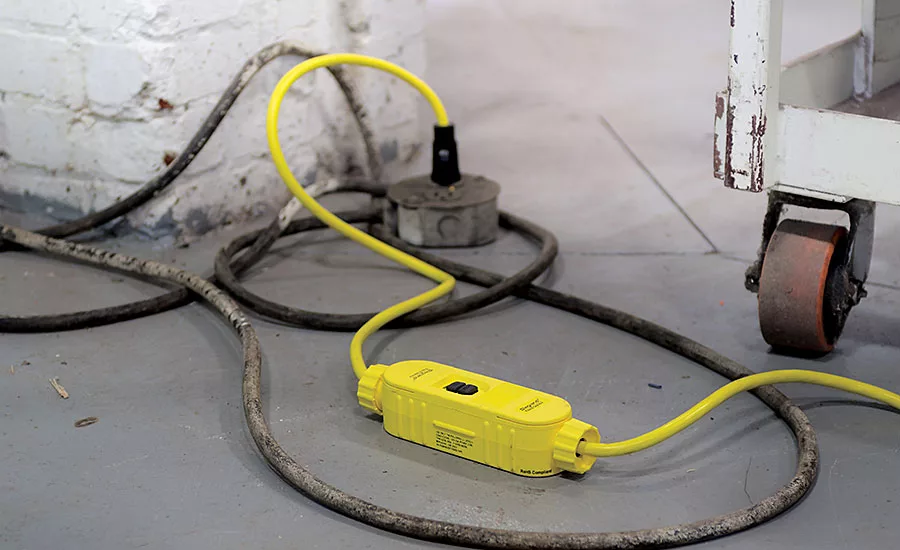
It is also important to ensure electrical devices use products and technology that support ground fault protection. A ground fault circuit interrupter (GFCI) device is designed to help keep workers safe from electrical shocks by monitoring the electrical current and shutting off power when a ground fault is detected. For industrial facilities, it is important to look for GFCI devices designed to withstand wet and corrosive indoor and outdoor environments.  

It’s also recommended that Ground Continuity Monitoring (GCM) plugs and connectors be used. Every GCM plug and connector is equipped with two sets of red and green LEDs to help indicate any one of seven potentially hazardous wiring conditions. Plugs and connectors that use GCM technology are able to look upstream or toward the panel. A break in ground continuity or reversed polarity from the receptacle back to the panel will be indicated by a red LED. A green LED will be illuminated when the problem lies downstream of the GCM plug, in the cord itself.  

Using both a GCM plug and connector is helpful in troubleshooting. A green light on the plug and a red light on the connector tells you your problem exists within the cordset; however, red lights on both ends indicate a definite problem behind the wall, as well as a potential problem with the cordset. 

Creating a safe working environment is essential to enhancing productivity, reducing down time and — most important — protecting workers. A culture of safety can be developed and cultivated through ongoing training, maintaining safety plans and continuous improvement of the facility and its electrical support equipment.  NP

KEYWORDS: supplier's perspective worker safety

Share This Story

Looking for a reprint of this article?
From high-res PDFs to custom plaques, order your copy today!


Jeff Seabury is industrial product manager for Legrand. For more information, visit www.legrand.us.

Recommended Content

JOIN TODAY
to unlock your recommendations.

Already have an account? Sign In

  • Double Charburger

    Premiumization drives burger category

    Shoppers seek out premium meat offerings to fulfill...
    Special Reports
    By: Sammy Bredar
  • JJS Adult Pekin duck

    Poultry Report 2025: Convenience propels poultry at retail

    Despite continued economic pressures, the poultry...
    Turkey
    By: Sammy Bredar
You must login or register in order to post a comment.

Report Abusive Comment

Manage My Account
  • eMagazine Subscriptions
  • Manage My Preferences
  • Newsletters
  • Online Registration
  • Subscription Customer Service
  • Connect with The National Provisioner

More Videos

Sponsored Content

Sponsored Content is a special paid section where industry companies provide high quality, objective, non-commercial content around topics of interest to the The National Provisioner audience. All Sponsored Content is supplied by the advertising company and any opinions expressed in this article are those of the author and not necessarily reflect the views of The National Provisioner or its parent company, BNP Media. Interested in participating in our Sponsored Content section? Contact your local rep!

close
  • A smiling man carrying a grocery basket is reaching down to pick up a package of meat in a grocery store.
    Sponsored byPIC

    The Green Light: New Data Shows 12-to-1 Support for Pork from PRRS-Resistant Pigs

  • Close up of a grocery cart full of groceries, a cropped image of a couple pushing the cart and a blurred background of the vegetable aisle.
    Sponsored byPIC

    New Market Research Finds Consumers in Eight Key Pork Markets Are Likely to Purchase Pork from Gene-Edited Pigs

  • Close up of a young pig with a blurred background.
    Sponsored byPIC

    New Research Forecasts Significant Economic and Market Impacts with PRRS-Resistant Pig Adoption

Popular Stories

Various new Primal snack sticks on a table amongst pencils, apples, a pair of glasses, lunch bags and a water bottle.

Protein demand drives snacking occasions

Several cuts of beef, pork and chicken on a wooden board, cast iron pan and salt.

Validated thermal lethality data and a new tool for ensuring safety of RTE meats

Cargill logo

Cargill initiates lockout at Fort Morgan beef plant after union rejects contract

2026 Top 100 Meat & Poultry Processors Report

Events

January 1, 2030

Webinar Sponsorship Information

For webinar sponsorship information, visit www.bnpevents.com/webinars or email webinars@bnpmedia.com.

View All Submit An Event

Products

Food Crime: An Introduction to Deviance in the Food Industry

Food Crime: An Introduction to Deviance in the Food Industry

See More Products
From Fresh to Frozen in 3 Minutes Flat: Unlocking the Secrets to Temperature Control Webinar Sponsored by Air Products

Related Articles

  • Food Safety Apparel in Meat Plant

    Food safety apparel in meat and poultry plants: Suit up for safety

    See More
  • New Glass Walls video details variety of worker safety practices in meat and poultry plants

    See More
  • Meat plant

    How thermal insulation affects safety, sanitation and asset reliability in meat and poultry plants

    See More

Related Products

See More Products
  • food safety.jpg

    Food Safety in the Seafood Industry: A Practical Guide for ISO 22000 and FSSC 22000 Implementation

  • Handbook of Meat, Poultry and Seafood Quality, second edition

  • emerging.jpg

    Emerging Technologies in Meat Processing: Production, Processing and Technology

See More Products

Events

View AllSubmit An Event
  • July 10, 2025

    Is Your Food Safety Plan Up to Date? Insights & Innovations Shaping Meat and Poultry Safety in 2025

    On-Demand Whether you're a processor, producer, or industry stakeholder, this is your chance to gain insider knowledge that will elevate your food safety practices from compliant to exemplary.
View AllSubmit An Event
×

Stay ahead of the curve. Unlock a dose of cutting-edge insights.

Receive our premium content directly to your inbox.

SIGN-UP TODAY
  • RESOURCES
    • Advertise
    • Contact Us
    • Directories
    • Store
    • Want More
  • SIGN UP TODAY
    • Create Account
    • eMagazine
    • Newsletter
    • Customer Service
    • Manage Preferences
  • SERVICES
    • Marketing Services
    • Reprints
    • Market Research
    • List Rental
    • Survey/Respondent Access
  • STAY CONNECTED
    • LinkedIn
    • Facebook
    • YouTube
    • X (Twitter)
  • PRIVACY
    • PRIVACY POLICY
    • TERMS & CONDITIONS
    • DO NOT SELL MY PERSONAL INFORMATION
    • PRIVACY REQUEST
    • ACCESSIBILITY

Copyright ©2026. All Rights Reserved BNP Media, Inc. and BNP Media II, LLC.

Design, CMS, Hosting & Web Development :: ePublishing