Pork and beef exports rebound in May, reports USMEF

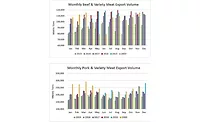
May exports of U.S. pork and beef were steady with last year’s strong volumes and increased year-over-year in value, according to data released by USDA and compiled by the U.S. Meat Export Federation (USMEF).
Pork exports totaled 217,999 metric tons (mt) in May, steady with last year’s pace, while value increased 1% to $567.8 million – the highest monthly value total since April 2018. For January through May, pork exports were still 4% below last year in volume (1.035 million mt) and down 10% in value to $2.57 billion.
Pork export value averaged $54.83 per head slaughtered in May, the highest monthly average since May 2018 ($55.05). For January through May, export value averaged $48.74 per head, down 12% from the same period last year. May exports accounted for 27.3% of total U.S. pork production and 23.2% for muscle cuts only, down from 27.8% and 24%, respectively, a year ago. For January through May, exports accounted for 25.4% of total pork production (down from 27.5%) and 22.1% for muscle cuts (down from 23.7%).
May beef exports were also steady year-over-year in volume (117,541 mt) while export value increased 1% to $727.6 million – the second-highest on record, trailing only the August 2018 total of $751.7 million. For January through May, exports were 3% below last year’s record pace in volume (530,088 mt) but only slightly lower in value at $3.3 billion.
Beef export value per head of fed slaughter averaged $312.85 in May, down slightly from a year ago. For January through May, beef export value averaged $309.33 per head, down 3%. May exports accounted for 14.6% of total U.S. beef production and 12% for muscle cuts only, each down slightly from a year ago. For January through May, exports accounted for 14% of total production and 11.3% for muscle cuts – down from 14.6% and 11.9%, respectively, a year ago. (Please note: due to a calculation error, the percentage of beef production exported was incorrectly reported from January 2017 through April 2019. These ratios have now been corrected, and are about 1.1 percentage points higher than originally reported.)
Rebound in Japan and China/Hong Kong offsets slower pork exports to Mexico
After trending lower through the first four months of 2019, May pork exports to leading value market Japan increased 5% from a year ago in volume (36,373 mt) and 3% in value ($148.6 million, the highest in 18 months.) Stronger May volumes included growth in chilled pork, up 2.5% to 19,795 mt. For January through May, exports to Japan were still 5% behind last year’s pace in volume (159,539 mt) and down 7% in value ($642 million). But chilled exports held close to last year at 87,362 mt, down less than 1% (valued at $414.9 million, down 2%). Japan’s import data shows the biggest decrease from the U.S. is in ground seasoned pork (GSP), where the U.S. faces the full 20% duty and competitors pay 13.3%. Japan’s imports of U.S. pork fell by $76 million through May, including a $46 million decrease in GSP.
Despite the continued 50% retaliatory duty on U.S. pork going to China, May also brought an uptick in pork exports to China/Hong Kong, which increased 33% from a year ago in volume to 45,442 mt, while value increased 5% to $84 million. Through the first five months of 2019, exports to the region still trailed last year by 7% in volume (173,642 mt) and 25% in value ($326 million).
On May 20, the 20% retaliatory duty on most U.S. pork entering Mexico was removed as the U.S., Mexico and Canada reached an agreement on steel and aluminum tariffs. While the return to duty-free status is expected to fuel a rebound in pork exports to Mexico, it came too late to have much impact on May results as exports fell 26% from a year ago in volume to 52,555 mt and 15% in value to $98.4 million. For January through May, exports to Mexico were down 19% in volume (284,946 mt) and 27% in value ($454.9 million).
“May export results for U.S. pork were very encouraging, especially the renewed momentum in Japan and China/Hong Kong,” said USMEF President and CEO Dan Halstrom. “When exports to Mexico get back on track and trade talks with Japan and China show progress, this will be a very welcome lift for the U.S. pork industry.”
All of U.S. pork and beef’s major competitors gained tariff relief in Japan this year through the Comprehensive and Progressive Agreement for Trans-Pacific Partnership (CPTPP) and the economic partnership agreement between Japan and the European Union, making red meat trade a major focus of the ongoing U.S.-Japan trade agreement negotiations. Access for U.S. agricultural products was also a priority in the high-level U.S.-China trade talks that broke off in early May but which are expected to resume following President Trump’s June 29 meeting with Chinese President Xi Jinping.
Other January-May highlights for U.S. pork include:
- South America is the leading tonnage growth market for U.S. pork in 2019 as continued growth in Colombia and Chile pushed exports 40% above last year’s record pace in volume (71,240 mt) and 37% higher in value ($171.8 million). Exports to Peru cooled in May but remain significantly higher year-over-year.
- Exports to Oceania continue to climb, increasing 45% in volume (52,502 mt) and 30% in value ($138.7 million) from a year ago. Australia is one of U.S. pork’s top-performing markets in 2019, with volume up 45% from last year’s record pace to 48,110 mt and value increasing 29% to $125.4 million. U.S. share of Australia’s imports climbed to 52%, compared to 45% last year. Exports to New Zealand were also significantly higher in both volume (4,392 mt, up 43%) and value ($13.3 million, up 33%).
- Also coming off a record year in 2018, exports to Central America climbed 11% in both volume (37,416 mt) and value ($88.2 million). While exports to leading market Honduras were up slightly from a year ago, double-digit growth was achieved in Guatemala, Panama, Costa Rica and Nicaragua.
- While pork exports to Taiwan slowed in May, January-May volume still increased 60% from a year ago to 9,972 mt while value was up 44% to $22 million.
Korea, Taiwan lead strong month for beef exports
Beef exports to South Korea remained on a record pace in May, climbing 11% to 23,004 mt and 13% in value to $165 million. January-May exports to Korea were 11% above last year in volume (101,761 mt) and 15% higher in value ($743.5 million). With continued growth at retail and foodservice, U.S. share of Korea’s chilled beef imports reached a post-BSE high of 61%, up from 57% last year and 52% in 2017. Chilled beef from the U.S. totaled 22,268 mt, up 8% year-over-year, valued at $224 million, up 12%.
Following a fairly steady first quarter, beef exports to Taiwan strengthened for the second straight month in May at 5,873 mt (up 27% from a year ago), valued at $52.6 million (up 28%). Through May, exports to Taiwan were 11% above last year’s record pace in volume (24,478 mt) and 4% higher in value ($218.2 million).
Though slightly below last year’s level, May export volume to leading market Japan rebounded to 29,749 mt, while value was down 3% to $190.8 million. Export volume through May was steady with last year’s pace at 128,045 mt while value increased 1% to $828 million. This performance was driven in part by a large increase in beef variety meat exports (mainly tongues and skirts), which jumped 23% in volume (24,135 mt) and 20% in value ($157.5 million). Despite the tariff disadvantages, U.S. beef’s share of Japan’s imports has held nearly steady this year at 41%, but with a level playing field there are tremendous opportunities for growth. For example, Japan’s imports of Canadian and Mexican beef increased by 76% and 39%, respectively, through May.
“The explosive growth U.S. beef has achieved in Korea and Taiwan is a testament to the quality of the product and the outstanding customer base the U.S. industry has established over the years,” Halstrom said. “That same dynamic is present in Japan, on an even larger scale. But for Japan to remain the ‘strong growth’ column, it is essential that we have market access comparable to our key competitors.”
Other January-May highlights for U.S. beef include:
- Mexico is a very solid market for U.S. beef in 2019. Although exports through May were 2% below last year’s pace at 97,102 mt, value increased 8% to $462.1 million. This was due to strong growth in muscle cut exports, which were up 7% from a year ago in volume (59,357 mt) and 10% in value ($361.5 million).
- Exports to the Dominican Republic remain on a tremendous roll, soaring 50% above last year’s record pace in volume (3,741 mt) and gaining 39% in value to $30.3 million. U.S. beef continues to capitalize on market access improvements secured in the Dominican Republic-Central-America-U.S. Free Trade Agreement (CAFTA-DR), with exports to Central America also increasing 5% from a year ago in volume (5,699 mt) and 10% in value ($33.8 million). Growth leaders in the region include Costa Rica, Guatemala, Honduras and Nicaragua.
- January-May exports to Egypt, the largest destination for U.S. beef livers, were down 7% year-over-year in volume at 28,912 mt, but increased 6% in value to $34.8 million. Exports strengthened in May, increasing 26% in volume (6,224 mt) and 35% in value ($7.1 million) year-over-year. This was significant, as changes in Egypt’s halal certification process that took effect May 1 are a concern for the U.S. industry. But at least so far, these changes do not appear to be slowing exports.
- Retaliatory tariffs in China and other market access challenges limited U.S. beef exports to China/Hong Kong, with January-May volume down one-third to 38,405 mt and value declining by 27% to $322 million.
Mexico fuels big month for U.S. lamb exports
Recent momentum for U.S. lamb exports has been led by strong variety meat demand in Mexico. Lamb variety meat exports to Mexico set a record in 2018 at more than 10,000 mt and are well ahead of that pace this year. One of the factors driving this success is the growing popularity of lamb neck meat for barbacoa, an item USMEF has aggressively promoted to importers in Mexico. Lamb muscle cut exports to Mexico also climbed significantly in May as combined lamb and lamb variety meat exports reached 1,155 mt, up 41% from a year ago, while value increased 67% to $1.4 million.
On a global basis, May lamb exports totaled 1,310 mt, up 31% from a year ago, while value increased 30% to $2.3 million. This pushed January-May exports 51% above last year in volume (6,710 mt) and 26% higher in value ($11.5 million). For muscle cuts only, January-May lamb exports were up 14% in volume (1,041 mt) and 19% in value ($6.7 million).
Complete January-May export results for U.S. beef, pork and lamb are available from USMEF’s statistics Web page.
Source: USMEF
Looking for a reprint of this article?
From high-res PDFs to custom plaques, order your copy today!