Provisioner logo
Provisioner logo
search
cart
facebook twitter linkedin youtube
  • Sign In
  • Create Account
  • Sign Out
  • My Account
Provisioner logo
Provisioner logo
  • NEWS
    • Industry News
    • Supplier News
    • Case Studies
    • Recalls
    • Regulations
    • New Consumer Products
  • EXCLUSIVES
    • Newsletters
    • Source Book
    • Sponsored Insights
    • Events
    • Webinars
    • Classifieds
    • White Papers
    • Provisioner Store
    • Market Research
  • MEAT PROCESSING
    • SUSTAINABILITY
    • Processing
    • Packaging
    • Ingredients
    • Formulation
    • Food Safety
    • Special Reports
    • Commentary
  • PROFILES
    • Processor Profiles
    • Processor of the Year
    • Top 100 Processors
  • MEDIA
    • Videos
    • Podcasts
  • DIRECTORY
  • MIHOF
  • INDEPENDENT PROCESSOR
  • EMAG
    • eMagazine
    • ARCHIVE ISSUES
    • Contact
    • Advertise
  • JOIN!
Meat and Poultry ProcessingFood SafetySpecial Reports

2020 Food Safety Report | Science & Technology

The chemistry of peracetic acid
By Daniel Sabo, Ph.D., Georgia Tech Research Institute, Food Processing Technology Division
foodborne pathogens
March 9, 2020

Bacterial pathogens, such as Salmonella spp. and Campylobacter, continue to be the leading suspected causes of foodborne illnesses from poultry products today. Currently, multiple intervention strategies in processing help reduce and eliminate these pathogens, with one fast becoming dominate over the others: peracetic acid (PAA). This article serves as an overview of the chemistry and interaction of PAA with materials common to poultry-processing plants.

This is by no means an exhaustive description of PAA, but serves as a brief introduction.

2020 Food Safety Report

Table of Contents:

  • Fight for Food Safety
  • Consultant's Corner
  • Business Strategies
  • Standards
  • Salmonella in Poultry
  • Equipment
  • Science & Technology
  • Cold-Chain Solutions
  • Apparel

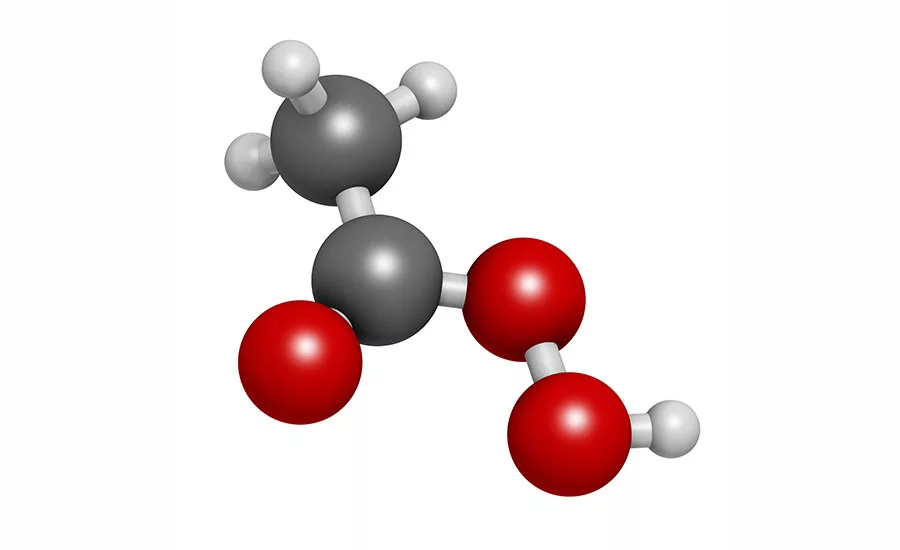
Peracetic acid, also known as peroxyacetic acid, is a peroxide version of acetic acid (vinegar) with an oxygen-oxygen bond. It is similar to hydrogen peroxide in structure, however, is more stable and a stronger antimicrobial compared to hydrogen peroxide due to the placement of this oxygen bond. For food applications, common formulations also usually contain a synthetic stabilizer to slow the rate of decomposition back into hydrogen peroxide and acetic acid. PAA is a colorless liquid with a characteristic pungent vinegar smell.

A PAA solution is a mixture of acetic acid, hydrogen peroxide, water and peracetic acid, which allows for many concentrations of PAA and hydrogen peroxide. Another reason for the various concentrations is its application. For example, the food industry typically uses a stock PAA with concentrations of 15-25 percent, while the paper industry requires a much higher concentration of PAA — around 50 percent — due to its bleaching ability.

While there are many modes of action for the disinfection activity of PAA, the main one is due to the release of the reactive oxygen species when PAA is activated by light in water. These reactive oxygen species cause irreparable damage to biomolecules common to bacteria as well as disruption to their normal cellular function.

The disinfection efficiency of PAA is dependent on certain factors that include temperature, pH, total suspended solids and metal ions.

PAA can function over a wide range of temperatures typical for the poultry industry; however, the rate of PAA degradation increases with temperature. It is sensitive to changes in pH and has its highest activity at or below 8.2. In general, PAA efficacy increases as the concentration of total suspended solids and biochemical oxygen demand decrease. The presence of metals, such as pure iron, will cause PAA to decay. Exposure to large amounts of metal in a short period of time can result in fire and/or explosions. Great care needs to be taken to avoid direct contact of PAA with iron metal.

Its efficacy for a wide range of pathogens makes PAA an attractive antimicrobial for the poultry industry. However, due to its reactive nature, great care is needed regarding how and where it will be stored and used within a facility. As the compatible and incompatible materials listed above are not exhaustive, managers should verify PAA material compatibility with equipment used throughout a plant by requesting a compatibility chart and consulting their PAA supplier. NP

Peracetic acid, at a glance

Advantages of PAA:

  • Antimicrobial agent for a wide range of bacteria, viruses, spores, fungi and protozoan cysts
  • Effective antimicrobial agent over a wide range of temperatures and pHs up to 8.5
  • Decomposes into innocuous products of acetic acid, water and oxygen
  • Compatible with some commonly used materials such as stainless steel, polytetrafluoroethylene (PTFE), and polyvinylidene fluoride (PVDF)

Disadvantages of PAA:

  • Strict storage conditions to prevent fire
  • Cost
  • Corrosive to copper, copper alloys, iron and synthetic rubber
  • Decomposes into acetic acid, which increases chemical oxygen demand in wastewater
KEYWORDS: bacteria Campylobacter foodborne illnesses pathogens Salmonella

Share This Story

Looking for a reprint of this article?
From high-res PDFs to custom plaques, order your copy today!

Dr. Daniel Sabo is a research scientist in the Georgia Tech Research Institute’s Food Processing Technology Division. This article is reprinted from PoultryTech, a publication of the Agricultural Technology Research Program of the Georgia Tech Research Institute, a program conducted in cooperation with the Georgia Poultry Federation with funding from the Georgia Legislature. For more insights, visit http://atrp.gatech.edu.

Recommended Content

JOIN TODAY
to unlock your recommendations.

Already have an account? Sign In

  • Double Charburger

    Premiumization drives burger category

    Shoppers seek out premium meat offerings to fulfill...
    Meat and Poultry Industry News
    By: Sammy Bredar
  • JJS Adult Pekin duck

    Poultry Report 2025: Convenience propels poultry at retail

    Despite continued economic pressures, the poultry...
    Chicken
    By: Sammy Bredar
You must login or register in order to post a comment.

Report Abusive Comment

Manage My Account
  • eMagazine Subscriptions
  • Manage My Preferences
  • Newsletters
  • Online Registration
  • Subscription Customer Service
  • Connect with The National Provisioner

More Videos

Sponsored Content

Sponsored Content is a special paid section where industry companies provide high quality, objective, non-commercial content around topics of interest to the The National Provisioner audience. All Sponsored Content is supplied by the advertising company and any opinions expressed in this article are those of the author and not necessarily reflect the views of The National Provisioner or its parent company, BNP Media. Interested in participating in our Sponsored Content section? Contact your local rep!

close
  • A smiling man carrying a grocery basket is reaching down to pick up a package of meat in a grocery store.
    Sponsored byPIC

    The Green Light: New Data Shows 12-to-1 Support for Pork from PRRS-Resistant Pigs

  • Close up of a grocery cart full of groceries, a cropped image of a couple pushing the cart and a blurred background of the vegetable aisle.
    Sponsored byPIC

    New Market Research Finds Consumers in Eight Key Pork Markets Are Likely to Purchase Pork from Gene-Edited Pigs

  • Close up of a young pig with a blurred background.
    Sponsored byPIC

    New Research Forecasts Significant Economic and Market Impacts with PRRS-Resistant Pig Adoption

Popular Stories

Spam Dog

Hormel rolls out Spam hot dog for foodservice applications

Various new Primal snack sticks on a table amongst pencils, apples, a pair of glasses, lunch bags and a water bottle.

Protein demand drives snacking occasions

Several cuts of beef, pork and chicken on a wooden board, cast iron pan and salt.

Validated thermal lethality data and a new tool for ensuring safety of RTE meats

2026 Top 100 Meat & Poultry Processors Report

Events

June 11, 2026

From Fresh to Frozen in 3 Minutes Flat: Unlocking the Secrets to Temperature Control

Join Tony Vacaro, Foods Industry Manager, and Emile Klein, Foods Market Strategy Manager at Air Products and Chemicals, Inc. , as they tackle key questions surrounding heat removal in food processing. 

January 1, 2030

Webinar Sponsorship Information

For webinar sponsorship information, visit www.bnpevents.com/webinars or email webinars@bnpmedia.com.

View All Submit An Event

Products

Food Crime: An Introduction to Deviance in the Food Industry

Food Crime: An Introduction to Deviance in the Food Industry

See More Products
From Fresh to Frozen in 3 Minutes Flat: Unlocking the Secrets to Temperature Control Webinar Sponsored by Air Products

Related Articles

  • BioSafe partners with other industry leaders, NIOSH in discussions regarding Peracetic Acid (PAA)

    See More
  • Enviro-Tech Peraguard

    Enviro Tech introduces PeraGuard - the first dry peracetic acid (PAA) sanitizer

    See More
  • USPOULTRY’s training video

    Peracetic acid best practices training

    See More

Related Products

See More Products
  • The 10 Principles of Food Industry Sustainability

See More Products

Events

View AllSubmit An Event
  • November 7, 2013

    Food Plant of the Future: The Future of Wastewater Management

    Available On-Demand Effective management of wastewater is becoming increasingly critical to food and beverage processors as the cost for incoming water increases...
  • April 26, 2012

    Food Plant of the Future: Raising the Bar on Plant Air Quality

    On demand Exclusively for thought-leaders in food and beverage processing facility management, Food Plant of the Future webinars are presented by Hixson, a leading design and engineering firm of food processing facilities in North America.
View AllSubmit An Event
×

Stay ahead of the curve. Unlock a dose of cutting-edge insights.

Receive our premium content directly to your inbox.

SIGN-UP TODAY
  • RESOURCES
    • Advertise
    • Contact Us
    • Directories
    • Store
    • Want More
  • SIGN UP TODAY
    • Create Account
    • eMagazine
    • Newsletter
    • Customer Service
    • Manage Preferences
  • SERVICES
    • Marketing Services
    • Reprints
    • Market Research
    • List Rental
    • Survey/Respondent Access
  • STAY CONNECTED
    • LinkedIn
    • Facebook
    • YouTube
    • X (Twitter)
  • PRIVACY
    • PRIVACY POLICY
    • TERMS & CONDITIONS
    • DO NOT SELL MY PERSONAL INFORMATION
    • PRIVACY REQUEST
    • ACCESSIBILITY

Copyright ©2026. All Rights Reserved BNP Media, Inc. and BNP Media II, LLC.

Design, CMS, Hosting & Web Development :: ePublishing