Provisioner logo
Provisioner logo
search
cart
facebook twitter linkedin youtube
  • Sign In
  • Create Account
  • Sign Out
  • My Account
Provisioner logo
Provisioner logo
  • NEWS
    • Industry News
    • Supplier News
    • Case Studies
    • Recalls
    • Regulations
    • New Consumer Products
  • EXCLUSIVES
    • Newsletters
    • Source Book
    • Sponsored Insights
    • Events
    • Webinars
    • Classifieds
    • White Papers
    • Provisioner Store
    • Market Research
  • MEAT PROCESSING
    • SUSTAINABILITY
    • Processing
    • Packaging
    • Ingredients
    • Formulation
    • Food Safety
    • Special Reports
    • Commentary
  • PROFILES
    • Processor Profiles
    • Processor of the Year
    • Top 100 Processors
  • MEDIA
    • Videos
    • Podcasts
  • DIRECTORY
  • MIHOF
  • INDEPENDENT PROCESSOR
  • EMAG
    • eMagazine
    • ARCHIVE ISSUES
    • Contact
    • Advertise
  • JOIN!
Meat and Poultry Industry NewsPorkCoronavirus Coverage

Facing supply chain challenges, UW–Madison meat science program partners with Vita Plus to distribute surplus pork to food pantries
By Industry News
University of Wisconsin pork
June 19, 2020

When the coronavirus pandemic started disrupting the nation’s meat supply chains this spring, the University of Wisconsin–Madison’s swine program soon found itself among the affected operations. The program, which houses around 1,500 pigs at a time at Arlington Agricultural Research Station, focuses on nutritional studies that support the hog industry in Wisconsin and across the Midwest. When the pigs reach market weight, they are typically sent to harvest at the Tyson Fresh Meats plant in Waterloo, Iowa. Not this spring, however.

The Tyson plant, dealing with worker shortages and a shut-down due to COVID-19 infections, couldn’t take the university’s hogs. At the same time, the demand for meat products at grocery stores and food pantries was rising.

“These processing facilities were shutting down and the other ones couldn’t pick up the slack—because the limiting factor is cooler space (to hang carcasses),” explains Jamie Reichert, manager of the swine facility at the Arlington station. “Although the UW–Madison campus was largely shut down at the time, I made the case that we have animal processing capability and cooler space at the Meat Science and Muscle Biology Laboratory. So let’s process our pigs that have nowhere to go and help supply meat to our community. Let’s be part of the solution here.”

And a great solution did arise—through a bit of serendipity and a key partnership.

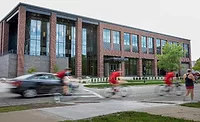
During a virtual meeting about the upcoming opening of campus’ new Meat Science and Animal Biologics Discovery Building, Jeff Sindelar, professor and extension meat specialist in the UW–Madison Department of Animal and Dairy Sciences, happened to mention the university’s surplus hog situation. Also on the call was Al Gunderson, vice president of Vita Plus, the Madison-based animal feed and technology company.

“After the call, Al independently reached out to us,” says Sindelar. “He said, ‘Hey, we’ve got this new Vita Plus Serving Customers and Rural Communities Project, and I think it may have good alignment [to help your situation].’”

The purpose of the Vita Plus project, which was launched in April with a $100,000 commitment from the company, is to purchase dairy, beef and pork products from producers and contribute them to local food pantries, school-based meal assistance programs, and other local food security efforts. The majority of the funding had already been used to support Vita Plus customers and their local communities, but some remained.

The UW partnership was quickly given the green light, and Gunderson worked with the UW team to help establish and manage the process. Reichert helped develop protocols to safely harvest the surplus hogs in the Department of Animal and Dairy Sciences' Meat Science and Muscle Biology Laboratory (MBL), along with Dillon Walker, MBL plant operations manager, and Mitch Monson, MBL retail operations manager.

“We all wear N95 masks and do extra sanitation,” says Walker. “And all of the stations are more than six feet apart, so we all have our own spots on the harvest floor.”

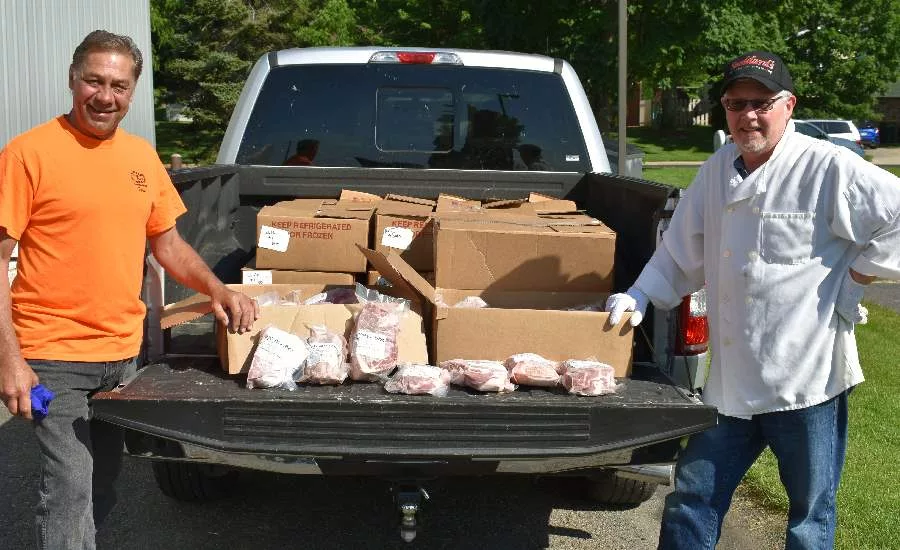
Gunderson recruited Jerry Stoddard of Stoddard’s Meat Market in Cottage Grove to help out by picking up the carcasses from campus for further processing at his operation. It’s a critical piece of the partnership—the step where carcasses are turned into familiar cuts such as chops, roasts, ribs, brats and sausage. Vita Plus employees drive the finished, frozen pork products to area food banks, and the company’s Serving Customers and Rural Communities Project helps cover the costs of the meat and processing.

“It turned out to be a great way to bring all of this together,” says Gunderson, a graduate of the university’s meat and animal science program. “It’s wonderful to have this pork that was in jeopardy of not being utilized go to people who need it and help the community.”

In May, the UW team completed two harvests of 15 hogs each. The third and final harvest for the project on June 29 will mark a milestone for the Department of Animal and Dairy Sciences. It will be the last harvest to take place in the old MBL facility before operations move to campus’ new Meat Science and Animal Biologics Discovery Building.

When all is said and done, the department will have provided around 8,700 pounds of meat to more than a dozen area food banks through the Vita Plus partnership. For the pantries receiving the pork, it’s a welcome gift.

“Pork is something we don’t always have, so this was an awesome donation,” says Ruth Ann Waugh, volunteer coordinator of the Poynette Area Community Food Pantry. “We serve the elderly, young families, the sick, people who’ve experienced some kind of crisis—anybody. Many people do receive some kind of [government] assistance, but we are that fill-in. When their shelves get low, we’re right there to help.”

For the team involved in making these pork donations happen, there’s a deep sense of satisfaction in the work.

“Everybody really has the attitude that this is going to a great cause,” says Gunderson.

Source: UW–Madison College of Agricultural and Life Sciences

KEYWORDS: COVID-19 plant closure university of wisconsin-madison

Share This Story

Looking for a reprint of this article?
From high-res PDFs to custom plaques, order your copy today!
Recommended Content

JOIN TODAY
to unlock your recommendations.

Already have an account? Sign In

  • Double Charburger

    Premiumization drives burger category

    Shoppers seek out premium meat offerings to fulfill...
    Beef
    By: Sammy Bredar
  • JJS Adult Pekin duck

    Poultry Report 2025: Convenience propels poultry at retail

    Despite continued economic pressures, the poultry...
    Turkey
    By: Sammy Bredar
You must login or register in order to post a comment.

Report Abusive Comment

Manage My Account
  • eMagazine Subscriptions
  • Manage My Preferences
  • Newsletters
  • Online Registration
  • Subscription Customer Service
  • Connect with The National Provisioner

More Videos

Sponsored Content

Sponsored Content is a special paid section where industry companies provide high quality, objective, non-commercial content around topics of interest to the The National Provisioner audience. All Sponsored Content is supplied by the advertising company and any opinions expressed in this article are those of the author and not necessarily reflect the views of The National Provisioner or its parent company, BNP Media. Interested in participating in our Sponsored Content section? Contact your local rep!

close
  • A smiling man carrying a grocery basket is reaching down to pick up a package of meat in a grocery store.
    Sponsored byPIC

    The Green Light: New Data Shows 12-to-1 Support for Pork from PRRS-Resistant Pigs

  • Close up of a grocery cart full of groceries, a cropped image of a couple pushing the cart and a blurred background of the vegetable aisle.
    Sponsored byPIC

    New Market Research Finds Consumers in Eight Key Pork Markets Are Likely to Purchase Pork from Gene-Edited Pigs

  • Close up of a young pig with a blurred background.
    Sponsored byPIC

    New Research Forecasts Significant Economic and Market Impacts with PRRS-Resistant Pig Adoption

Popular Stories

Spam Dog

Hormel rolls out Spam hot dog for foodservice applications

Various new Primal snack sticks on a table amongst pencils, apples, a pair of glasses, lunch bags and a water bottle.

Protein demand drives snacking occasions

Several cuts of beef, pork and chicken on a wooden board, cast iron pan and salt.

Validated thermal lethality data and a new tool for ensuring safety of RTE meats

2026 Top 100 Meat & Poultry Processors Report

Events

June 11, 2026

From Fresh to Frozen in 3 Minutes Flat: Unlocking the Secrets to Temperature Control

Join Tony Vacaro, Foods Industry Manager, and Emile Klein, Foods Market Strategy Manager at Air Products and Chemicals, Inc. , as they tackle key questions surrounding heat removal in food processing. 

January 1, 2030

Webinar Sponsorship Information

For webinar sponsorship information, visit www.bnpevents.com/webinars or email webinars@bnpmedia.com.

View All Submit An Event

Products

Food Crime: An Introduction to Deviance in the Food Industry

Food Crime: An Introduction to Deviance in the Food Industry

See More Products
From Fresh to Frozen in 3 Minutes Flat: Unlocking the Secrets to Temperature Control Webinar Sponsored by Air Products

Related Articles

  • Wixon makes significant donation to UW-Madison Meat Science Laboratory

    See More
  • UW Madison building

    Celebration for UW–Madison’s new Meat Science and Animal Biologics Discovery building set for Nov. 6

    See More
  • HRS Heat Exchangers manages ongoing supply chain challenges

    HRS Heat Exchangers manages ongoing supply chain challenges

    See More

Related Products

See More Products
  • food-crime.jpg

    Food Crime: An Introduction to Deviance in the Food Industry

  • GlobalData_logo_blue_header.png

    Fresh Meat (Counter) (Meat) Market in the United States of America - Outlook to 2023...

  • GlobalData_logo_blue_header.png

    Chilled Raw Packaged Meat - Whole Cuts (Meat) Market in the United States of America - Outlook to 2023...

See More Products

Related Directories

  • American Meat Science Assn.

    The American Meat Science Association (AMSA) fosters community and professional development among individuals who create and apply science to efficiently provide safe and high-quality meat (defined as red meat (beef, pork and lamb), poultry, fish/seafood and meat from other managed species). AMSA is a broad-reaching organization of individuals that discovers, develops, and disseminates its collective meat science knowledge to provide leadership, education, and professional development.
×

Stay ahead of the curve. Unlock a dose of cutting-edge insights.

Receive our premium content directly to your inbox.

SIGN-UP TODAY
  • RESOURCES
    • Advertise
    • Contact Us
    • Directories
    • Store
    • Want More
  • SIGN UP TODAY
    • Create Account
    • eMagazine
    • Newsletter
    • Customer Service
    • Manage Preferences
  • SERVICES
    • Marketing Services
    • Reprints
    • Market Research
    • List Rental
    • Survey/Respondent Access
  • STAY CONNECTED
    • LinkedIn
    • Facebook
    • YouTube
    • X (Twitter)
  • PRIVACY
    • PRIVACY POLICY
    • TERMS & CONDITIONS
    • DO NOT SELL MY PERSONAL INFORMATION
    • PRIVACY REQUEST
    • ACCESSIBILITY

Copyright ©2026. All Rights Reserved BNP Media, Inc. and BNP Media II, LLC.

Design, CMS, Hosting & Web Development :: ePublishing