USMEF Conference concludes with election of new officers and overview of current trade landscape
Trade policy consultant Sharon Bomer Lauritsen emphasizes the critical need for U.S. agriculture to remain engaged on U.S. trade policy.
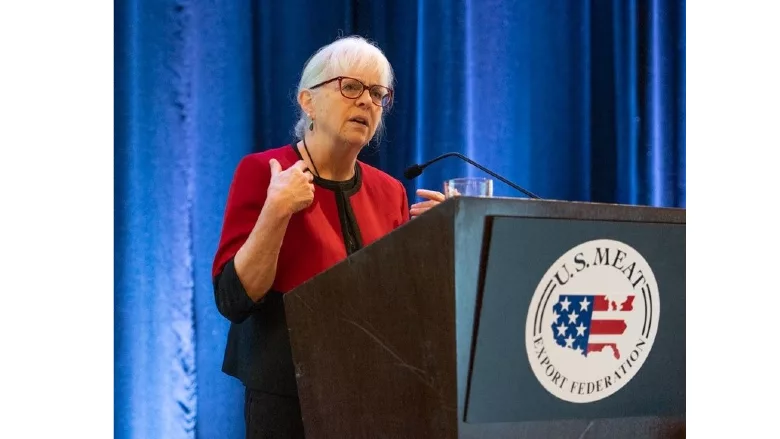
The U.S. Meat Export Federation (USMEF) Strategic Planning Conference wrapped up on Friday, Nov. 11, in Oklahoma City with the election of a new officer team. Dean Meyer, a corn, soybean and livestock producer from Rock Rapids, Iowa, is the new USMEF chair.
In addition to raising corn and soybeans, Meyer’s diversified operation – which he oversees with his three sons – includes a cattle feedlot and a farrow-to-finish hog facility. This provides him with a deep appreciation of the diverse range of agricultural sectors that make up USMEF.
“USMEF is a very unique organization where a corn grower from North Dakota, a cattle feeder from Texas and a soybean farmer from Indiana can pull together to market the same product,” Meyer said. “I’ve seen the momentum growing in the way these sectors work together, and my goal is to enhance that even more. Wearing several different hats, I have a broad perspective – and this organization is my passion.”
Meyer became involved with red meat exports through the Iowa Corn Growers Association, where he served as a director and as Iowa Corn’s USMEF representative. During his time in the USMEF leadership, Meyer has had several opportunities to visit major export markets and share details of his farming operation with importers, distributors and everyday consumers. His farm was also recently featured in a video campaign promoting U.S. beef in Japan.
“It was really an honor to showcase my family and my farm, and to educate Japanese consumers on how we sustainably raise our livestock and crops,” he said. “Our customers overseas love the quality and safety of U.S. red meat, but they want more than that. They want to know the story behind these products and details on how they are produced. Having the opportunity to tell that story and engage with these customers has been a very positive experience.”
Meyer succeeds outgoing USMEF Chair Mark Swanson of Fort Collins, Colo., founder of food safety and management consulting firm Tru Grit KGMS Enterprises LLC. Minnesota pork producer Randy Spronk will serve as USMEF chair-elect in the coming year, while the vice chair is Steve Hanson, a cattle rancher from southwestern Nebraska. The newest USMEF officer is Secretary/Treasurer Jay Theiler, executive vice president of corporate affairs for Agri Beef, based in Boise, Idaho.
Friday’s closing business session offered attendees a comprehensive overview of the Biden administration’s current trade initiatives and their potential impact on red meat exports. Longtime U.S. trade negotiator Sharon Bomer Lauritsen, who is now a trade policy consultant with AgTrade Strategies, LLC, praised her successors for their efforts to address trade barriers that limit U.S. agricultural exports. But she questioned the degree to which the Biden administration has prioritized agricultural trade, noting that Congress still has yet to confirm the nominees for USTR chief agricultural negotiator and USDA undersecretary for trade.
“So it’s hard to get that political push for agriculture when it’s not the priority that it has been in prior administrations – including the Obama administration,” Bomer Lauritsen said.
She spotlighted tense relations between the U.S. and China but noted that the vast Chinese market still holds tremendous opportunities for U.S. agricultural exports.
“I think it’s important to try and separate food trade, and to calm some of the rhetoric we’re seeing in our own politics related to China,” she said. “While I know that your industry is having some difficulties with China, I would still argue that the Phase One Agreement that we negotiated is a huge success.”
Bomer Lauritsen closed by emphasizing the critical need for U.S. agriculture to remain engaged on U.S. trade policy.
“If you’re not there speaking up, you’re never going to see any positive changes,” she said. “You must engage with people at the civil service level – where I was – as well as with your elected officials in Congress and your foreign country counterparts, or things won’t get fixed.”
On Thursday, the conference focused on the 45th anniversary of USMEF’s inaugural office in Tokyo. The session showcased the value the U.S.-Japan trade partnership delivers for the U.S. red meat industry, highlighting marketing initiatives and future opportunities. Japan has consistently been the leading value destination for U.S. red meat exports and 2022 is no exception, with shipments through September topping $3 billion.
Masayoshi Kinoshita, director of meat marketing and trade policy for Japan’s Ministry of Agriculture, Forestry and Fisheries, kicked off the discussion with an historical overview of meat supply and demand in Japan. Kinoshita recounted his positive experiences in working with USMEF and described the challenges Japan faces in its domestic production, leading to an expanded role for imports in meeting the country’s growing demand for red meat.
A panel discussion featuring USMEF-Japan staff was moderated by USMEF Vice President of Economic Analysis Erin Borror and included Japan Director Takemichi Yamashoji, Marketing Director Satoshi Kato and Taz Hijikata, consumer affairs director. The session centered on Japan’s value to the U.S. red meat industry as a trusted and reliable customer, and the potential for further growth as consumers in nearly every age group continue to shift from high-priced seafood consumption toward animal proteins.
Japan’s value as a trading partner goes beyond its billions of dollars in annual purchases, displaying a tremendous appetite for cuts and variety meats that are underutilized in the United States. This demand delivers value back to livestock producers and to every level of the U.S. supply chain.
“Japan is importing $20 worth of beef tongue from every animal this year and its purchases of skirts and hangers adds $10.45 to each fed animal in the U.S.,” Borror explained. “Japan also accounts for more than 6% of U.S. pork loin production and about 13% to 15% of our picnic production through its demand for ground seasoned pork.”
Panelists described recent marketing initiatives developed to promote new applications and uses for underutilized cuts and variety meats in Japan’s foodservice and retail sectors. Longstanding industry relationships are key to USMEF’s ability to introduce and test new applications in the Japanese market. This year, for example, marketing programs have targeted the foodservice sector with promotions for fried pork loin, new pulled pork recipes utilizing the picnic and new U.S. beef recipes for Japan’s fast-growing yakiniku sector.
“Inflation and a weakened yen have tightened consumer budgets and the market is very receptive to trying affordable protein options,” said Yamashoji. “We are conducting promotions at foodservice and retail, and these new recipe ideas are reaching millions of consumers through social media.”
Thursday’s activities also included meetings of USMEF’s standing committees, which allow members to receive updates on issues impacting specific sectors. Members of the USMEF Feedgrains and Oilseeds Caucus were treated to an appearance by Oklahoma Secretary of Agriculture Blayne Arthur. She welcomed USMEF’s first-ever meeting in Oklahoma and praised the state’s agricultural organizations for their role in expanding global demand for U.S. red meat.
Global production forecasts, export projections, market access challenges and logistics updates were among the agenda items in breakout sessions for the Pork and Allied Industries Committee, Beef and Allied Industries Committee and Exporter Committee. One presentation that received particular attention was a panel discussion by USMEF’s directors in Korea, South America and the ASEAN region on convenience-driven trends in product packaging.
The Exporter Committee and Pork and Allied Industries Committee collaborated on a resolution requesting that USDA and the Office of the U.S. Trade Representative make it a top priority to reach regionalization agreements with key trading partners related to African swine fever and other foreign animal diseases. The resolution notes that when implemented in cooperation with state animal health officials, these agreements can be a critical tool for mitigating trade disruptions in the event of an animal disease outbreak.
Former U.S. Trade Representative Robert Lighthizer, who spearheaded key trade agreements achieved under the Trump administration, was honored with USMEF’s Michael J. Mansfield Award. The USMEF Distinguished Service Award was presented to Where Food Comes From co-founder Leann Saunders. More details on these awards can be found here.
Highlights from the conference’s opening day are also available in this USMEF release.
USMEF members will next meet at the federation’s spring conference in Minneapolis, Minn., on May 24-26.
For questions, please email Joe Schuele or call 303-547-0030.
Source: U.S. Meat Export Federation
Looking for a reprint of this article?
From high-res PDFs to custom plaques, order your copy today!



.webp?height=200&t=1666036435&width=200 "NAMI logo")