Meat and poultry packing gets smarter with robotic palletizers
Automation isn’t the future of meat and poultry packing — it’s the present.
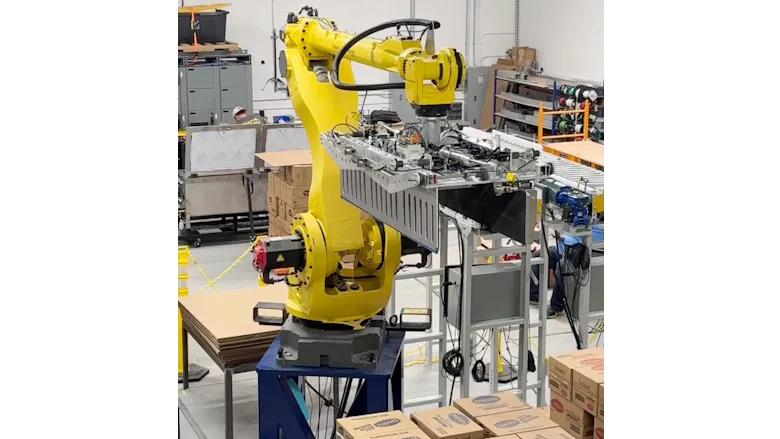
Photo credit: Hoj Innovations
Automation technologies are reshaping meat and poultry processing, providing smarter solutions to complex industry challenges.
Robotic palletizers, in particular, offer targeted relief for persistent operational hurdles, enhancing workforce stability, improving safety, and supporting regulatory compliance while positioning processors for sustained efficiency and growth.
Labor shortages and turnover
North American meat and poultry processors are facing chronic labor shortages, with food manufacturing unemployment at a 20-year low. This makes staffing tough for labor-intensive roles like manual palletizing incredibly difficult.
Further, with turnover rates often hitting 60% to 150% annually, plants are caught in a constant cycle of training new personnel, which is both costly and inefficient. Robotic palletizers step in as a consistent, tireless workforce, providing immediate relief. This frees existing staff for more valuable and less physically demanding tasks.
Worker safety in harsh environments
Few manufacturing environments are as tough as meat and poultry plants. The toll of working in cold, wet conditions, constantly lifting heavy loads, is significant. In 2022 alone, over 266,000 musculoskeletal injuries sidelined workers doing manual material handling tasks.
That represents substantial pain and lost productivity. Robotic palletizers, in stark contrast, handle these repetitive, strenuous tasks in freezer environments without issue, dramatically reducing the risk of injury and fatigue for human teams.
By completely eliminating the need for manual lifting and stacking, companies have reported up to a 40% reduction in labor-related injuries after implementation.
As Spencer Palmer, project manager at Hoj Innovations, puts it: “Manual palletizing can be strenuous and has an increased risk of injury for workers. Automating it can save on time and dramatically reduce the risk of injury."
This not only boosts safety but also cuts down on workers’ comp claims and lost-time incidents.
Food safety pressures and sanitary design
Despite best efforts, human workers can unintentionally introduce contaminants. This is where robotic systems excel: they are built to be fully enclosed, washdown-ready and are made from food-grade materials.
With IP69K ratings, these robots can withstand aggressive cleaning and high-pressure sprays, preventing microbial buildup and easily meeting rigorous USDA hygiene standards. They help maintain product purity and compliance with the USDA standards.
Faster operations, lower costs and rapid ROI
Manual palletizing is physically demanding and often inconsistent, as worker fatigue frequently slows production, especially during demanding peak shifts. In contrast, automated palletizers provide reliable, continuous operation 24/7, ensuring uniform stacking and reducing product damage.
Their compact footprints maximize throughput even in tighter spaces, potentially serving multiple lines from a single cell without expanding physical plant infrastructure. Beyond operational improvements, robotic palletizers deliver substantial financial benefits, reporting labor savings of 25% to 40%, typically paying for themselves within two years.
Additionally, Robotics-as-a-Service (RaaS) options lower financial barriers, enabling automation without significant upfront capital expenses and delivering rapid returns within one to three years.
These integrated robotic solutions directly address critical operational challenges faced by meat and poultry processors, clearly paving the way toward operations that are more resilient, efficient, and significantly safer for everyone involved.
Implementation insights for meat and poultry plants
Successful robotic palletizer integration in meat and poultry plants demands specific considerations. Beyond general benefits, these systems must thrive in challenging environments and expertly handle diverse products.
Robotic palletizers for meat and poultry must withstand extreme cold and daily washdowns. Leading models offer sealed bearings, corrosion-resistant coatings, and food-safe materials. System integrators ensure all cell components—including conveyors and sensors—meet low-temperature and sanitation specs.
The diversity of product sizes and case types in protein processing can complicate palletizing. Robotic systems overcome this with flexible programming, vision systems, and on-the-fly pattern switching. Whether palletizing IQF boxes or case-ready packs, robots adapt quickly, reducing changeover time and labor complexity.
Gripper selection is critical. Robots use vacuum suction, mechanical clamps, or specialized layer grippers. Quick-change tooling adds versatility, allowing handling a broad product mix. EOAT must also meet food-grade standards for hygiene.
Effective implementation relies on robust, adaptable technology and expert integration. Addressing these factors ensures robotic investments deliver maximum efficiency and longevity.
Technology trends driving the future
The landscape of robotic palletizing is constantly evolving, driven by new technological breakthroughs. These innovations promise even greater efficiency and adaptability for meat and poultry processors.
Advanced vision systems and AI software are transforming robotic palletizing. Robots identify products in real-time, dynamically adjusting stacking patterns for optimal load balance. These systems learn from past cycles, improving performance and reducing handling errors.
Compact, mobile palletizers are making automation accessible, especially for smaller processors. These modular systems deploy quickly and relocate as needed. Collaborative robots (cobots) offer low-footprint solutions for light-duty tasks, expanding automation to secondary lines.
These trends are making automation more intelligent and accessible. They're pushing boundaries, ensuring robotic palletizing remains a vital solution for future challenges.
Conclusion
Automation isn’t the future of meat and poultry packing — it’s the present. Robotic palletizers help processors tackle labor shortages, meet safety standards, and improve operational efficiency without expanding footprint or headcount.
From ROI to reliability, robotic palletizing is quickly becoming standard in protein plants of all sizes. As more companies adopt these systems, the smart factory vision becomes a practical, powerful reality.
Looking for a reprint of this article?
From high-res PDFs to custom plaques, order your copy today!