AI-powered factories and the future of food manufacturing
While AI supports better decisions and responsiveness, human expertise remains crucial.
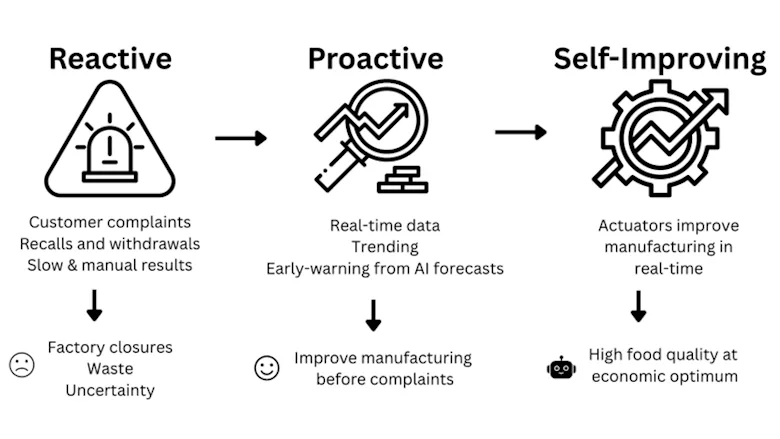
Photo credit: Max Grell
Producing fresh food is highly time-pressured. One break in the line or the supply chain creates disruption, missed delivery deadlines, and huge waste, and immediate adaptation is required.
In the just-in-time food system, if an ingredient or delivery doesn’t arrive, you feel it immediately in the production line. But it’s much harder to know if an ingredient or finished product meets your specifications. The industry relies on raw material suppliers' performance built up over time. For homogeneous raw materials this can be reliable, but it is less so for highly variable foods. The performance trends rely on limited sample testing or reacting to customer-complaints after they happen. Routine sample testing and inspections are commonplace (in the UK, for example, up to one in 1000 packs of case-ready poultry get tested for microbiology; pathogenic and spoilage organisms). But traditional sample testing methods, like microbiology and sensory, can only cover a small sample size (they’re expensive), data is slow (often many days later), sparse (one data point per sample) and varied. So, quality issues that cause complaints must be addressed after the fact. The old rule of thumb is that, for every customer complaint, there were 100 customers who didn't report the issue.
The combination of slow data and just-in-time production means that, once issues are identified, it's often 1-3 weeks after they first occurred. This means tonnes of food product may already be shipped below standard. For example, every summer, entire manufacturing plants get black-listed by major retail and QSR customer because of high consumer complaints. From the retailer’s point of view, the supplier took too long to fix it. This is the status quo that most food manufacturers have been in for the last 50 years. It causes huge amounts of waste and uncertainty while incurring huge costs on the industry. But there is change afoot, towards A) pro-active and real-time food manufacturing, which leads to B) predictive food manufacturing.
Technology is enabling not just real-time information, but predictive forecasting. This means, for example, that factories can forecast order volumes, quality problems and customer complaints before they happen, enabling pro-active management. Adoption is happening in 2025 thanks to new sensors, AI-enabled software, machine vision and signal processing. The ability to course-correct in advance is hugely beneficial, for example by forecasting food-quality, allowing correction before causing complaints, minimizing the chance of entire manufacturing sites being blacklisted. A major poultry producer now monitors whether they will make shelf-life with a spoilage forecast from day 1, based on sensors in retained samples. If the forecasted shelf-life starts to drop week-on-week they can tighten manufacturing hygiene or, if necessary, reduce the shelf-life, before risking customer complaints. They have seen a 33% reduction in customer complaints compared to the previous year. Real-time data is uncovering previously unseen challenges, such as the quality variation between products manufactured on the same line. The industry understands that pack to pack variation can be large, but traditional testing volumes and the time lag in results hamper them effectively managing that variation and its implications. With new sensors and the use of AI, however, some manufacturers are looking even further. The factory-of-the-future, like a self-driving car that automatically navigates risks in the road ahead, will be able to manage ever-more of the decisions, optimizing its own quality and reducing its own overheads.
What storage temperature, gas mix, sealing heat or ingredient concentrations should you use, for producing high quality food at the economic-optimum, in any given month of the year? AI-powered factories solve this continuously using real-time sensor data, predictive analytics, and in-line/robotic actuators. The cooling-temperature will respond to product spoilage. The cleaning-intensity will respond to surface cleanliness. While AI supports better decisions and responsiveness, human expertise will remain crucial for oversight, addressing novel situations, and maintaining control over critical processes. A collaborative decision-making approach means AI serves as a powerful tool, augmenting the human capabilities your best operators.
Looking for a reprint of this article?
From high-res PDFs to custom plaques, order your copy today!