Small processors urged to beef up cybersecurity
AAMP 2025 expo workshop details fraud threats and steps to mitigate risk.
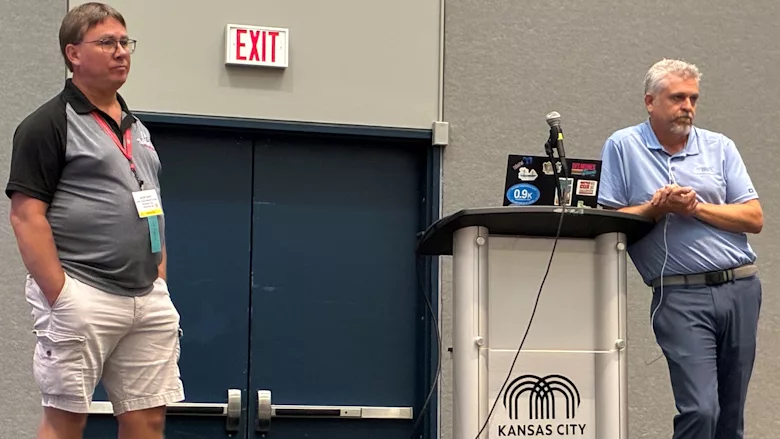
Jake Sailer (left) and IT security specialist Robert Austin share tips to mitigate businesses' risk of online fraud during an educational session as part of AAMP 2025 in Kansas City.
KANSAS CITY, Mo. — Jake Sailer, owner of Elmwood, Wisc.-based Sailer’s Food Market & Meat Processing Inc., and IT security specialist Robert Austin shared firsthand accounts of the critical importance of employing robust cybersecurity for small meat processors during an educational session as part of the 86th American Association of Meat Processors and Suppliers Exhibition on July 23-26. (Learn more about AAMP 2025 news and new products here and here.)
Austin, founder and CEO of Kansas City, Mo.-based Tech Express, an IT consulting services provider for small to mid-sized businesses, said small processors must be aware of the danger inattention to cybersecurity poses to their businesses.
“As technology evolves, those dangers get more and more severe,” Austin said.
Sailer said his business was the target of a cyberattack a couple of years ago while the company was undertaking an expansion project, a busy time with lots of bills and invoices coming in. Sailer’s Food Market & Meat Processing Inc. became the target of email phishing, a fraudulent attempt to obtain information such as usernames, passwords, account details or other personal data by posing as a trustworthy entity. Phishing emails often mimic banks, social media platforms or online retailers to trick recipients into revealing information.
“They get into your computer, and they watch what you’re doing,’ Sailer said. “They were watching my email for approximately 30 days, according to our IT guy.”
Austin said phishing operations can last for years while they watch and wait for the opportunity to strike, noting that money lost to email scams is not FDIC-insured and banks may offer varying degrees of assistance in resolving the situation.
In Sailer’s case, a hacker fraudulently billed Sailer’s Food Market & Meat Processing Inc. for nearly $150,000 by sending fraudulent emails that looked like legitimate vendor invoices, he said. Within a couple of weeks, Sailer's bank was able to recover about $142,000. Austin described Sailer’s case as a best-case scenario once your business has been defrauded.
He said hackers’ embrace of emerging AI technology heightens the risk to companies.
Among the steps Austin suggested to mitigate cyberfraud is making sure to back up data, employing two-factor identification for network access and asking the bank to contact you before proceeding with any transaction greater than $10,000. He emphasized that companies cannot afford to treat IT and cybersecurity as an afterthought.
“You could lose a whole year of sales with one IT mistake,” he said.
Looking for a reprint of this article?
From high-res PDFs to custom plaques, order your copy today!
.webp?height=96&t=1647275041&width=96)