Meat and poultry demand holds steady despite tariffs, labor and AI challenges
Broiler segment finds opportunity while US beef prices hit all-time highs.
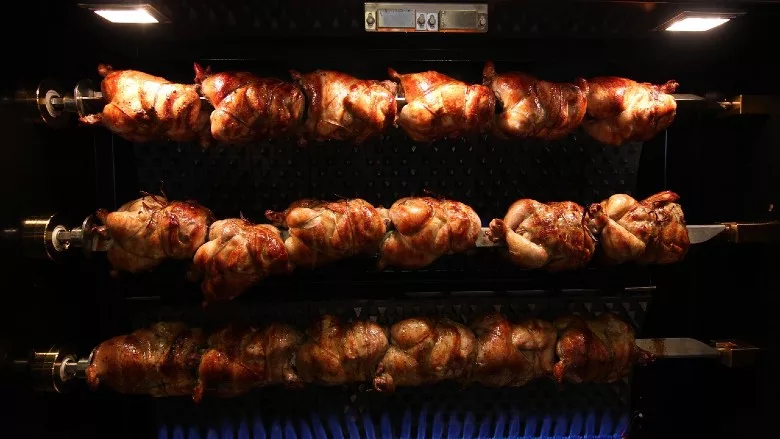
Chicken rotisserie
Photo courtesy of negativespacedesign/Pixabay
Significant downward revisions to monthly payroll estimates in August 2025 led many market observers to anticipate the Federal Reserve would begin cutting interest rate cuts more aggressively. However, recent economic data has generally been positive, tempering expectations for more significant cuts before the end of the year.
According to a new quarterly report from CoBank’s Knowledge Exchange, the most likely scenario is an additional four or five cuts of 25 basis points through 2026, leaving the overnight rate around 3.0% by the end of 2026. The actual outcome will depend heavily on how the economic data looks and how successful the White House is in influencing monetary policy.
Tariff policy uncertainty, the sharp decline in immigration and the massive surge in AI investments have made interpreting traditional economic reports more difficult. The CoBank report suggests sharp swings in monthly import volumes, a flattening of working-age population growth and a soaring stock market make it difficult to gauge how “Main Street” America is doing economically.
“The intense politicization of attitudes has rendered longstanding public sentiment surveys erratic and unhelpful in gauging actual economic conditions,” said Rob Fox, vice president of CoBank’s Knowledge Exchange. “The federal government shutdown and potential loss of scheduled economic reports will make it even more difficult for businesses to gauge the economy and make prudent business decisions.”
Despite rising fears that the rapid adoption of AI will soften the labor market and dim job prospects for college graduates, Fox said there is little evidence to support those fears. “New technologies have always raised concerns about job losses. The recurring theme is job transformation, not elimination. This time isn’t any different. Today’s college graduates are already deeply familiar with AI and are using it to sharpen skills hiring managers value most.”
US economy
Personal consumption and unemployment rates, arguably the most important economic signals, have held steady in the face of ongoing uncertainty. However, other signs suggest the economy may be slowing. Personal income growth, adjusted for inflation, has fallen from 4% in early 2024 to about 2% today. Consumers have responded by dipping into savings to maintain their spending, which cannot be sustained indefinitely. While a potentially slowing economy and declining interest rates should put downward pressure on the dollar, the effect for US agricultural exports has been muted. Row crop exports have not experienced the benefit of the weakening dollar relative to the currencies of America’s largest grain importers.
US government
The government shutdown and lack of congressional action are contributing to widespread political and economic uncertainty. With no more funds to support most federal programs or pay many public servants, the suspension of most revenue-generating capabilities are halted and will likely negatively impact the economy as time goes on. Meanwhile, the abundance of American agricultural commodities is no longer an asset but rather a liability for many US farmers. Tariffs have ultimately shut out American commodities to many countries. The administration is expected to announce $10-15 billion in farm aid to struggling producers, but that may be delayed because of the government shutdown.
Grains, farm supply and biofuels
US farmers are harvesting a record-large corn crop and the second-largest soybean crop in five years following the largest wheat harvest in five years. The supply abundance is welcomed news for grain elevators looking to capture bigger carries in the futures market. But the record grain crop will strain US storage and transportation infrastructure. The demand outlook for US grains remains clouded by geopolitical uncertainty. Corn and wheat sales enter the fourth quarter historically strong, but soybean sales are abysmal due to the lack of Chinese purchases. Low water levels on the Mississippi River threaten to slow grain and oilseed exports during the peak shipping season.
Elevated crop input costs will further erode producer profitability during the current low commodity price cycle. Producers will likely reduce fall fertilizer applications and stall overall input purchases for 2026 due to higher prices. Tariffs are also driving up input costs. The average tariff on crop inputs imported to the US has increased from 1% to nearly 12%, according to data published by North Dakota State University. Fertilizer prices remain the biggest headwind for producers. Farmers will be reassessing and potentially reducing their usage rates of nitrogen, phosphorus and potassium. If farmers shift more applications to the spring, high seasonal demand could lead to supply chain hiccups.
Biofuel demand remains a silver lining for the crop side of the agricultural economy. But the delay in regulatory policy on renewable volume obligations and small refinery exemption reallocation are casting a cloud over future demand. The EPA is unlikely to finalize next year’s renewable volume obligations before 2026. Renewable diesel and biodiesel margins will stay in the red as producers work through the long transition from the Blenders Tax Credit to the 45Z Tax Credit. Ethanol producer margins should remain positive to close out the year, due to plentiful corn supplies and low prices for natural gas and corn.
Animal protein
Dollar sales of retail ground beef grew by double digits in August, up 13% year-over-year at $1.7 billion, according to Circana. While beef prices remain elevated on tight cattle supplies, persistent demand boosted overall sales, and volume kept pace. Domestic cattle prices rose throughout much of the third quarter, setting new records and boosting returns to ranchers, but complicating beef market dynamics otherwise. Beef packer margins struggled during the third quarter. Despite strong demand for beef, several factors are limiting production growth.
A slimming US hog herd served to lift market prices. Price rallies for lean hog futures and feeder pigs persisted over the summer, settling at 20% and 48% higher year-over-year, respectively, in late September. In August, farrow-to-finish profit margins reached $52.58 per head, the highest since June 2021, according to Iowa State University. Pork producers have now posted profits for 17 consecutive months. Export demand has slowed slightly compared to 2024, which was a record export year for US pork. Mexico remains the largest buyer of US pork.
With beef prices hitting all-time highs, the US broiler segment capitalized on the opportunity to provide consumers a value offering this summer. A strong focus on chicken at retail and foodservice boosted white-meat values through August. The quick-service restaurant segment featured a multitude of chicken options focused on strips and new flavors. Softening white-meat values during the remainder of the year are likely to crimp margins but will continue to position chicken as a competitive value offering in 2026. Broiler production is expected to remain elevated through the end of 2025.
US dairy farmers continue to enhance their revenue by producing calves destined for beef production. Beef’s contribution to the bottom line has moved from $1 to $4 per cwt. over the past four years. The US dairy herd has climbed to its highest level in over 30 years, in part, to capitalize on revenue from beef-on-dairy calves. While milk production margins had been somewhat favorable, strong output in recent months significantly changed the price forecasts. Butterfat production is in overdrive and ample supplies have sent milk futures lower. Typically, that would prompt dairies to reduce production. But the combination of the lowest feed prices in five years and profit margins for beef may be a stronger signal.
Deconsolidation
Merger and acquisition activity in the food sector continues, as evidenced by marquee deals including Ferrero’s acquisition of WK Kellogg and Mars’ purchase of Kellanova. However, deconsolidation and divestures are becoming equally common. Unraveling the biggest deal of a decade ago, Kraft Heinz is splitting into two companies. The move reflects a growing trend toward deconsolidation as companies aim to focus their efforts more narrowly and increase their agility to address changing consumer needs. This trend will likely continue as consumer sentiment shifts toward more cost-effective, at-home meal solutions.
Power and digital infrastructure
The cost of electricity is becoming a chief economic concern for Americans, as prices are rising twice as fast as inflation. While data centers’ enormous appetite for power is frequently assigned blame, the problem of rising electricity prices pre-dates data centers. The North American Electric Reliability Corporation has long warned of supply challenges. Large load growth customers such as data centers could be a catalyst for modernizing the US electric grid, ultimately helping to lower rates for all customers. However, regulatory misalignment or the mis-apportionment of system costs could deter the beneficial load growth needed to temper electricity costs. The imperative for utilities is to insulate consumers from data center cost sharing.
Historic investments continue pouring into data center and AI infrastructure development. Capital expenditures could approach $400 billion in 2025, up from $235 billion in 2024. Investments will surge even higher in 2026, with Oracle, Microsoft and Broadcom signaling continued growth in AI infrastructure. That momentum creates a unique opportunity for rural America, as data center developers and hyperscalers search for land and a clear path to power. But the road ahead is not without challenges. The looming supply-demand imbalance in US energy markets could become a bottleneck for growth and increase the risk of critical AI training activities migrating overseas.
Source: CoBank
Looking for a reprint of this article?
From high-res PDFs to custom plaques, order your copy today!