In the beef market, the higher the peak, the deeper the valley
Shifting market dynamics position packers to gain leverage over feedlots.

In September, cattle futures were pricing April 2026 fed cattle at near $250/cwt and feeder cattle at $375/cwt. Two months later, fed cattle futures have declined $42/cwt (-17%) and feeder cattle have lost $80/cwt (-21%).
What happened? To answer that question one first needs to recognize what caused prices to climb to those record highs in the first place. Tariffs imposed in April raised costs for beef importers across the board, the cattle trade with Mexico was suspended for a third time, and reports emerged of cattle infested with New World Screwworm less than 100 miles from the border. Brazil, the world’s largest beef supplier, saw its effective tariff rate double from 36.4% in June to 76.4% by Aug. 4. At the same time, new packing plants came online, increasing demand for cattle when feedlots were already struggling to secure replacements. The result of all these events playing out over the spring and summer were cattle prices far beyond what anyone envisioned at the start of 2025.
A few months later, however, many of those bullish factors have reversed. Tariffs are now back to where they stood at the end of March. Beef is no longer subject to reciprocal tariffs and is also excluded from the additional US tariff on Brazil. To put this in perspective, if a Brazilian supplier previously sold a load of 90CL frozen boneless beef in the US market for $395/cwt, they faced a tax of $302/cwt. Effectively this stopped all trade of Brazilian beef. Even Australian suppliers that faced just a 10% tariff would have to pay near $40/cwt on any meat sold. Now Brazil will face only a 26.4% out of quota tariff while Australia will pay no tariff while New Zealand pays only $4.4/cwt for anything withing its relatively large quota allocation. Beef imports were record high in 2025 and, after the recent decision, we could see imports increase by another 400 milion to 500 million pounds in 2026. Combined with the expected decline in exports, this is expected to offset the reduction in domestic beef production next year.
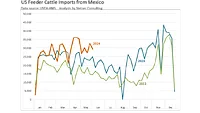
Additionally, US and Mexican officials have begun working more closely to develop protocols to resume cattle trade. While nothing has been formally announced, the lack of Screwworm cases in northern Mexico suggests that trade could resume. Previously, Mexico shipped over 1 million head a cattle a year to the US. With the border closed for much of the last 12 months, there are hundreds of thousands of cattle currently sitting on Mexican ranches that could enter US feedlots in the first half of 2026.
While the supply picture has started to shift, one of the largest US beef packers announced a sharp cut to its capacity. Tyson will close its Lexington, Neb., plant by the end of January, eliminating around 5,000 head a day of capacity, and will reduce its Amarillo plant to one shift. These closures do not necessarily imply a 5% to 7 % drop in fed slaughter, since other plants may run more efficiently. Instead, packers stand to gain leverage over feedlots, especially with heavy front end supplies. For now, futures have sought to account for all these factors, hence the double digit decline in futures. Looming in the background, however, is the outlook for the US economy and the potential impact this could have on US beef demand.Looking for a reprint of this article?
From high-res PDFs to custom plaques, order your copy today!