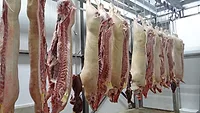
USDA proposed line-speed rules seek to increase global competitiveness for US pork and poultry producers
Changes would update outdated limits by allowing eligible establishments to operate at speeds supported by their processes, equipment and food safety performance, with FSIS maintaining full oversight.

The US Secretary of Agriculture Brooke Rollins is announcing proposed updates to federal line speed regulations in poultry and pork establishments operating under modern inspection systems, allowing for greater efficiency while maintaining food safety standards.
USDA’s proposals would update outdated limits by allowing eligible establishments to operate at speeds supported by their processes, equipment and food safety performance, with FSIS maintaining full oversight. The proposals maintain full federal oversight in every establishment and reaffirms the authority of inspectors to slow or stop operations whenever inspection cannot be performed effectively.
The updated regulations would also remove worker safety attestations that fall outside USDA’s statutory authority, reducing redundant paperwork for industry.
"These updates remove outdated bottlenecks so that we can lower production costs and create greater stability in our food system," Rollins said. "By bringing our regulations in line with proven, real-world capabilities, we are supporting a stronger supply chain, giving producers and processors the certainty they need, and helping keep groceries more affordable for every household."
USDA invites public comment on both proposed rules for 60 days following publication in the Federal Register.
In response to the proposed rules, National Chicken Council President Harrison Kircher said, “I want to thank Secretary Rollins and the Trump administration for adhering to science-based principles and following almost 30 years of experience, studies and data on increased line speeds in chicken processing plants.
“The current patchwork approach has created significant uncertainty for companies and has put our members at a disadvantage globally, where other countries operate at faster speeds. We appreciate the administration’s pro-business approach and for helping to increase the global competitiveness of America’s chicken producers. We look forward to providing input as the rulemaking process begins.”
Line speeds in poultry processing
A pilot program using almost two dozen chicken processing plants was initiated under the Clinton administration allowing line speeds of up to 175 birds per minute (bpm), up from 140bpm. It is important to note that the part of the processing line (evisceration) that deals with the speed increase is almost entirely automated. This modernized system has been studied, debated and reviewed in depth for two and a half decades to assure its effectiveness in further modernizing chicken inspection while improving food safety and protecting workers. Research has confirmed that higher evisceration line speeds in chicken processing plants do not lead to increased food safety risks.
While the industry has been safely increasing line speeds over the past 30 years, the poultry industry’s injury and illness rate has fallen 90%, according to the most recent data from the US Department of Labor, demonstrating the advancements the industry has made in improving safety for its workforce.
Further, in January 2025, FSIS issued a study that found that the risk of injuries among workers at poultry processing plants was not influenced by evisceration line speed.
Any individual plant’s line speeds are based on many factors, including a plant being able to maintain process control, producing safe food, keeping workers safe, and staffing considerations. If a plant determines that one of these factors calls for slowing down the line, the plant will do so. USDA maintains the regulatory authority to slow down or stop a production line in poultry processing plants if deemed unsafe.
Chicken processing plants in Canada, Belgium, Germany, Brazil and Argentina, among others, all operate at line speeds of 200+ bpm, using the same equipment, putting the US at a competitive disadvantage in the global marketplace.
Boosting pork processing capacity
The National Pork Producers Council applauds the proposed rule to update the New Swine Inspection System’s line speed regulations to increase efficiency at pork processing plants.
“Thank you, Secretary Rollins and the Food Safety and Inspection Service, for taking steps to unleash the potential to process pork more efficiently while also protecting food and worker safety,” said NPPC President Duane Stateler, a pork producer from McComb, Ohio.
“Greater efficiency of increased line speeds provides financial security and more stability for pork producers. Without the NSIS program, some pork producers could have incurred an additional loss of nearly $10 a head.”
Since 2019, NPPC has advocated for increased line speeds.
Sources: USDA; National Chicken Council; National Pork Producers Council
Looking for a reprint of this article?
From high-res PDFs to custom plaques, order your copy today!