Green flags and red flags
 |
At most of the 550 U.S. hog farms growing for Niman Ranch, hogs are likely foraging outdoors on about 20 percent of the farm. Fields making up another fifth of the farm are likely growing corn, nourished by the manure left behind from the hogs that lived there last year, while another fifth is growing soybeans. Each of the last two-fifths is probably growing any number of produce crops — or simply left uncultivated.
Next year, everything will shift. The hogs will forage on a different field, the corn will grow on another and so on.
And that corn and soybean harvest will go to fatten the same farm’s pigs, helping to marble the pork that will be sold at specialty restaurants and grocery chains such as Whole Foods.
This setup is one of the most critical hallmarks of sustainable agriculture. The diversity of land use, rotation of crops and cycling of nutrients — using manure to nourish the soil and crops, then the harvest to nourish the animals — are all important indicators of an environmentally responsible livestock farm, say sustainable agriculture experts.
“A sustainable farmer always starts with the question, ‘How would nature do this?” says Brian Snyder, executive director of the Pennsylvania Association for Sustainable Agriculture in Millheim, Pa. “And when you look at nature, you find nature loves diversity. Nature loves to move things around.”
In the system typically found among Niman Ranch farmers, says Nick McCann, agriculture specialist at the National Center for Appropriate Technology, a non-profit organization in Butte, Mont., promoting sustainable agriculture, “You’re keeping a lot of nutrients on the farm, and that’s very important from a closed-loop perspective. You want to bring in as little from off the farm and export as little as you can.”
As a graduate student, McCann worked at the Leopold Center for Sustainable Agriculture at Iowa State University.
Doing it right
Environmental responsibility is not just a niche market, issue or conversation. The Cattlemen’s Beef Board and National Cattlemen’s Beef Association last year issued its first formal review of the beef industry’s influence on communities, the economy, public health and the environment in “The Cattlemen’s Stewardship Review: Connecting our Vision and Values.”
The review cited a Washington State University study that found each pound of beef raised in 2007 used 20 percent less feed, 30 percent less land, 14 percent less water and 9 percent less fossil fuel energy compared to 20 years ago. In all, the carbon footprint of a pound of beef is 18 percent lower than in 1977, according to the NCBA.
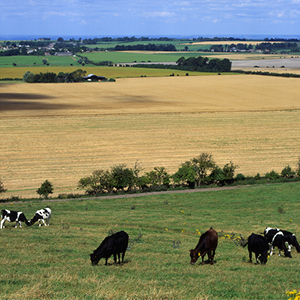
On livestock farms, other “green flags” are healthy pastures of various heights with different kinds of plants — opposite of bare ground or a uniform, “golf course” look — and vegetation along the boundaries of the farm and any waterways to absorb excess nutrients from entering streams. Generally, the more the animals are outside, the better, and the more cows are fed grass over grain, the better. Animals should look healthy, alert and content, with shiny hair and coats, according to Ann Wells, program director and veterinarian, and Mary Penick, livestock manager, at the Kerr Center, a non-profit in Poteau, Okla., affiliated with several southern universities.
Those are signs of low-stress animals, and research is mounting that gentle handling of animals from field to slaughter directly affects meat quality. Penick recommends processors check to see whether farms are following any of Dr. Temple Grandin’s livestock-handling protocols.
Work still to do
On the flip side, “red flags” — or indicators of an unsustainable operation — include gaunt, limping and sickly animals. Farrowing crates for pigs — indoor crates that do not allow a pig enough space to turn around — or battery cages for chickens — that don’t allow laying hens natural behaviors like walking, spreading their wings or laying eggs in nests, are definitely red flags, says Scott Exo, executive director of the Food Alliance in Portland, Ore., a third-party certifier of sustainable farms.
The Food Alliance certifies to its standards 150 livestock farms, including many western rangeland beef producers. Its certified livestock farms represent about 5 million acres in the United States and Canada, and the value of alliance-certified meat is about $60 million.
Other red flags would be manure concentrated in one place — versus dispersed on fields — or animals standing in a creek. Both are indicators that excess nitrogen is running off the farm into fresh waterways. Excess nutrient runoff from farm fields is a high-profile problem for the Mississippi River and Chesapeake Bay watersheds, where decomposing algal blooms rob the bay and Gulf of Mexico of oxygen, creating “dead zones.”
If one type of animal is raised across all parts of the farm, uniformly and in high-densities, it’s a sign of unsustainable, environmentally irresponsible operations, says PASA’s Snyder. “You don’t ever want to see a lot of bare ground on a farm,” says Snyder. “That’s a sign of overgrazing, or in the case of crops, it means they may not be using cover crops sufficiently.”
According to sustainable agriculture experts, the highest-priority areas also include antibiotics use.
The U.S. Centers for Disease Control has linked use of antibiotics in livestock production as a factor in the public health problem of antibiotic-resistant bacteria. The World Health Organization determined antibiotics used to promote growth in livestock is unsafe for public health. To achieve Food Alliance certification, a farm may use antibiotics only to treat a sick animal.
While there are visual cues, so much about sustainable agriculture has to do with what can’t be seen, such as the quality of the soil on the farm and water leaving the farm, says Snyder. So he encourages processors to ask a lot of questions, visit farms and — perhaps most importantly — understand their own power and influence in the food system.
“[Concentrated animal feeding operations] and feedlots don’t appear because a farmer gets up some day and thinks, ‘Gee, this is how I want to farm,’” says Snyder. “They feel like what they’re doing is meeting the demands of the marketplace.”
Beware of encouraging too much uniformity for the sake of ultra-efficiency at the farm level, such that the farms damage soil and water quality and engage in inhumane animal practices, he says. Consumers appreciate variety, he says.
Definitions of sustainability encompass not just environmental practices, but the quality of life and profitability of farmers, health of farm workers and animal-handling practices. The Kerr Center defines a sustainable farm as one that is making money, environmentally sound and provides a good quality of life for the farming family.
Family ownership is a key part of Niman Ranch’s definition of a sustainable farm. Niman Ranch buys exclusively from family farms because it believes family ownership means a farmer is invested and has an incentive in the long-term health of the land versus a corporate owner that is likely to prioritize efficiency and squeeze maximum short-term profits out of the land, says Jeff Tripician, Niman’s chief marketing and sales officer.
But other voices promoting sustainable agriculture do not draw such stark lines. Not all feedlots are bad, explains Penick at the Kerr Center, and PASA’s Snyder says there are some appropriate uses for chemicals on farms.
Exo, at the Food Alliance, emphasizes traceability and transparency. The more a processing buyer knows about where an animal came from, how it has lived, and how it has been treated, fed and handled, the better, he says. A great litmus test on farming practices is to consider whether consumers would want to see a video of it, says Exo.
Perhaps the most critical thing protein processors can do around sustainability is understand their influence, ask questions and listen to the farmer’s philosophy — and story.
Looking for a reprint of this article?
From high-res PDFs to custom plaques, order your copy today!