Processing Tech
Mixers and blenders: Food safety in the mix
Mixers and blenders are adding increased sanitary design and automation features.
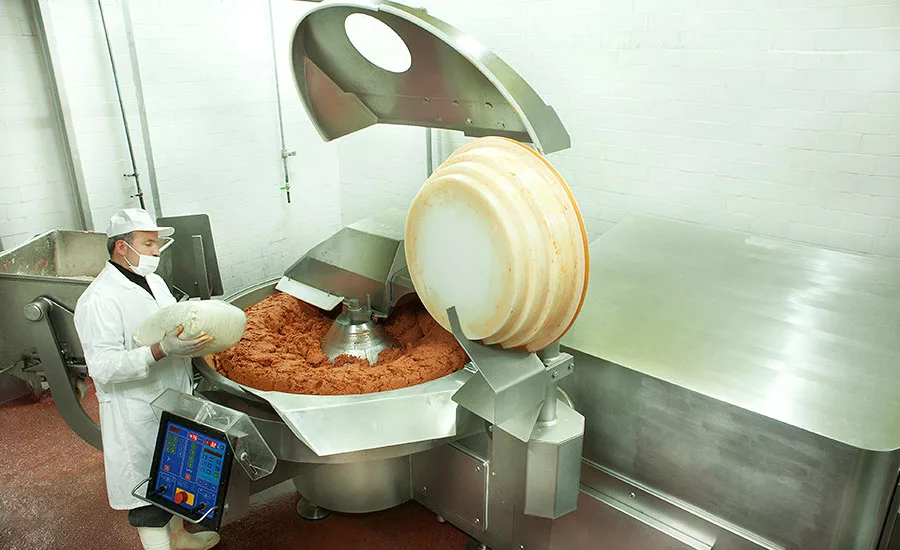
The likely culprits in most cases of foodborne illnesses are improper equipment maintenance and sanitation. Mixers and blenders are being upgraded for increased sanitary design and automation.
“The greatest advances in mixers and blenders today is in sanitary design,” says Jeff Sindelar, Ph.D., associate professor at the University of Wisconsin-Madison. “A lot of companies require their pieces be dissembled for cleaning purposes. Equipment with mixers and grinders need to be completely removed so harbor sites cannot form.”
Grinders, bowl choppers, mixers, etc., are all being designed for easy clean-up, with better moisture-resistant seals and fewer “nooks and crannies,” says Chris Fuller, consultant with Fuller Consulting LLC and director of Stockyards at US Foods, San Diego.
“The machines are fully washable, so you don’t have to spend more time protecting parts of the machine from hoses during washdown,” he says. “Also, they’re being designed with rounded spaces so that meat particles do not get trapped in corners and create a place for bacteria to hide.”
With rounded edges, everything is easily sprayed and washed down with minimal need for small brushes and specialty tools to get at those hard-to-reach places, Fuller says.
“For sausage making, this design is great because the meat, when mixed properly for sausage making, is finely chopped, sticky in texture and has a lot of fat,” Fuller says. “All of those features of the meat make it perfect to stick, smear and create a very difficult cleaning procedure if the machine is not designed with those nice, smooth, rounded edges.”
Creating custom processes
Plant systems are also increasingly automated.
“Mostly, the automation innovations are in the ability to create custom ‘recipes’ and allow operators to program machines to have just the right processes for the best outcome of the product,” says Fuller. “What I mean here is each feature of the machine can be programmed — length of mixing time, speed of mixing, when to have pauses and breaks in mixing, reversal of mixing direction, even the temperature of the chamber on some of the high-end machines.”
Mixers have been modified to allow for continuous fat measurements, accommodate product angles and utilize new designs for paddles, Sindelar says.
“A better alignment of equipment design benefits dry sausage, extended muscles and cooked sausage products, in particular,” Sindelar says.
Different paddle designs are available for specific blends of meat, and variable mixing speeds are also crucial depending on what type of mix you’re looking for, Fuller says.
In addition, machinery is increasingly integrated from the grinder to the final cooker.
“Many sausage making lines are fully integrated where the mix will be moved from one step of the process to the next automatically,” Fuller says. “The meat will be fed into the grinder, or chopper, and by the time it is seen again, it’s packaged and being fed into boxes, ready to ship; all of the mixing, extruding, filling of casings, twisting, cutting and packaging are done by machines.”
Eliminating system errors
Processors eliminate — or try to eliminate — errors such as overmixing or undermixing through strict quality control programs, Fuller says.
“Product is always being measured through different analytics to find room for improvement on product specs,” he says. “It’s all in an effort to create the most consistent, high-quality product they can within their constraints — whether that’s labor related, equipment related or cost of goods related.”
All of the data is collected over periods of time and management uses various methods to identify improvement areas.
“In my opinion, there is always room to improve, never perfect,” Fuller says. “But, you rely on your quality control team and customer feedback to find areas that need improvement.”
When an area for improvement is identified, processors will need to conduct a root-cause analysis.
“This analysis will help identify what is causing the defect, and then you can find a solution to correct that defect,” Fuller says. “Is it employee error? Is it the machine’s program that needs correcting? Is it the meat block you’re starting with that needs to be worked on improving? Maybe your recipe is not dialed in to where it needs to be.”
Using labor efficiently
Plant workers will always be a necessary part of production; however, the more automation used, the fewer labor hours needed.
“There will always be a need for people to monitor the production steps to make sure that the automatic machines are not doing something wrong — what if a machine is out of its program or what if there is a fault on one of the machines that is negatively affecting the product’s quality?” Fuller says.
Fresh eyes also are needed when inspecting or performing pre-operational checks on equipment.
“If the same person pre-ops the machines daily, they tend to unconsciously overlook things that they normally would not,” says Gregg Rentfrow, Ph.D., associate extension professor and meat science specialist at the University of Kentucky, in Lexington. “Much like the name of the gas station or strip mall that you pass daily and you don’t remember their names. We suggest that pre-op people rotate job assignments/areas to eliminate complacency and to give fresh eyes.”
As an operator, labor is always a challenge in a very competitive marketplace. “If I can automate a process, I likely will,” Fuller says. “Not only for expense reasons, but also because using machines tends to cut down on the element of human error and create a more consistent product.”
Today’s machines can create an authentic artisan-style product. “I’ve seen some really high-quality products on the marketplace that are made in very highly automated plants,” Fuller says. “However, when you compare those products to a truly handmade product from a small batch, the small batch may win out.”
Reducing footprints
Most processors are interested in decreasing their equipment footprint while improving the durability, cleanability and quality impact of their mixing/blending systems, Sindelar says.
“There’s always great interest and a high priority given to sanitation — by being able to tear the machine apart to clean the nooks and crannies — and still have the design perform the way it needs to in the plant,” Sindelar says.
As with anything, there is always room for improvement with mixing and blending machines.
“I’d like to see the future designs implement more cost-effective, smaller-sized equipment which would allow mid-scale operators the opportunity to produce products at the cost of the largest processors,” Fuller says. “Right now, the equipment is so expensive to invest in, very few small plants can afford to process products that are competitive with the large companies.” NP
Editor’s Note: In November, The National Provisioner hosted a Webinar detailing an innovative new way to clean blenders while significantly improving worker safety: http://bit.ly/NPBlenderCleaning
Looking for a reprint of this article?
From high-res PDFs to custom plaques, order your copy today!