Cover Story
Nicole Johnson-Hoffman: Sustainable Beef's global guide
Nicole Johnson-Hoffman begins her first term as president of the Global Roundtable for Sustainable Beef, placing an emphasis on inclusion of many diverse voices focused on continuous improvement of the global beef value chain.
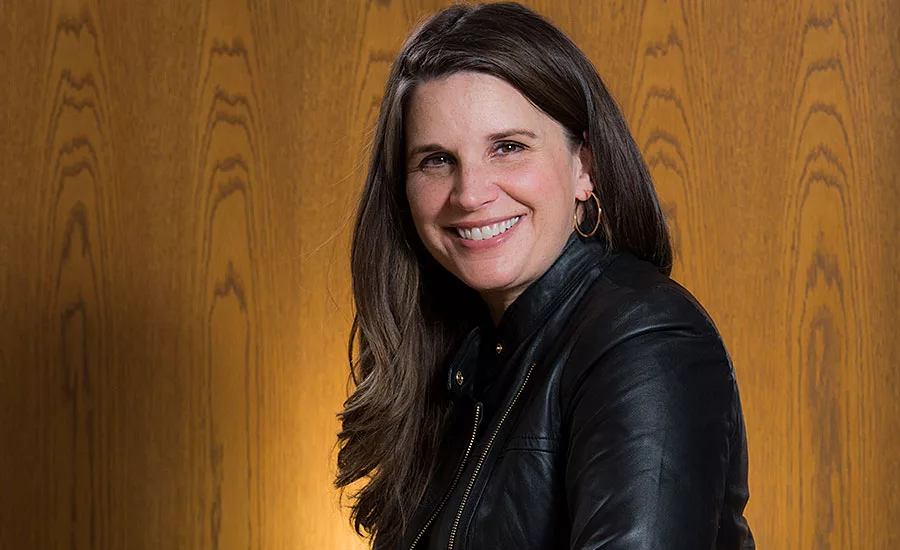
Nicole Johnson-Hoffman, president, Global Roundtable for Sustainable Beef, and chief sustainability offi cer and senior vice president for OSI Group.
PHOTO BY VITO PALMISANO
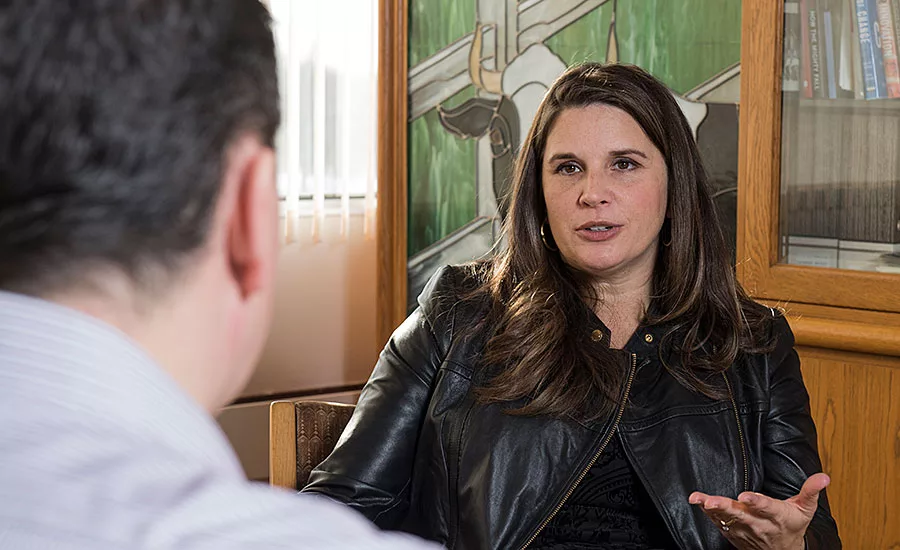
The National Provisioner's editor-in-chief, Andy Hanacek, discusses the GRSB and its mission with Johnson-Hoffman.
PHOTO BY VITO PALMISANO
On January 1, 2018, Nicole Johnson-Hoffman, senior vice president and chief sustainability officer for OSI Group, began her first term as president of the Global Roundtable for Sustainable Beef (GRSB). Andy Hanacek, editor-in-chief of The National Provisioner, sat down with Johnson-Hoffman to discuss the GRSB and its mission, as well as her goals for the group and its members moving forward. What follows is a portion of their conversation:
Hanacek: What has the GRSB accomplished of late, and how has it wrestled with the definition of sustainability, which is a very wide-reaching term?
Johnson-Hoffman: The first work of the Global Roundtable for Sustainable Beef was to define what it means to produce beef sustainably. Roundtable work welcomes all perspectives to the process and doesn’t give any one perspective power over the others. Some groups approach sustainability from the standpoint of mandating practices, but that is not what [GRSB] does — that makes it challenging but ultimately much more valid, and gives it a much greater buy-in for the industry participants. So that work took a while, but we came up with the “GRSB Principles and Criteria for Defining Global Sustainable Beef.”
Hanacek: What were some of the challenges that arose during this process of developing the principles and criteria?
Johnson-Hoffman: The biggest challenge was trying to decide just how detailed the principles should be, and just what kind of help we would provide beef-producing countries of the world. The principles and criteria are designed to be fairly general, in that, if you want to claim that you’re working on improving sustainable beef production, you must address each of the five principles. But the different beef-producing countries in the world will wrestle with specific issues and develop indicators for sustainability and a metric to measure their improvement on the issues of most concern to them. For example, if you’re producing beef in Brazil, you know you’re working on deforestation issues. But if you’re producing beef in Canada, deforestation is not your concern, it’s actually encroachment of forests and preservation of native grasslands. So they’re working on different issues, and that’s appropriate.
It was a really challenging process to try to marry together all the different perspectives and concerns of the participants. For me, that’s the value of the roundtable process: If you’re not having conflict and difficult conversations about practices or issues of concern to people, you’re not doing the job right and don’t have the right people in the room. We try to teach the group that conflict is the point, and that creating a forum for difficult conversations is the point for these roundtables.
Hanacek: With regard to the U.S. Roundtable specifically, what’s the issue of most concern right now?
Johnson-Hoffman: In the U.S., we wrestle with the sheer number of beef producers in the country and the diversity of their situations. You have really large operations with a couple hundred-thousand head of cattle, and what is appropriate for them will be very different than what’s appropriate for a family farm that maybe raises two or three animals at a time. Trying to manage that diversity is the challenge for the U.S.
The U.S. Roundtable designs its indicators in a way that everyone can participate. Maybe I’m running a really small farm only raising a couple head of cattle, so my level of participation might be at an entry level, but I have an opportunity to improve my sustainability outcomes. Through my relationship with the U.S. Roundtable, I can learn things that will help me do that, and I can share the improvements that I’m making if I choose.
Hanacek: OSI Group has been a member of the GRSB from Day One, before you came on board at the company, and you mentioned that it has supported your presidency of the GRSB from the beginning. What has been the evolution of OSI Group as a member of GRSB?
Johnson-Hoffman: Our customers are really concerned about their own sustainability impact as well as the impact of their supply chain, so OSI Group has always been a partner to those customers in our sustainability work. We’re really taking hold of the issue, taking a stronger stand on sustainability in particular. Just last summer, [management] asked if I would take the chief sustainability officer role for OSI Group — a new role for our company — to help divine a sustainability strategy for our organization and create a team around it. Today, we’re in the process of developing our goals and our metrics so that we’ll be able to demonstrate and share our progress with interested people in the future. That’s been a really great evolution for OSI.
OSI has been active in these beef roundtables from the beginning. I’m thankful to have the support of OSI’s leadership [as president of GRSB]. The OSI team really believes in the sustainability work that’s going on in the beef industry, and in agriculture in general. We believe in it as a company, and I’ve been thankful for the support of our leaders.
Hanacek: What are some of the things you’re hoping to bring to the roundtable as president? Are there things you want to focus on?
Johnson-Hoffman: We’re supporting the formation of roundtables around the world. We’re seeing a lot of really interesting activity right now in Latin America, South America, and also Africa, where beef production is really important to individual farmers and the economies, and where the sustainability impacts are significant. We’re helping to make sure these roundtables are created so that they can wrestle with specific issues and get solutions that work in those parts of the world for the participants in that value chain. My next two years will be spent supporting the formation of those roundtables, and helping them get the information they need for effective conversations that will drive continuous improvement.
As I said earlier, the issues are really different country to country or region to region. So you can’t lift the details, the indicators or the metrics used to demonstrate progress from one roundtable to use in another, but you absolutely can use them as examples that will get a regional roundtable thinking on its own. Another goal for the next two years is to ensure that we are supporting and enabling the work of the beef-producing regions and countries to address their sustainability challenges.
In two years when you come back to me and ask, “How did we do, Nicole?” I hope to say we’ve improved our connections to the regional roundtables and their important work, and we’ve enabled their work. This Global Roundtable is really about empowering and enabling the people who are doing the hard work of continuous improvement in beef sustainability around the world.
Hanacek: How do membership goals factor into your role as president of the GRSB? Is growing the membership base a goal of yours as the president?
Johnson-Hoffman: The Global Roundtable’s membership has been pretty steady, which we’re pleased with. For me, it’s important that the membership reflects the diversity of beef-producing parts of the world and their perspectives. Diversity is more important than quantity. We need to make sure that we are not so heavily weighted in favor of North America, for example. We have a lot of North American voices on the Global Roundtable for Sustainable Beef. While we are working really hard to ensure we have voices from other parts of the world, we also need to make sure it’s not only industry participants, so this doesn’t become some kind of trade association, because that’s not the purpose for which it was formed — it was formed to wrestle with tough issues and deal with conflict. Part of my job is making sure we always have an NGO perspective, or a retailer perspective, and that we have enough of those voices to be heard.
Hanacek: How does GRSB connect this all to consumers? Can GRSB use its resources and principles to help consumers understand what the beef industry is doing?
Johnson-Hoffman: How to use the work of the roundtable really differs country to country. For example, the Canadian Roundtable decided it will create a certification program to communicate [beef] produced in Canada under a sustainable beef program, which I think is great and I really celebrate. In other parts of the world, however, that’s not a part of the work of the roundtable.
Hanacek: What about as a “defender of the industry,” an expert source that gives the scientific side of the story — is there a mechanism for that now? If not, is there a plan to have a mechanism? Or is that not really what the roundtable is designed to do?
Johnson-Hoffman: The roundtable is designed to allow for communication on some of these challenging issues, so we have communication teams to respond to questions or participate in conferences, and discuss these kinds of issues and share information. The roundtable is not an industry body, but it is a body for sharing of information, and in particular has a commitment to a scientific approach to sustainability that has a valuable place in this discussion.
Hanacek: You mentioned earlier the goal to maintain membership balance. Is there any particular sector right now from which you feel like the voices need to be a little bit more numerous or louder?
Johnson-Hoffman: We’ve had a few leading retailers who have been involved in the roundtables from the start, but we could use more. Retailers are challenged in this environment, and we know that it’s really difficult for them to find the resources and time to participate, but they bring a really valuable connection to the consumer that we need.
Hanacek: You also mentioned earlier that, while other groups may be developing principles and guidelines that revolve more around qualifications and requirements, that is not the mission of the GRSB. Can you expand on what that means for the members?
Johnson-Hoffman: One thing that will not happen, is that the Global Roundtable will not be dictating practices to beef producers, retailers or packer-processors in various parts of the world. That’s not the purpose of the Global Roundtable; the Global Roundtable’s purpose is to enable continuous improvement in the U.S. or in Latin America, or in Europe. And then the U.S. Roundtable, for example, takes that and makes important decisions about what the U.S. is going to work on, what are its big issues?
We’ve then designed the U.S. Roundtable’s work to welcome anybody who participates in the beef value chain no matter how large or how small they might be, so long as they want to work on continuous improvement on sustainability. It’s important to me that the largest and smallest, and the least and most sophisticated of all the beef value-chain participants all have a place and a voice in this process, because that’s really the only way we’re going to improve the sustainability outcomes of beef production in this country. NP
Looking for a reprint of this article?
From high-res PDFs to custom plaques, order your copy today!



