Tech | Processing
Pandemic era worker safety
Spaced out, decked out and safe
“We may never return to normal” is a phrase noted in newspaper articles, echoed by TV anchors and professed by self-proclaimed experts in the era of COVID-19. Certainly, the food and agriculture industries have not been spared the social and economic impacts of this pandemic.
But this crisis does give one pause to consider areas of processes that otherwise may not have been prioritized. Much of the focus within our industry has been on the physical design of facilities and equipment. Results of this continual effort have increased production efficiencies, improved workers’ health and safety and ensured the food safety and the integrity of consumer products. In our effort to deliver wholesome, healthy, and cost-effective products to consumers, some areas have drawn less attention. Increased focus will need to be placed on the efficiencies of locker rooms, break rooms and proper utilization of PPE.
The food industry, and more specifically the meat industry, has identified issues with commingling work areas decades ago. As leaders in social distancing, meat facilities recognized the need to keep certain processes separate and have dedicated locker rooms and break rooms. Harvest areas, further processing and cooking areas have been separated with varying degrees of intervention. Physical interventions not only provide specific welfare areas but also preventive measures to ensure limited personnel traffic between areas. Entrances and exits from various processing areas are provided with boot washes, hand washes and sanitizers and color-specific garments.
My passion has always been efficiencies. Designing facilities and production processes has been engaging, but the most difficult part of the design is factoring in the personnel. Multiple models are used to plan and evaluate the movement of personnel from the parking lots, through the locker rooms, on and off the production floors and in and out of break rooms. Multiply those events several times a day and by several shifts. Finally, add social distancing to the model and we now face our new normal. Do not be concerned, as the food industry will lead this effort although we will likely not be credited for the design.
Locker rooms
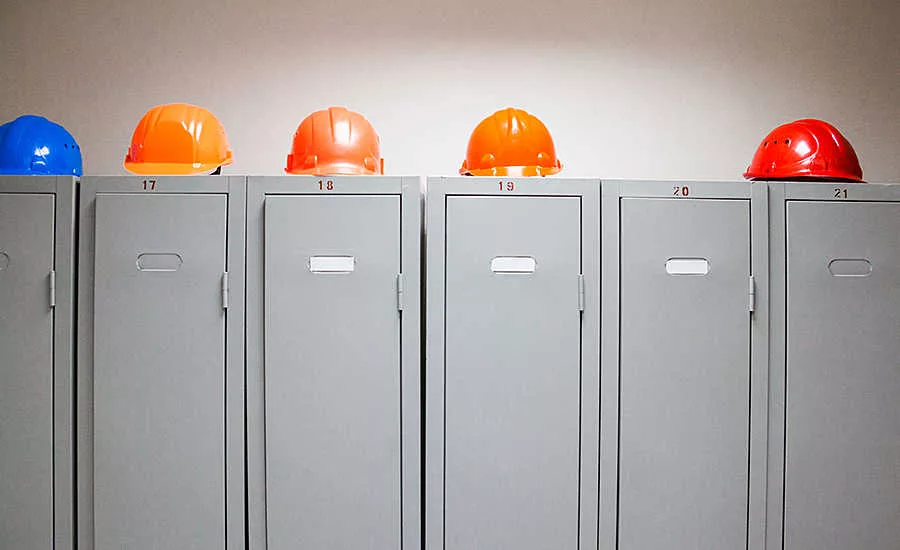
The term locker room may cause you to think of a PE class from school or the local gym or health club. Technically it is a room full of lockers. But for personnel at a food facility, its intent is to provide a safe area in which to secure personal property, company equipment and an area to change in and out of work clothes. These rooms typically have separate welfare areas for bathrooms and hand washing. Unfortunately, the locker rooms can turn into areas for social gatherings. It is incumbent on each individual to adjust their social norms, efficiently change clothes and minimize excessive lingering. It would be impossible to design a locker room that places a locker every 6 feet.
But the mitigation for constraints of locker rooms is manageable. First, the separation of production areas has already provided a relief valve by not having an entire shift utilize one area. Secondly, staggered start times based on paced production lines, minimize the overall occupancy of a locker room at any one point in time. Finally, personnel can assist with efficient entrance and exit of the area.
Break rooms
Some larger facilities have a full cafeteria and provide hot meals for personnel. Other facilities provide ample vending machines and microwaves for a variety of choices to buy food and drink items as well as an opportunity to heat up food brought from home. Again, a challenge to social distancing is waiting in line for either the hot meal or microwaves. And it seems no matter how many microwaves a break room has, there is never enough to satisfy all personnel. I think social distancing in break rooms started about a decade ago.
Those who have been in the industry for decades know the lunch or dinner breaks had been social times. A break room may have had a TV mounted to the wall and different programs playing. The smart phone phenomenon changed the interaction of personnel in break rooms and established a new normal long ago. I recall my most recent project was at a facility at which no one was talking to each other at the lunch tables. Nearly everyone was using their devices to text, watch a program or surf the internet. A positive aspect is now we can seek to expand the physical areas between individuals at least when they are eating at the tables.
Personal protective equipment (PPE)
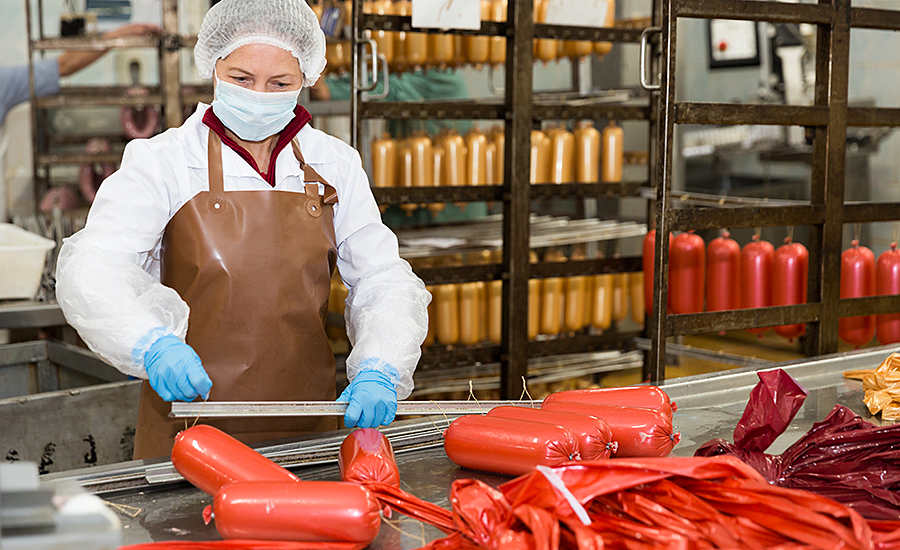
I had to laugh over the last several weeks listening to news anchors talk about PPE. It was as if it were the latest, greatest invention. Probably more laughable was watching some of these people trying to put on the equipment or wear it properly. This illustrates the challenge facilities have and will face regarding the proper wearing of PPE.
“Most of today’s food-production facilities have great practices in place,” says Ruth Bitterman, director of quality assurance – North America Swisse. “Where many are lacking is in the monitoring of the hygiene practices. Additionally, they are facing a new ask, (to) keep them separated. With the proper training, guidance and monitoring, the food-production facilities are capable of stepping up on the worker safety challenges while maintaining current (good manufacturing practices) GMP’s for food safety.”
Training personnel is a continual process. By now, after all the local, state and federal announcements, we should all know to wash our hands for 20 seconds with warm water and soap. These public information announcements almost seem like a no brainer to any personnel in our industry. Signage is clearly marked on production doors, and the queue for the boot wash, hand wash and sanitizer is quite efficient in many facilities. “Make certain that the hand-wash stations are properly equipped with soap, warm water, paper towels, hand sanitizers and trash receptacles,” Bitterman says.
Conclusion
There are non-production areas that can be addressed and tweaked to create or adapt to the new normal. Overall, food and meat facilities have been improving on personnel and food safety for decades. Social distancing to six feet will be a challenge on production floors, but new technologies and processes are minimizing the interactive distance between personnel.
Adapting to the new normal in welfare areas will need to be a combined effort of physical layouts, staggered access times to prevent overlaps and modified personal activities. Others can look to the significant amount of expertise within the food and agricultural industries to help develop their plan. NP
Looking for a reprint of this article?
From high-res PDFs to custom plaques, order your copy today!