Provisioner logo
Provisioner logo
search
cart
facebook twitter linkedin youtube
  • Sign In
  • Create Account
  • Sign Out
  • My Account
Provisioner logo
Provisioner logo
  • NEWS
    • Industry News
    • Supplier News
    • Case Studies
    • Recalls
    • Regulations
    • New Consumer Products
  • EXCLUSIVES
    • Newsletters
    • Source Book
    • Sponsored Insights
    • Events
    • Webinars
    • Classifieds
    • White Papers
    • Provisioner Store
    • Market Research
  • MEAT PROCESSING
    • SUSTAINABILITY
    • Processing
    • Packaging
    • Ingredients
    • Formulation
    • Food Safety
    • Special Reports
    • Commentary
  • PROFILES
    • Processor Profiles
    • Processor of the Year
    • Top 100 Processors
  • MEDIA
    • Videos
    • Podcasts
  • DIRECTORY
  • MIHOF
  • INDEPENDENT PROCESSOR
  • EMAG
    • eMagazine
    • ARCHIVE ISSUES
    • Contact
    • Advertise
  • JOIN!
Meat and Poultry ProcessingBeef

Tech | Meat Science

Spray chilling beef sides can hasten temperature decline during postmortem chilling
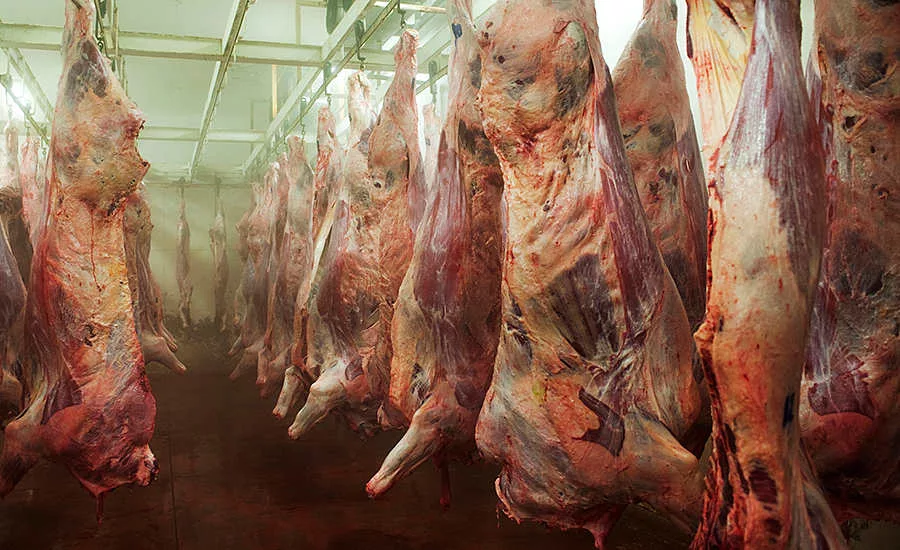
beef sides
January 20, 2021

By Lydia M. Hite, Amanda D. Blair, Keith R. Underwood, Judson K. Grubbs, Department of Animal Science, South Dakota State University, Brookings, S.D.

Depending on the species, processing facilities implement chilling methods that include air or spray chilling of carcasses.

Air chilling involves the movement of air around the carcasses, averaging about 39° F.

Spray chilling includes similar air movement throughout the cooler with the addition of a cooled water being sprayed over the carcass during the chilling cycle. The use of spray chilling historically has been to improve yields by reducing moisture loss that occurs during chilling.

In 1991, the first National Beef Quality Audit was conducted to provide baseline data for the beef industry and has been done approximately every five years since. Beef hot-carcass weights have increased from an average of 760 pounds in 1991 to an average of 859 pounds in 2019.  So, the chilling systems initially built in the 1980s were designed to chill carcasses 100 pounds lighter than the average beef hot-carcass weight of today. Heavier beef carcasses may require a longer chilling period because of biochemical heat generation in the carcass. Inadequately chilling a beef carcass can result in food safety and beef quality issues that will negatively impact consumers’ eating experience.

Evidence also suggests that spray chilling decreases the temperature in carcasses more quickly than air chilling. The majority of small processors and university meat laboratories use air chilling systems to chill carcasses. To better understand spray-chilling systems utilized by large processing facilities, the objective of this study was to evaluate the effect of a chilling system on the temperature decline in the chuck, loin and round of beef carcasses. Ten cattle were slaughtered, and sides of the carcass were assigned to one of two chilling system treatments: air chilling (AIR) or spray chilling (SPRY). The AIR treatment consisted of sides being chilled by air movement only. The air temperature of the chilling cooler was on average 38° F with air movement about 4,500 yards per minute. The SPRY treatment included similar air movement within the cooler with the addition of a timed spraying of cooled water at 39° F. Water was sprayed over the beef sides for 80 seconds and repeated every 32 minutes for 24 hours at 60 – 65 psi. Prior to entering the chilling cooler, temperature data loggers were placed into the chuck, loin and round of each carcass at different depths and temperature was recorded every 30 minutes for 24 hours. In the chuck, data loggers were placed at 4, 6 and 8 inches deep into the serratus ventralis. Data loggers were placed 2, 4, 6 and 8 inches deep into the semimembranosus of the round. Due to a smaller size of the loin primal compared to the chuck or round, only one logger was placed, 4 inches deep, into the longissimus lumborum.

The beef sides exposed to the SPRY treatment were cooler than AIR-chilled sides in the round, loin and chuck. In the chuck, the sides exposed to the SPRY treatment had lower temperatures recorded by the loggers placed at 4 and 6 inches deep compared with the AIR sides. At time 0, when the beef sides were entering the chilling cooler, the 2-inch-deep data logger in the round recorded an average temperature of 86° F. The average of 86° F for the 2-inch-deep data logger in the round was lower in temperature compared to the 4-, 6- and 8-inches-deep data loggers that had temperatures of 102, 104 and 102° F respectively at time 0. At 24 hours into the chilling period, as depth increased in the round, temperature also increased as temperatures recorded by each data logger differed.

Tissues located closer to the surface reached lower temperatures and chilled faster than deep tissue in both the AIR and SPRY treatments. Internal temperature decline differed between depths for AIR and SPRY treatments in all primals. The use of spray-chilling systems on beef sides allowed for more rapid chilling compared with air-chilled sides. The air-chilled sides had higher temperatures than the spray-chilled sides at all depths. Higher temperatures in beef sides can result in increased protein denaturation postmortem. Protein denaturation can result in product quality issues through poor color and decrease in tenderness formation. The use of a spray-chilling system on beef sides can decrease protein denaturation and increase tenderness development postmortem. NP

KEYWORDS: carcass yield chilling moisture spray applications

Share This Story

Looking for a reprint of this article?
From high-res PDFs to custom plaques, order your copy today!


Recommended Content

JOIN TODAY
to unlock your recommendations.

Already have an account? Sign In

  • Double Charburger

    Premiumization drives burger category

    Shoppers seek out premium meat offerings to fulfill...
    Meat and Poultry Industry News
    By: Sammy Bredar
  • JJS Adult Pekin duck

    Poultry Report 2025: Convenience propels poultry at retail

    Despite continued economic pressures, the poultry...
    Meat and Poultry Industry News
    By: Sammy Bredar
You must login or register in order to post a comment.

Report Abusive Comment

Manage My Account
  • eMagazine Subscriptions
  • Manage My Preferences
  • Newsletters
  • Online Registration
  • Subscription Customer Service
  • Connect with The National Provisioner

More Videos

Sponsored Content

Sponsored Content is a special paid section where industry companies provide high quality, objective, non-commercial content around topics of interest to the The National Provisioner audience. All Sponsored Content is supplied by the advertising company and any opinions expressed in this article are those of the author and not necessarily reflect the views of The National Provisioner or its parent company, BNP Media. Interested in participating in our Sponsored Content section? Contact your local rep!

close
  • A smiling man carrying a grocery basket is reaching down to pick up a package of meat in a grocery store.
    Sponsored byPIC

    The Green Light: New Data Shows 12-to-1 Support for Pork from PRRS-Resistant Pigs

  • Close up of a grocery cart full of groceries, a cropped image of a couple pushing the cart and a blurred background of the vegetable aisle.
    Sponsored byPIC

    New Market Research Finds Consumers in Eight Key Pork Markets Are Likely to Purchase Pork from Gene-Edited Pigs

  • Close up of a young pig with a blurred background.
    Sponsored byPIC

    New Research Forecasts Significant Economic and Market Impacts with PRRS-Resistant Pig Adoption

Popular Stories

JBS USA logo

JBS USA closing pair of processing facilities

Various new Primal snack sticks on a table amongst pencils, apples, a pair of glasses, lunch bags and a water bottle.

Protein demand drives snacking occasions

Several cuts of beef, pork and chicken on a wooden board, cast iron pan and salt.

Validated thermal lethality data and a new tool for ensuring safety of RTE meats

2026 Top 100 Meat & Poultry Processors Report

Events

January 1, 2030

Webinar Sponsorship Information

For webinar sponsorship information, visit www.bnpevents.com/webinars or email webinars@bnpmedia.com.

View All Submit An Event

Products

Food Crime: An Introduction to Deviance in the Food Industry

Food Crime: An Introduction to Deviance in the Food Industry

See More Products
From Fresh to Frozen in 3 Minutes Flat: Unlocking the Secrets to Temperature Control Webinar Sponsored by Air Products

Related Articles

  • Cryoline RC

    Linde showcases cryogenic freezing and chilling systems at EATS 2025

    See More
  • frozen beef carcasses

    Freezing and chilling technologies: Get sold on the cold

    See More
  • Frozen Meat in Ice Block

    Freezing, chilling become hot topics in meat and poultry processing

    See More

Related Products

See More Products
  • meat.jpg

    Non-Thermal Processing Technologies for the Meat, Fish, and Poultry Industries

  • fermented.jpg

    Handbook of Fermented Meat and Poultry, 2nd Edition

  • The 10 Principles of Food Industry Sustainability

See More Products

Events

View AllSubmit An Event
  • June 11, 2026

    From Fresh to Frozen in 3 Minutes Flat: Unlocking the Secrets to Temperature Control

    On Demand Join Tony Vacaro, Foods Industry Manager, and Emile Klein, Foods Market Strategy Manager at Air Products and Chemicals, Inc. , as they tackle key questions surrounding heat removal in food processing. 
View AllSubmit An Event

Related Directories

  • Linde

    Linde is a leading provider of cryogenic and industrial gases for the food processing industry. Linde's cryogenic freezing and chilling systems provide precise temperature control, atmosphere application expertise and technical service support to processors. Our systems comply with USDA sanitation guidelines. The company's offerings include the CRYOLINE UPT ultra performance tunnel freezer for improved productivity, the CRYOLINE CVT cryovantage tunnel for economical processing and the ACCU-CHILL LXC cryogen injection valve system for optimal heat removal while mixing or blending.
×

Stay ahead of the curve. Unlock a dose of cutting-edge insights.

Receive our premium content directly to your inbox.

SIGN-UP TODAY
  • RESOURCES
    • Advertise
    • Contact Us
    • Directories
    • Store
    • Want More
  • SIGN UP TODAY
    • Create Account
    • eMagazine
    • Newsletter
    • Customer Service
    • Manage Preferences
  • SERVICES
    • Marketing Services
    • Reprints
    • Market Research
    • List Rental
    • Survey/Respondent Access
  • STAY CONNECTED
    • LinkedIn
    • Facebook
    • YouTube
    • X (Twitter)
  • PRIVACY
    • PRIVACY POLICY
    • TERMS & CONDITIONS
    • DO NOT SELL MY PERSONAL INFORMATION
    • PRIVACY REQUEST
    • ACCESSIBILITY

Copyright ©2026. All Rights Reserved BNP Media, Inc. and BNP Media II, LLC.

Design, CMS, Hosting & Web Development :: ePublishing