How to meet peak food product demand with efficient pallet flow rack
Dynamic racking speeds food product loading and unloading, while minimizing labor and maximizing storage.
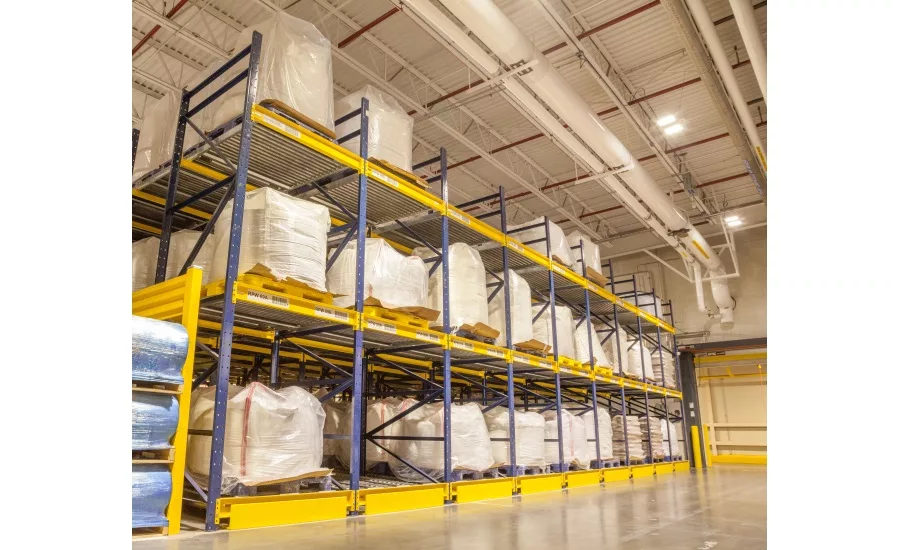
Food and beverage processors, retailers, and the warehouses and distributors that support them, know that empty shelves lead to lost revenue. But, in any period of peak demand—whether in a crisis like a pandemic, hurricane or other disaster; or a holiday season, etc.—food and beverage industry shelves and refrigerated cases can become notoriously empty when logistical bottlenecks occur in the supply chain.
When food and beverage warehouses and distributors are driven to get more product to stores and consumers, having a more effective racking system that organizes the product and provides quick access for loading and unloading is essential.
In this respect, a pallet flow rack system is exceptional and can be a key tool in helping logistics professionals quickly and reliably meet peak demand whenever first-in, first-out (FIFO) product retrieval is required, while minimizing labor and forklift travel. On top of this, the racking can store up to 100 percent more product than selective racking and reduce aisle space by 75 percent.
Simply defined, this type of dynamic racking system is designed so that when the pallet in front is removed by a forklift, the pallets behind gently “flow” forward to replace it. Inclined tracks, rollers, and brakes—with an assist from gravity—are used to accomplish this task. New inventory is then loaded at the back end of the rack, facilitating FIFO product rotation, which is particularly valuable for items with expiration dates.
Flow storage is useful in many applications including ambient, cooler, and freezer environments, raw materials receiving and storage, work-in-process, buffer storage, finished goods and cross docking. It is also often successfully used in pick module and automatic storage and retrieval systems (AS/RS).
Expedite fulfillment, minimize labor
In terms of improving shipping logistics, there are significant benefits to using a flow system. Pallet flow rack can drastically reduce the labor required to pick pallets, because a forklift is only needed for initial loading of the pallets as well as final unloading. With static racks, forklifts must travel further down aisles and often must spend time rearranging inventory to access the correct items.
However, when tailoring a pallet flow system to an application, it is necessary to plan for efficiency.
“Forklift travel distance can be minimized with proper pallet flow planning,” says Ryan Wachsmuth, Dynamic Storage Sales Manager at Steel King Industries, a major designer and manufacturer of warehouse material handling, storage, and safety products.
He explains, “You don’t have to travel hundreds of feet to pick a pallet. If you install pallet flow rack in the ideal location, you may only have to travel twenty feet to pick a pallet. When you return, the next pallet is waiting. This minimizes labor as well as speeds loading and unloading.”
Wachsmuth says to let gravity do the work with pallet flow by designing pallet unloading as close to the truck loading dock as feasible.
When a large number of pallets with a single product SKU are routinely loaded into trucks, locating the pallet flow rack near the loading dock minimizes the distance that forklifts travel, which speeds material handling. Even pallets with varied SKUs that are being shipped to the same location can be located near each other to further speed truck loading.
According to Wachsmuth, a similar approach applies to pallet flow storage depth, which should be designed and grouped to logistically ease loading and unloading.
“Just because you can design pallet flow storage 20 pallets deep, doesn’t mean you should,” says Wachsmuth. “Consider what works best. If you can only load 10 pallets at a time in a truck, it may be better to design the system 10 pallets deep but several levels high. After unloading one group of 10 pallets, go to the level above to unload the next truckload of pallets.”
Enhance storage density
Since pallet flow design eliminates aisles and fills the space with additional pallets, it provides many times more storage than selective rack. Better space utilization also minimizes the need to light, heat and cool the facility, further decreasing expenses.
In this type of “dynamic” racking approach, goods can be stored 3, 10, even 20 pallets deep and on multiple levels. This eliminates the need for wide aisles between every row of traditional “static” rack required for forklift access and maneuverability.
By storing more palletized goods in less space, facility managers can dramatically increase the amount of inventory in a specific warehouse footprint or, on the flip side, reduce the amount of space required for new warehouse construction.
“Compared to traditional fixed racking, a high-density pallet flow system can essentially cut the required square footage for a warehouse in half,” says Wachsmuth. “The savings can be significant in terms of reduced property and building costs.”
Plan for the future
Because budget and inventory requirements change at both the facility and corporate level, it is wise to select a flow system with a design that can grow as business needs evolve.
“With flow systems, bays can be added to groups and the bay widths and depths can be easily expanded to hold additional inventory, which allows you to buy for your current needs and expand later,” says Wachsmuth.
To be even more accommodating of future needs, such as higher or heavier pallets, Wachsmuth also advises selecting a flow system that provides vertically adjustable beams and ample strength.
“You can always re-profile your flow rack to handle higher, heavier pallets if you design for it,” says Wachsmuth. “Let’s say you use a 48” high pallet today, but decide later that a 60” high pallet is more efficient because you want to add two more levels of ice cream to each pallet. A system with vertically adjustable beams would allow you to do it, provided you have the rack strength.”
To improve pallet flow at any time, entry guides can be installed in flow lanes to allow more forgiving pallet placement. Along with this, heavy gauge pallet flow rollers can be placed in the entry and exit flow lanes to better withstand pallet impact.
If a warehouse facility is heavily used, forklift drivers are more prone to impact racking. Because a flow system’s entry uprights tend to receive the most damage from forklift impact, Wachsmuth advises working with a vendor that offers a range of reinforced upright options.
Guardrail, rack and column protectors, as well as weld bumpers (angles welded to the aisle side beams), can also help to protect the pallet flow rack system from forklift impact. If impact occurs, these safety items can be quickly replaced without having to close off lanes or bays. Facilities should also consider holding extra rack inventory, such as uprights and beams, so any rack damage can be repaired immediately. This keeps production going without waiting for a supplier to ship replacement parts.
The bottom line is that a pallet flow system can help retailers and the logistical supply chain keep up with surges in food and beverage product demand today and in the future, while enhancing the efficiency, productivity, and profitability of the operation.
For more info on pallet flow storage systems and video of flow rack in action, contact Steel King at 2700 Chamber St., Stevens Point, WI 54481; call 800-826-0203; email: dheemstra@steelking.com or visit the website www.steelking.com.
Looking for a reprint of this article?
From high-res PDFs to custom plaques, order your copy today!