Provisioner logo
Provisioner logo
search
cart
facebook twitter linkedin youtube
  • Sign In
  • Create Account
  • Sign Out
  • My Account
Provisioner logo
Provisioner logo
  • NEWS
    • Industry News
    • Supplier News
    • Case Studies
    • Recalls
    • Regulations
    • New Consumer Products
  • EXCLUSIVES
    • Newsletters
    • Source Book
    • Sponsored Insights
    • Events
    • Webinars
    • Classifieds
    • White Papers
    • Provisioner Store
    • Market Research
  • MEAT PROCESSING
    • SUSTAINABILITY
    • Processing
    • Packaging
    • Ingredients
    • Formulation
    • Food Safety
    • Special Reports
    • Commentary
  • PROFILES
    • Processor Profiles
    • Processor of the Year
    • Top 100 Processors
  • MEDIA
    • Videos
    • Podcasts
  • DIRECTORY
  • MIHOF
  • INDEPENDENT PROCESSOR
  • EMAG
    • eMagazine
    • ARCHIVE ISSUES
    • Contact
    • Advertise
  • JOIN!
IngredientsBeef

Surface redness declines with the aerobic repackaging of dark-cutting steaks
By M. L. Denzer, G. G. Mafi, D. L. VanOverbeke, R. Ramanathan
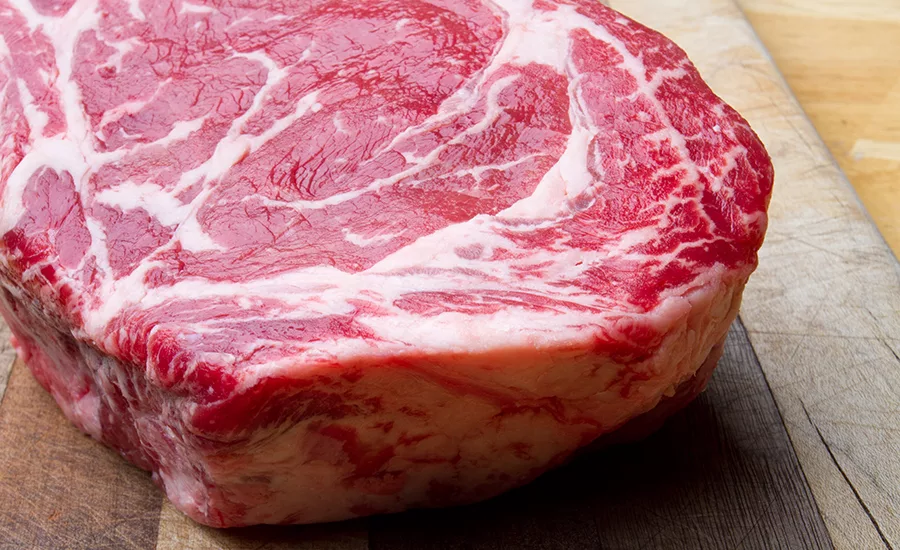
Thick Bone-In Rib Eye Steak on a cutting board
Getty Images
April 24, 2022

Nitrite-embedded packaging utilizes nitrite embedded in the film (Siegel, 2011). When nitrite comes in contact with meat, a series of biochemical reactions take place, and finally, a bright red pigment called nitric oxide myoglobin is formed (Siegel, 2011). A bright red appearance is preferred by consumers at retail (Carpenter, Cornforth, & Whittier, 2001). Dark-cutting beef has a darker appearance, limiting its use in retail settings based on consumer perception. Nitric oxide myoglobin formation in nitrite-embedded packaging has been shown to improve the redness of dark-cutting beef, and the addition of rosemary to nitrite-embedded packaging further improved the appearance of dark-cutting beef compared to polyvinyl chloride (PVC) film (Ramanathan et al., 2018). There is limited knowledge on the effects of repackaging dark-cutting steaks into PVC from the nitrite-embedded packaging system.  

Dark-cutting (pH = 6.21-6.77) and USDA Low Choice loins (pH = 5.53-5.59) were obtained from a commercial processing facility (Creekstone Farms, Arkansas City, Kan.) and transported back to Oklahoma State University on ice. Dark-cutting loins were enhanced with rosemary (0.1%) and glucono delta lactone (0.5%). Steaks were sliced from the enhanced and nonenhanced dark-cutting sections. Nitrite-embedded packaging was used for the enhanced dark-cutting steaks, and USDA Low Choice and nonenhanced dark-cutting steaks were packaged in vacuum packaging. After a dark storage of 3, 6 or 9 days, the steaks were removed from their packaging and placed in PVC (15,500-16,275 cm3 O2/m2/24 h at 23°C, E-Z Wrap Crystal Clear Polyvinyl Chloride Wrapping Film; Koch Supplies; Kansas City, Mo.) for 6 days of retail display. The HunterLab spectrophotometer was used to measure retail color every 12 hours along with six trained panelists evaluating surface discoloration [1 = no discoloration (0%), 7 = extensive discoloration (81-100%)]. The nitric oxide myoglobin content during retail display was determined using the reflectance from the HunterLab spectrophotometer. Chroma was determined torepresent the red intensity of the surface of the steak (AMSA, 2012).

Upon repackaging, the enhanced dark-cutting steaks had similar redness and red intensity (P > 0.05) as the USDA Choice steaks at hour 0 of retail display. The repackaged enhanced dark-cutting steaks decreased (P < 0.05) in redness and red intensity within 12 hours of retail display compared to the USDA Choice steaks. Nitric oxide myoglobin content loss paralleled with the decrease in redness in retail display. Enhanced dark-cutting steaks were more (P < 0.05) discolored than the USDA Choice and nonenhanced dark-cutting steaks at 12 hours of display for all dark storage periods. Additionally, by the end of display, the enhanced dark-cutting steaks had greater (P < 0.05) discoloration than USDA Choice and nonenhanced dark-cutting steaks for steaks stored in dark storage 3 or 6 days.

In conclusion, the enhancement of glucono delta-lactone and nitrite-embedded packaging resulted in the improvement of the color of dark-cutting steaks. The process of repackaging the enhanced dark-cutting steaks in PVC resulted in greater surface discoloration and loss of redness. Therefore, we concluded that the anaerobic nitrite-embedded packaging system improves redness of dark-cutting steaks. However, repackaging in traditional PVC is not an option for color stability.

References

AMSA (2012). Meat color measurement guidelines. Champaign, IL, USA: American Meat Science Association.

Carpenter, C. E., Cornforth, D. P., & Whittier, D. (2001). Consumer preferences for beef color and packaging did not affect eating satisfaction. Meat Science, 57(4), 359-363. doi: https://doi.org/10.1016/S0309-1740(00)00111-X

Ramanathan, R., Mitacek, R. M., Billups, S. D., Jadeja, R., Pfeiffer, M. M., Mafi, G. G., & VanOverbeke, D. L. (2018). Novel nitrite-embedded packaging improves surface redness of dark-cutting longissimus steaks. Translational Animal Science, 2(2), 135-143. doi: 10.1093/tas/txy006

Siegel, D. (2011). An update on packaging fresh meat with nitrite-containing film. 64th Reciprocal Meat Conference, June 22. Kansas State University (Presentation).

For more information:

Repackaging Nitrite-Embedded Dark-Cutting Steak in Aerobic Polyvinyl Chloride Film Decreases Surface Redness

Authors: Morgan L. Denzer, Gretchen G. Mafi, Deborah L. VanOverebeke, Ranjith Ramanathan. Meat and Muscle Biology 5(1). p.1-12. Doi: https://www.iastatedigitalpress.com/mmb/article/id/12944/


KEYWORDS: barbecue consumer trends formulation strategies

Share This Story

Looking for a reprint of this article?
From high-res PDFs to custom plaques, order your copy today!


M.L Denzer, Corresponding Author 

Department of Animal and Food Sciences, Oklahoma State University, Stillwater, OK 74078

G.G. Mafi is with the Department of Animal and Food Sciences at Oklahoma State University, Stillwater.
D.L. VanOverbeke is with the Department of Animal and Food Sciences at Oklahoma State University, Stillwater.

R. Ramanathan is from the Department of Animal and Food Sciences at Oklahoma State University, Stillwater. Contact Ramanathan at ranjith.ramanathan@okstate.edu or 405-744-9260.

Recommended Content

JOIN TODAY
to unlock your recommendations.

Already have an account? Sign In

  • Double Charburger

    Premiumization drives burger category

    Shoppers seek out premium meat offerings to fulfill...
    Beef
    By: Sammy Bredar
  • JJS Adult Pekin duck

    Poultry Report 2025: Convenience propels poultry at retail

    Despite continued economic pressures, the poultry...
    Chicken
    By: Sammy Bredar
You must login or register in order to post a comment.

Report Abusive Comment

Manage My Account
  • eMagazine Subscriptions
  • Manage My Preferences
  • Newsletters
  • Online Registration
  • Subscription Customer Service
  • Connect with The National Provisioner

More Videos

Sponsored Content

Sponsored Content is a special paid section where industry companies provide high quality, objective, non-commercial content around topics of interest to the The National Provisioner audience. All Sponsored Content is supplied by the advertising company and any opinions expressed in this article are those of the author and not necessarily reflect the views of The National Provisioner or its parent company, BNP Media. Interested in participating in our Sponsored Content section? Contact your local rep!

close
  • A smiling man carrying a grocery basket is reaching down to pick up a package of meat in a grocery store.
    Sponsored byPIC

    The Green Light: New Data Shows 12-to-1 Support for Pork from PRRS-Resistant Pigs

  • Close up of a grocery cart full of groceries, a cropped image of a couple pushing the cart and a blurred background of the vegetable aisle.
    Sponsored byPIC

    New Market Research Finds Consumers in Eight Key Pork Markets Are Likely to Purchase Pork from Gene-Edited Pigs

  • Close up of a young pig with a blurred background.
    Sponsored byPIC

    New Research Forecasts Significant Economic and Market Impacts with PRRS-Resistant Pig Adoption

Popular Stories

JBS USA logo

JBS USA closing pair of processing facilities

Various new Primal snack sticks on a table amongst pencils, apples, a pair of glasses, lunch bags and a water bottle.

Protein demand drives snacking occasions

Several cuts of beef, pork and chicken on a wooden board, cast iron pan and salt.

Validated thermal lethality data and a new tool for ensuring safety of RTE meats

2026 Top 100 Meat & Poultry Processors Report

Events

January 1, 2030

Webinar Sponsorship Information

For webinar sponsorship information, visit www.bnpevents.com/webinars or email webinars@bnpmedia.com.

View All Submit An Event

Products

Food Crime: An Introduction to Deviance in the Food Industry

Food Crime: An Introduction to Deviance in the Food Industry

See More Products
From Fresh to Frozen in 3 Minutes Flat: Unlocking the Secrets to Temperature Control Webinar Sponsored by Air Products

Related Articles

  • Dark-Cutting Steak Comparison

    MAP improves redness of dark-cutting beef

    See More
  • Variety of Raw Black Angus Prime meat steaks

    Economic losses due to beef discoloration in the U.S.

    See More
  • ground chicken

    Effects of modified atmospheric packaging on ground chicken color and lipid oxidation

    See More

Related Products

See More Products
  • The 10 Principles of Food Industry Sustainability

See More Products

Events

View AllSubmit An Event
  • September 9, 2010

    Food Plant of the Future: Surviving and Thriving with Automation

    On Demand: Hixson Architecture Engineering Interiors presents Surviving and Thriving with Automation.
  • March 10, 2011

    Food Plant of the Future: Renovation Mythbusters

    On demand Major food and beverage expansion projects often start with the preconception that a Greenfield plant is needed to achieve desired performance goals.
View AllSubmit An Event

Related Directories

  • American Cutting Edge

    American Cutting Edge (ACE) supplies food processing and packaging machine knives and industrial razor blades. Founded in 1965, ACE simplifies industrial cutting by listening to client needs and offering tailored solutions. With a vast inventory, ACE provides off-the-shelf or custom products, ensuring efficient, hassle-free cutting for every application.
×

Stay ahead of the curve. Unlock a dose of cutting-edge insights.

Receive our premium content directly to your inbox.

SIGN-UP TODAY
  • RESOURCES
    • Advertise
    • Contact Us
    • Directories
    • Store
    • Want More
  • SIGN UP TODAY
    • Create Account
    • eMagazine
    • Newsletter
    • Customer Service
    • Manage Preferences
  • SERVICES
    • Marketing Services
    • Reprints
    • Market Research
    • List Rental
    • Survey/Respondent Access
  • STAY CONNECTED
    • LinkedIn
    • Facebook
    • YouTube
    • X (Twitter)
  • PRIVACY
    • PRIVACY POLICY
    • TERMS & CONDITIONS
    • DO NOT SELL MY PERSONAL INFORMATION
    • PRIVACY REQUEST
    • ACCESSIBILITY

Copyright ©2026. All Rights Reserved BNP Media, Inc. and BNP Media II, LLC.

Design, CMS, Hosting & Web Development :: ePublishing