Commentary: AMSA
Beef × dairy carcass yield can be equal to or greater than conventional beef carcass yield
Advantages in carcass yield of beef × dairy cattle can only be realized if they are managed and harvested at a lesser fat thickness than conventional beef cattle.
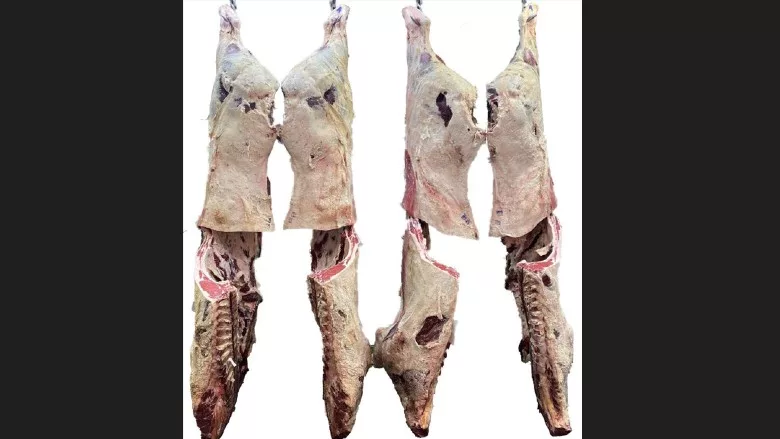
Photo credit: AMSA
The practice of beef × dairy crossbreeding in the dairy industry has resulted in the displacement of a majority of straightbred Holstein cattle entering the beef supply chain with crossbred beef × dairy cattle. Few studies evaluating carcass performance have been published on this modern beef × dairy cattle population, and even less work has been conducted to understand the variability of value-determining traits within contemporary groups of this population.
In a 2021 study, we evaluated the carcass yields and cutout values of conventional beef, crossbred beef × dairy, and dairy (Holstein) steers. We aimed to identify differences in carcass yield and cutout value among unsegregated beef and dairy cattle and high-yielding (HY) and low-yielding (LY) beef × dairy cattle. Then, we proceeded to investigate which carcass regions and characteristics of those regions had the most profound influence on differences in yield.
Carcasses were selected to represent the industry average slaughter endpoint at the time of the study for 12th rib fat thickness for their respective cattle type. The left side of each carcass was fabricated at a commercial processing facility according to a standard, generally boneless cutout for the facility. Weights of subprimals, fat, bone, and trimmings were obtained within each primal for each carcass. Beef × dairy crossbreds were equally segregated into HY and LY designations within harvest lot based on the mean subprimal yield percentage for that lot. In total, carcasses from 26 beef, 21 dairy, 26 HY beef × dairy, and 26 LY beef × dairy cattle were included in the study. Yields of subprimals, fat, trimmings, and bone were expressed as a percentage of the hot side weight. Subprimal cutout values were calculated by multiplying subprimal weight by the average value of that subprimal reported by USDA across all weeks of 2021.
Of the cattle types evaluated, dairy cattle had the highest percentage of bone, and LY beef × dairy and dairy cattle had the lowest percentage of subprimals. Beef and LY beef × dairy cattle produced a higher percentage of fat than HY beef × dairy cattle. The percentage of subprimals produced between beef and HY beef × dairy cattle was similar. The percentage of trimmings was not different between cattle types. Together, these findings resulted in beef and HY beef × dairy cattle producing the highest subprimal-to-bone ratio and HY beef × dairy cattle producing the highest subprimal-to-fat ratio. Not surprisingly, dairy cattle produced the lowest subprimal-to-bone ratio. Using 2021 values, the cutout value of the subprimal portion differed between each cattle type as follows: HY beef × dairy > beef > LY beef × dairy > dairy.
The subprimal yield percentage and subprimal cutout value of the round and chuck were markedly greater in HY versus LY beef × dairy cattle. We investigated characteristics of these primals further by evaluating the distribution of total subprimal yield and subprimal cutout value into carcass primals. Dairy and HY beef × dairy cattle distributed a greater percentage of their total subprimal weight and cutout value into the round compared to beef and LY beef × dairy cattle. Both HY and LY beef × dairy cattle distributed a greater percentage of their total subprimal weight and cutout value into the rib than dairy cattle.
We further investigated characteristics of each primal that would lend towards differences into total subprimal yield and cutout value, especially within the beef x dairy population. Subprimal-to-bone and subprimal-to-fat ratios within each primal were used to predict the subprimal cutout value in the entire carcass for beef × dairy crossbreds. Independent of HY or LY designation, an increase in subprimal-to-bone of the round was the most distinguishing characteristic in increasing subprimal cutout value within this population.
This study indicated that, when harvested at industry-average slaughter endpoints for fat thickness, beef × dairy cattle produce considerably greater carcass yields and cutout value than straightbred dairy cattle. Increased carcass yield and value is one positive implication of the displacement of fed dairy cattle with beef × dairy cattle in the beef supply chain
When HY beef × dairy cattle were equivalent in subprimal-to-bone to beef cattle, they produced greater subprimal cutout value than beef cattle. Subprimal-to-bone ratio of the round was the most responsible characteristic in increasing total carcass subprimal cutout value between HY and LY beef × dairy cattle. As genetics providers aim to provide more profitable solutions to dairies implementing beef × dairy, a focus on hindquarter muscularity while minimizing excessive frame is likely to lend towards minimizing discounts associated with inferior carcass yield. Finally, these advantages in carcass yield of beef × dairy cattle can only be realized if they are managed and harvested at a lesser fat thickness than conventional beef cattle.
How to cite
Foraker, B. A., Johnson, B. J., Brooks, J. C., Miller, M. F., Hardcastle, N. C. & Woerner, D. R., (2024) “Carcass Yield and Subprimal Cutout Value of Beef, High- and Low-Yielding Beef × Dairy, and Dairy Steers”, Meat and Muscle Biology 8(1): 17004, 1-16. doi: https://doi.org/10.22175/mmb.17004
Looking for a reprint of this article?
From high-res PDFs to custom plaques, order your copy today!