A new approach to seal inspection set to cut costs and food waste
Adjusting X-ray energy to a suitably low level allows detection of very thin layers of seal contamination.
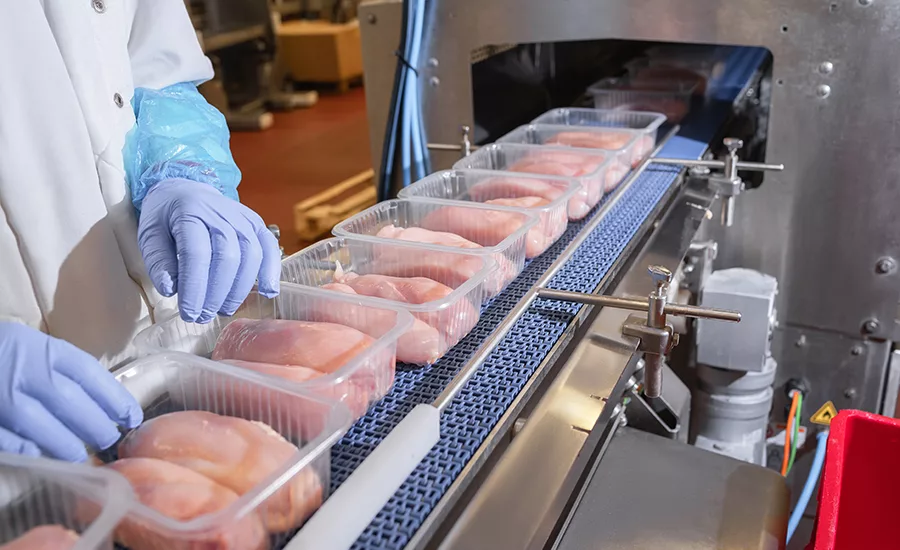
In the drive to cut food waste, airtight packaging has a crucial role to play in helping meat and poultry products stay fresh for as long as possible. This means a good seal is vital. If a fragment of chicken skin gets caught up in the seal and is left sticking out of a pack of fresh chicken breasts, for example, it will breach the airtight seal and allow in oxygen – which will make the product spoil faster and lead to wastage and customer complaints.
An estimated 40% of all food produced in the world goes to waste — amounting to £2.5 billion tons every year. And the Food & Agriculture Organization (FAO) of the United Nations puts the financial cost of this waste at around US$1 trillion annually — on top of the environmental impacts. So, it's no surprise that some of the latest production-line technology is focused on helping meat and poultry processors avoid wasting food – and money.
Traditionally, seal inspection solutions have involved a sniffer approach, to detect modified atmosphere packaging (MAP) gases such as nitrogen or carbon dioxide, or a pressure-decay leak tester to check for any seal leakage by measuring the pressure in a cavity — if it reduces, it gets rejected. Another option is vision systems — but their accuracy is limited.
The latest X-ray technology, on the other hand, offers unrivalled accuracy. Two or more images are generated from a single detector — one optimized for the product and one for the seal area. It means even a small amount of an ingredient trapped in the seal of a chicken TV dinner can be detected. And, unlike vision systems, X-ray seal inspection can cope with non-transparent packaging and items with pack colors that are all very similar.
Sealing with plastic, metalized film or foil material — whether in the form of flow-wrap packaging, form fill seal, or thermoformed trays — means there is a bond between one or more surfaces of a film material and a substrate, such as the lip of a tray. The seal can become ineffective for various reasons. The two sides of the seal can simply not be bonded together, for example, resulting in a blown seal — or food matter can be trapped between the sealing surfaces, creating a non-sterile channel.
Locating operators at the end of the production line to perform a visual inspection to detect such problems represents a substantial cost and an operational burden for processors — and humans are not infallible when it comes to spotting seal breaches. But the latest generation of X-ray technology can help save time and money.
By adjusting the X-ray energy to a suitably low level, it is possible to detect very thin layers of seal contamination. At this very low level, the resulting contrast in the X-ray image data will be much reduced and subject to general signal fluctuations. The systematic nature of these fluctuations can be exploited to create a compensated image. An example of such a fluctuation would be the joint in a conveyor belt, which would generally appear as a somewhat denser region of the overall background image. This can be factored out by a compensation algorithm. Then, by scanning along the seal for an incrementally different response, the technology can reliably detect organic material deposits as small as 50 microns thick.
There are also other clues to the presence of contamination, allowing hotspots in the seal region to be identified. For example, the presence of a strand of food adjacent to the seal region will indicate that material on the seal has been extruded away from the sealing surface. These hotspots trigger implementation of an algorithm to enhance the detectability of small seal defects.
Another major advantage the latest X-ray technology offers meat and poultry processors is end-of-line inspection of the contents of packages for the traditional range of foreign bodies. A pack of ground beef, for example, will need to be inspected for metal and bone fragments. Traditionally, this has required two X-ray systems – one for the seal and one for the product inspection – as the product inspection requires the penetration of a considerable thickness of food material in the package. This has meant duplication of a significant amount of expensive hardware.
The new generation of X-ray technology, however, can produce two sets of output data simultaneously. The first output creates an image suitable for contaminant detection within the product, and also defines where the product is within the packaging. The second output uses this data to define the seal inspection zone, where it creates an image of much higher sensitivity. Combining these two different types of inspection in a single unit means a simplified set-up and product changeover, as well as combined statistics and just one interface to factory information systems.
Packaging is in the spotlight like never before as the world strives to move away from single-use plastic to sustainable packaging to protect the environment. Yet the role of packaging in preventing food waste is all too often overlooked. If food waste was a country, it would be the third highest emitter of greenhouse gases after the US and China, according to the FAO. And if, as a planet, we stopped wasting food altogether, we would eliminate 8% of our total emissions. The latest generation of X-ray inspection technology offers a new vision of the future for the food processing industry.
Looking for a reprint of this article?
From high-res PDFs to custom plaques, order your copy today!