International demand for red meat reaches record levels despite heightened competition
US Meat Export Federation hosts its annual conference for the red meat industry.
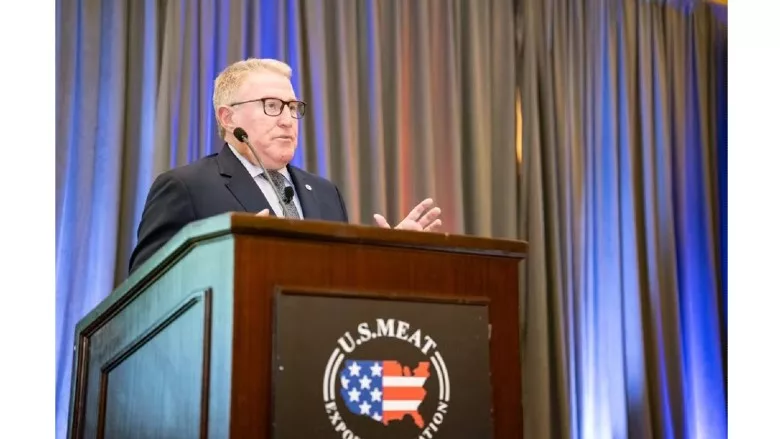
USMEF President and CEO Dan Halstrom details the organization’s effort to expand demand for US pork, beef and lamb in both established and emerging markets.
Photo courtesy of the US Meat Export Federation
Representatives of the entire US red meat supply chain recently gathered in Fort Worth, Texas, at the US Meat Export Federation Spring Conference. USMEF Chair Steve Hanson, a rancher, cattle feeder and grain farmer from southwestern Nebraska, welcomed members with an optimistic message, despite heightened uncertainty in the trade policy arena.
“While our industry is obviously facing many challenges, it’s also a very exciting time to be in the red meat business,” Hanson said. “Our products are better than ever, and international demand is outstanding. There are many factors we cannot control, so it is important to remain customer-focused and not lose sight of our mission, which is to expand the global footprint for US pork, beef and lamb.”
USMEF President and CEO Dan Halstrom built on this theme, noting that demand for US red meat is at record levels in many international markets, even in the face of heightened competition.
“A lot of times the best defense is a strong offense, and in many key markets we are doing both,” said Halstrom. “We're defending where necessary, especially against newcomers like Brazil, which has recently gained greater access in several key regions. But at the same time we are aggressively pursuing new opportunities in both established and emerging markets.”
As an example, Halstrom pointed to the recent expansion of USMEF’s staff presence, with new representation in West Africa and Malaysia, and an additional staff member in Indonesia. He also shared highlights from USMEF’s recent two-day trade seminar in Accra, Ghana, which attracted buyers from 12 African nations.
Halstrom concluded by comparing USMEF’s approach to international marketing to the insights shared recently at Berkshire Hathaway’s annual shareholders’ meeting. He noted that Berkshire’s leadership views holdings in markets such as Japan, for example, as investments of 50 years or more, focusing on company fundamentals rather than being distracted by short-term issues that dominate headlines.
“That's really what USMEF does as well, focusing on the long-term vision of building demand in targeted export markets,” Halstrom said. “Global populations are growing and the middle class is expanding, but it's really about the spending power. We're not focused on all consumers. We're focused on the top tiers in these markets and those top tiers want and can pay for high-quality proteins. So despite there being a lot of noise about international trade, we're going to keep our eye on the ball and remain focused on the long term.”
Rick Stott, president and CEO of Superior Farms, explained how community and industry interests came together to overcome a proposal advanced by anti-agriculture activists in 2024. Voters in Denver rejected a ballot initiative that would have banned slaughterhouses within the city limits. If passed, the measure would have forced closure of Superior Farms’ lamb processing facility, which employs about 160 workers and provides essential services for lamb producers.
“We took a survey right out of the gate and one of the things we found was that economic impact was very important to the community,” said Stott. “We were blessed to have Colorado State University jump on board early on to identify what was close to a $1 billion dollar negative impact on the city of Denver and the surrounding communities, if we disappeared.”
Keynote speaker Randy Blach, CEO of CattleFax, provided USMEF members with a cautiously optimistic outlook on the US cattle industry’s herd rebuilding efforts. He noted that cow slaughter has declined significantly, providing greater herd stability. And while heifer retention has been slow to develop, Blach sees enough encouraging signs that he feels January 2025 will prove to be the low point of this cattle cycle.
“Does this [rebuild] look anything like it did back in 2014 and 2015 – the most rapid expansion in the history of the industry?” Blach said. “No, this one isn't that way. It is much, much slower, just as we expected it would be. And I think you need to plan on it continuing to be a slower expansion as it unfolds.”
Blach provided a broad outlook of the US protein market, analyzing demand trends for beef, pork and poultry. He noted that the beef industry’s heightened focus on quality has paid strong dividends—not in terms of consumption volume, but in consumers’ willingness to pay for higher quality cuts.
“When you look at demand across all proteins, chicken is capturing 50% of the stomach but 25% of the wallet,” Blach said. “Beef, on the other hand, is getting 25% of the stomach and 50% of the wallet. Which would you rather have?”
Blach said exports continue to make critical contributions to the bottom line of US livestock and poultry producers, who collectively export about 17% of total production. The pork sector leads the way at 30%, with beef exports accounting for about 14% of production.
“Right now we are in a profitable period across the board, for cattle, pork and poultry producers,” Blach said. “And that’s something we hadn’t seen in several years.”
USMEF concluded its Spring Conference with a panel discussion in which senior international staff gave examples of innovative efforts to overcome trade challenges.
Jihae Yang, USMEF vice president for the Asia Pacific, noted that with high tariffs and other barriers severely limiting pork and beef exports to China, the organization has intensified campaigns aimed at moving items traditionally popular in China to alternative markets. For example, USMEF partnered with a major retailer in South Korea for a promotion of US beef short plate, after uncertainty over plant eligibility and higher tariffs made the product more difficult to move in China. Yang added that if the trade impasse with China persists, she foresees more US short plate being available to importers and distributors in Southeast Asia.
Yang also updated members on how USMEF is working with a Korean meal kit manufacturer and a Japanese distributor to develop and promote items featuring US pork bung. US pork tongue trimmings are also being promoted in popular dishes in Japan’s casual-dining sector.
Gerardo Rodriguez, USMEF director for Mexico, Central America and the Dominican Republic, explained that while Mexico has been developed into the largest destination for US red meat, the US industry now faces unprecedented levels of competition in the Mexican market. He noted that it is more important than ever to differentiate .. red meat from other suppliers’ products and educate consumers about its unique attributes.
“Right now a major focus for USMEF is to establish loyalty in the next generation of consumers, developing several programs for the future customer,” Rodriguez said. “With Mexico being a trading partner for so long, it can be easy to think of it as a mature market. But there are always new markets within the market that we can expand, and new tactics we can employ. Our mobile grill academy is a good example, where we highlight the unique attributes of US red meat all across the country.”
USMEF Latin America Representative Homero Recio highlighted the US industry’s efforts to overcome Colombia’s restrictions on US beef, which were imposed for much of last year due to findings of highly pathogenic avian influenza in dairy cows. The ban, which eventually extended to beef from 14 US states, was lifted in September 2024, but the impact has persisted, in part because it created a new opportunity in the Colombian market for Canadian beef. Recio said that while reclaiming this business has not been easy, it has resulted in heightened efforts to establish customer loyalty to US red meat.
“This really gave us the resolve to say, ‘we're going to get this back, we're going to fight back,’” Recio said. “In the past, we often talked about ‘our importers.’ Well, you know what? ‘Our importers’ went and bought Canadian beef. So we have to go to the next level, whether it's with a supermarket chain or a foodservice chain, and develop a further, stronger relationship with them and really tie them to a brand.”
John Newton, executive head of Terrain, applauded the House of Representatives’ passage of President Trump’s budget reconciliation bill earlier in the day on May 23.
“If anybody stayed up until 3:00 or 4:00 in the morning last night, you know that President Trump’s ‘big, beautiful bill’ made it over the finish line in the House. There is work to do in the Senate, but the bill touches on a lot of the Farm Bill elements that farmers have been asking for.”
Newton explained the urgency of many farm programs included in the bill as he described some of the major challenges facing agriculture, especially row crop producers. Farm operating costs remain elevated while revenue derived for major crops have been below cost of production for three straight years, he said. Input costs show no signs of going down, while crop prices have, in some cases, fallen by 30% and show no signs of improvement.
“For seven years now, Congress has responded to ag market conditions with annual ad hoc support for agriculture. But it's that federal support that's been propping up the farm economy. It's not because we're seeing higher grain prices.”
Newton described the process the bill will undergo in the Senate and while expecting some modifications, believes the goal in the Senate is to get it signed by July 4.
Newton highlighted an increase in funding for USDA’s export market development programs as critical support for America’s farmers and ranchers; he noted that strengthening these programs will be helpful in finding and developing new markets around the world. Newton also noted that the USDA Foreign Agricultural Service is particularly bullish on expanding American agriculture’s footprint in Southeast Asia.
“The world becomes more competitive each year, so, it's really important for us to get out and find those new deals to help the farm economy,” Newton said. “Trade is clearly a focus of this administration, and I think President Trump will push for substantive progress ahead of next year’s midterm elections. In fact, I might be one of the few people who thinks we're going to get a Phase Two deal with China.”
Heightened US-China trade tensions, which have severely limited beef and pork exports to China in recent weeks, were a major topic of discussion throughout the USMEF Spring Conference. But USMEF President and CEO Dan Halstrom noted that rather than dwell on trade obstacles, the conference focused mostly on how to develop and capitalize on alternative destinations.
“USMEF’s focus is on bringing solutions to the table,” Halstrom said. “So when we see something like China happen, we're pivoting on the demand side – and this is what our membership expects of us. That's why we have these offices all over the world, 105 employees in 20 regions, and that's what they are there for – to be as nimble as possible at finding solutions when there are changes in market conditions and market access.”
USMEF members will next meet at the organization’s annual Strategic Planning Conference, Nov. 12-14 in Indianapolis.
Source: US Meat Export Federation
Looking for a reprint of this article?
From high-res PDFs to custom plaques, order your copy today!