Consumers’ growing emphasis on taste and convenience underpins beef demand and cattle prices
Taste and freshness now surpass price as the most important factors influencing consumers' beef purchases.
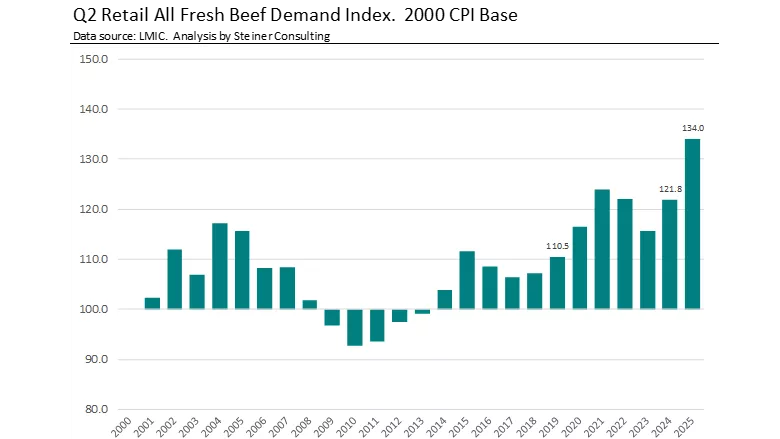
Beef demand has long been a subject of discussion, but it is once again drawing attention as cattle prices reach record levels and wholesale beef values rank second only to those seen during the COVID-related supply disruptions and panic buying. To better capture shifts in demand, agricultural economists have developed tools that track changes over time. The chart above shows the beef demand index compiled by the Livestock Market Information Center for Q2.
For those not familiar, the demand index measures the actual change in per capita beef consumption in the US relative to what would normally be expected given changes in beef prices. While demand has been strong in recent years, it was especially so in the first half of this year. In Q2, the index reached 134, 12 points (+10%) higher than a year ago and 24 points (+22%) above 2019, before COVID.
A number of factors influence beef demand, but the most important in our view are incomes, taste and preferences, quality, and consumer eating patterns. While much attention has been given to inflation’s impact on consumer spending, what is often overlooked is that disposable income growth in the last three years has outpaced inflation. Since January 2023, disposable income is up nearly 13% compared to a 7% rise in headline CPI and increases of 10.7% and 3.7% for foodservice and grocery store prices, respectively.
As for taste and preferences, consumers have steadily increased the share of protein in their diets, with beef consistently ranking at the top. Recent Kansas State studies show that taste and freshness now surpass price as the most important factors influencing beef purchases. US cattle producers are also delivering the highest-quality product ever. So far this year, nearly 85% of cattle have graded Choice or Prime, with Prime alone making up 12% of the mix.
Spending patterns reinforce these trends. Through July 2025, consumers spent $681 billion on food away from home, 5.6% more than last year, while grocery store sales totaled $532 billion, up 3.2% year-over-year.
There is, of course, no guarantee that this level of demand will persist. But for now, robust economic growth and consumers’ growing emphasis on taste and convenience continue to underpin both beef demand and cattle prices..
Looking for a reprint of this article?
From high-res PDFs to custom plaques, order your copy today!