Beef and chicken power October meat department gains
Inflation across a number of proteins leads to an overall increase of 5.1% for meat and poultry prices in October 2025.
October in review
- The US federal government shut down on October 1, 2025 after Congress failed to enact appropriations for FY2026. Around 900,000 federal workers were furloughed, with an additional 700,000 required to work without pay. Lasting the full month of October into November, the shutdown pressured household income in regions with heavy federal employment.
- The Supplemental Nutrition Assistance Program (SNAP), serving more than 40 million Americans, faced a funding shortfall. Many retailers, manufacturers and restaurants donated to food banks and offered free meals and meat.
- The shutdown weighed on consumer sentiment. The University of Michigan Index of Consumer Sentiment dropped 6.2% month-over-month in early November to 50.4, with the shutdown and inflation cited as key drivers. The decline was seen across age, income and political affiliation.
- Meanwhile, US online grocery sales have soared to unprecedented levels, hitting a new high of $12.5 billion in September 2025, according to Brick Meets Click. This was driven by the largest base of monthly e-grocery shoppers to date, continued gains in order frequency and a higher average order value, up 8% YOY. Online order gains were recorded across channels, with larger surges in order size at hard discounters and club stores.
- Walmart is partnering with ChatGPT to let its shoppers purchase products directly inside the AI platform. Inquiries can be converted to orders and payments without ever visiting the retailer’s site. ChatGPT commands about 75% of AI-chatbot traffic and sees shopping queries in about 2% of its conversations, giving it a powerful new storefront.
- Total retail food and beverage volume declined slightly in October, but has been on a flat-to-down trajectory for months as persistent headwinds, including low consumer confidence, tight economic conditions and job concerns weigh on demand. The shutdown does not appear to have had a substantial downward impact on retail food and beverage volume sales.
Inflation insights
In October 2025 (the five weeks ending 11/2/2025), the price per unit across all foods and beverages in the Circana MULO+ universe stood at $4.33, up 2.2% year-over-year. Most categories showed modest price growth, while categories like chocolate, coffee and meat experienced sharper increases.
- Center-store prices averaged $4.08, an increase of 3.2% year-on-year.
- Perishables rose to $4.35 per unit, which was an increase of 1.6% over October 2024.
Inflation across a number of proteins led to an overall increase of 5.1% for meat and poultry prices in October. Fresh meat prices increased far more than processed meat and poultry prices.
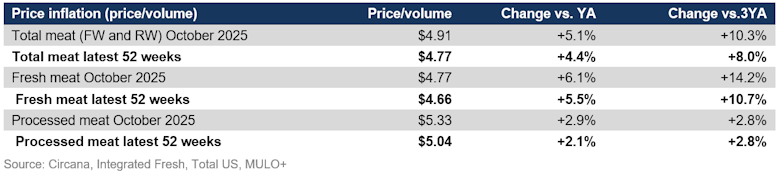 Circana, Integrated Fresh, Total US, MULO+
 Lamb and beef had the highest levels of inflation on above-average base pricing. On the fresh meat side, chicken inflated the least, at +2.9%. On the processed meat side, bacon and hot dogs had the highest price increases, whereas prices of processed chicken (nuggets, strips, etc.) came down a bit compared with October 2024.
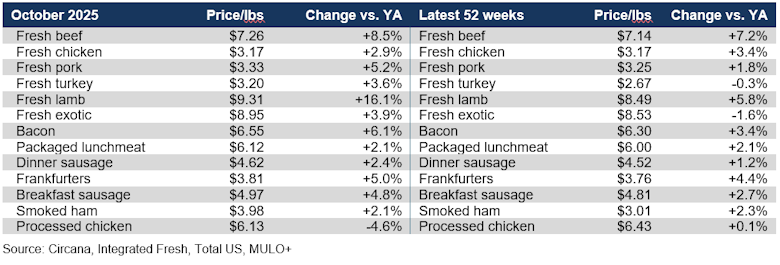 Circana, Integrated Fresh, Total US, MULO+
Meat sales
The five-week month of October generated $10.7 billion in meat department sales. This reflects inflationary gains as well as demand-driven growth. Pound sales increased 1.1% versus October 2024. This increase was fully driven by fresh meat sales that increased 2.1% in October while processed meat sales were down 1.7%.
 Circana, Integrated Fresh, Total US, MULO+
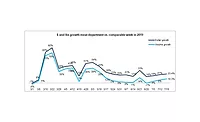
Meat department sales have been positive since the first quarter of 2023, with increases ranging from 0.3% to 7.3%. In all cases, dollar gains were a combination of inflation and demand growth. While the second quarter of 2025 benefitted from the late Easter timing, October pound sales continued to grow contrary to trends in many other departments across the store.
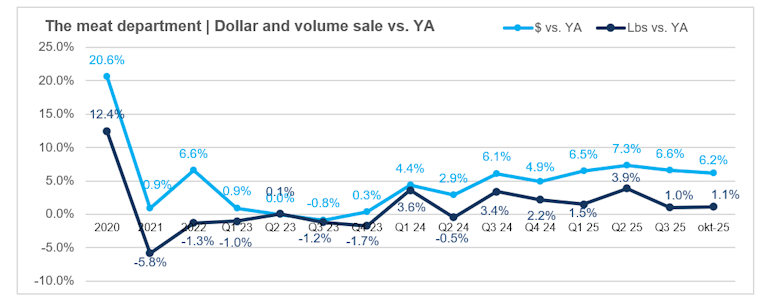 Circana, Integrated Fresh, Total US, MULO+
The first week of October experienced substantial declines in pound sales. Dollar sales were neutral as a result of inflation. All other weeks experienced substantial increases in dollar and volume sales. Beef and chicken drove the majority of these increases, with the year-over-year pound gains for chicken accelerating. Turkey was a third area of growth.
Assortment
The average number of items per store per week is remarkable stable, despite some supply chain challenges across several proteins.
Fresh meat sales by protein
Beef’s reign continued, generating $4.3 billion in the five October weeks. This was up by double digits in dollars while pound sales grew 2.1%. Only chicken had higher pound gains in October, at +4.0%. In the full-year view, beef volume sales grew 4.7%, distantly followed by chicken, at 3.1%.
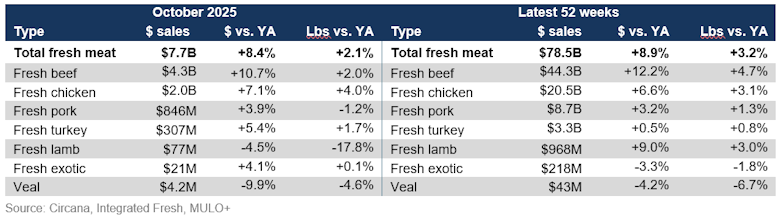 Circana, Integrated Fresh, MULO+
Processed meat
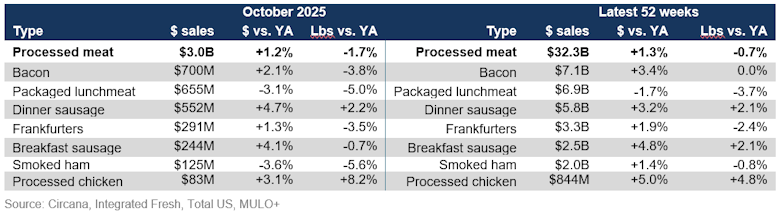
Patterns were mixed for processed meat. Lunchmeat sales continued to trend down in October, whereas dinner sausage and processed chicken showed substantial gains. In the full-year view, breakfast sausage is another growth area, but volume sales fell slightly short of October 2024 in the monthly view.
 Circana, Integrated Fresh, Total US, MULO+
Grinds
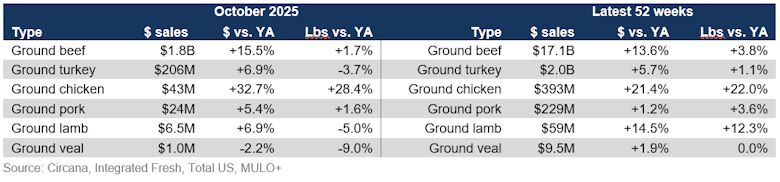
Ground beef sales have been extremely strong all year and October was no exception. The five-week period generated $1.8 billion in sales, up 15.5% year-on-year. While this is mostly price driven, pounds grew 1.7%. Ground chicken had an impressive 32.7% increase in sales, though off a fairly small base.
 Circana, Integrated Fresh, Total US, MULO+
Organic deep dive
Organic meat and poultry generate 3.3% of total meat department dollar sales. The pound share is a bit lower, at 2.2%.
Organic has been and remains an area of growth for the meat department, regardless of the financial pressure on income. Organic chicken is the largest, at $1.8 billion, just edging out beef, at $1.3 billion annually. Beef has the highest growth rate, that is in line with the gains seen in grass-fed as well.
 Circana, Integrated Fresh, Total US, MULO+
What’s next?
- Economists estimate the shutdown could trim Q4 2025 GDP growth by up to 1 percentage point or more, with observable drag on foodservice consumption, especially among lower-income households and federal-dependent regions.
- The Conference Board is pointing to a K-shaped economy, with those earning more than $200,000 annually feeling upbeat, fueling holiday, foodservice and retail spending. High-income households have made far fewer changes to retail and foodservice spending thus far. The top 20% of households by income drive 40% of consumer spending and the strength in premium item sales.
- At this point, 47% of consumers plan to host or attend a Thanksgiving meal/celebration with family or friends and 27% plan to prepare a special meal just for themselves/their households. The average party size is expected to be between eight and nine people. 42% plan to travel for their Thanksgiving celebrations, with the majority driving (30%) versus flying (3%).
- For more information about Thanksgiving meat choices, please visit a new resource from the National Turkey Federation: Https://www.eatturkey.org/2025/11/04/94-of-americans-plan-to-celebrate-thanksgiving-and-turkey-remains-the-star-of-the-table/
- Q4 success will require solutions for consumers across the affluence spectrum with relevant, timely promotions and omni-channel engagement.
Looking for a reprint of this article?
From high-res PDFs to custom plaques, order your copy today!