New World Screwworm cases surge, yet reopening speculation persists
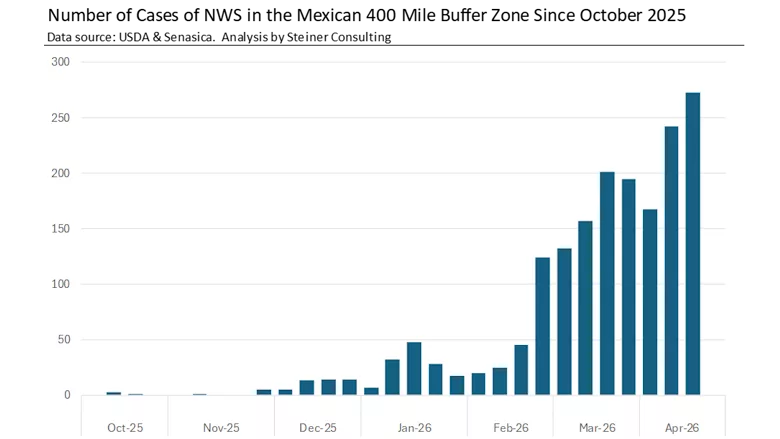
For the week ending April 18, 2026, there were 273 NWS cases reported within a 400-mile buffer zone from the US border.
In late October last year, the Mexican ag minister visited Washington, D.C., followed by a visit by US Ag Secretary Rollins to Mexico.
At the time, US cattle trade with Mexico had already undergone three suspensions, and Mexican ranchers and US cattle buyers were hoping for trade to resume. While trade did not resume as many had hoped, a protocol was developed whereby trade would slowly resume if Mexico managed to control or limit the infestation within a 400-mile buffer zone from the US border. To accomplish this, the US provided additional support, both financial and logistical, including the release of more sterile flies in Mexico.
The above below shows the success, or lack thereof, of the protocol developed at the time. Keep in mind that this reflects both the normal spread of the infestation into new territory and seasonal activity, with spring and summer typically seeing stronger propagation and spread. This was always viewed as a risk, which is why the US pushed hard to control the infestation during the winter. It did not work. According to data from Mexican authorities and reported by USDA, for the week ending April 18 there were 273 cases within the buffer zone. The number of cases in the state of Tamaulipas, which borders Texas, jumped to 75, more than in the first three months of the year combined.
There has been a lot of talk recently about the US moving ahead with a plan to restart cattle trade with Mexico despite the increase in cases. This speculation, whether in social media or among futures traders, contradicts a recent USDA playbook on dealing with potential outbreaks of NWS in the US. According to the plan, the first line of defense is to stop the pest from spreading geographically by imposing animal movement restrictions and inspection requirements. This would involve livestock but also the control of wildlife and pets. If this is the protocol for dealing with the situation in the US, why would it not apply at the border with Mexico?
Those supporting resumption of trade argue that cattle imports from Mexico will undergo strict inspections and will come from areas not affected by the pest. Wild animals are far more likely to carry the infestation into the US. Logical as this is, it would still be a politically fraught decision for USDA decision makers.
In the near term, speculation about reopening continues to drive volatility in the cattle market. But even if the border is reopened tomorrow, the number of cattle crossing is likely to be far smaller given the restrictions in place as well as rules around spayed heifers. And should the infestation cross the border, with the closest case currently about 90 miles away, it would likely further disrupt markets and drive volatility.
Looking for a reprint of this article?
From high-res PDFs to custom plaques, order your copy today!