Raised right
Sometimes, it pays to do the right thing, rather than follow that which data supports. Veal producers in the United States are learning that lesson as they transition from the decades-old method of stall-raised calves to an improved consumer perception of the product they produce.
On May 9, 2007, the American Veal Association (AVA) voted unanimously to adopt a resolution calling for all U.S. veal farms to transition to group-housing systems by Dec. 31, 2017.
Producers were given 10 years, but Chris Landwehr, a veal producer in DePere, Wis., and a member of the AVA Board of Directors, thinks the industry is in line to meet the goal early.
“Just two years into [the resolution], we’re already at 35 percent, so it’s moving pretty rapidly,” Landwehr explains. “As fellow producers are getting into the group-housing barns and talking to producers like me who are happy to have made the transition, they see it’s more consumer friendly, and I’m hoping we can beat that deadline maybe by five years even.”
Landwehr, who admits he wasn’t the very first producer to buy into the change, has been a pioneer of the method, and converted his two veal farms in the DePere area to group housing six years ago, prior to the AVA’s resolution. Landwehr grew up on a veal farm (one of his farms he bought from his parents upon their retirement) — so he is aware of the positives and negatives to both the old and new strategies.
“In the beginning I thought, ‘We’ve been raising them in stalls for 30 years,’ and I wasn’t interested at first, which is why I wasn’t the first one,” Landwehr explains. “Once [a couple other producers] made the transition, I liked what I saw and knew that was the direction the industry was headed. So I thought I’d join in then and become one of the pioneers of the concept.”
After seeing a slowthe continued attacks of activist claims against the stall-raised methods of rearing calves, Landwehr decided that, in the end, the industry would need to change its approach to altering consumer perception of the trade he plied.
“I think the most positive is the consumer perception of the calves now not being confined to one pen and being able to run around, be rowdy and do what calves do,” Landwehr says. “Even though we’ve got tons of scientific data that shows stall-raised is the best way to do it, it hasn’t changed consumer perception enough. Ultimately, if we want to stay in business, we have to sell a product that the consumer wants.”
Beyond consumer perception, the health of calves seems to have improved, at least in Landwehr’s barns.
“With the calves getting more exercise, they’re healthier,” he adds. “I think also each calf being able to interact with more calves than just the neighbor on each side probably stimulates their immune systems too.”
Landwehr says there was some concern that allowing the calves to run around in the pens would cause more bruising or injuries to the legs or hips, but he reports that most producers have not seen any type of increase there, and product quality has not suffered so far as he is aware.
Certainly, there are challenges to incorporating the transition — cost being one of them (see “How to make the transition,” on page 27). But the AVA and Landwehr have worked hard to help producers and consumers see the benefits. Landwehr has hosted several tours of his farm with culinary students at Kendall College in Chicago, to give the chefs-to-be a first-hand look at the humane practices his farm uses.
“The reason we started the tours was to get these student chefs — who are mostly city kids — out on to the farm, so as they [decide] to put veal on their menu, if they are approached about why they’re carrying veal, they can say that they’ve seen a veal farm first-hand and know the truth,” he explains. “They can be assured the calves are very comfortable, humanely raised, and the chefs will be comfortable having veal on the menu.”
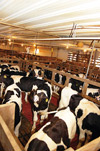
Indeed, within minutes of The National Provisioner executive editor Andy Hanacek’s arrival at Landwehr’s smaller farm, calves were rambling around their pens and riding each other playfully. Certainly, it wasn’t a pastoral painting of a herd ambling around a pasture, but Landwehr says that’s an unrealistic ideal.
“Everyone would love to see this picture-perfect animal running on a hillside, but it’s not practical. First of all, veal is a special-fed, light-colored, very tender product. Once you put these animals on the hillside, they’re eating grass, and then they’re beef, not veal anymore.”
Landwehr adds that weather conditions also play a major role in the housing of veal calves, particularly since most veal is raised in the northern tier of the United States, meaning cold, snowy winters, muddy springs and hot summers.
“We have them in environment-controlled facilities, where it’s cool in the summer and warm in the winter,” he says. “It’s very comfortable in there. … In terms of bedding, you cannot bed them enough in an outside environment to keep them dry. I’m not saying it’s impossible, but you couldn’t do it affordably.”
Group housing keeps the calves comfortable, healthy and able to produce consistent product. Scientifically, it may not be proven to be the best method, but contrast that picture with the old, single-animal stalls the resolution seeks to eliminate, and consumers who have concerns about the animal welfare aspect of veal production can rest more easily about the product they’re eating.
How to make the transition
When the American Veal Association (AVA) resolution was updated in a news release by the AVA in 2008, veal producer Chris Landwehr estimated it would cost a veal producer with an average-sized barn about $30,000 to convert that facility from individual to group housing. Today, Landwehr says, cost remains the most challenging barrier for producers, but there are several other aspects a producer must consider when preparing to make the transition to group housing. What follows are some of the challenges Landwehr faced when changing his barns to group housing six years ago.
NP executive editor Andy Hanacek: How long did the overall transition take and what were the steps you took at your farms?
Chris Landwehr: When my last group of stall calves went out, instead of cleaning and sanitizing everything, I simply cut the old stalls out, hauled them out and burned them. I then put in the new pens. There was some concrete work, but not a lot. I had my son and his friends helping too, so the actual transition only took about two to three weeks. And then we started a new group of calves in the new pens.
Hanacek: So it was an easy switchover?
Landwehr: It was easy, but it is expensive. The wood we use is all white oak for its durability. If you used a soft wood like a pine, the calves are practically like termites — they’ll chew right through it. The white oak, though, is very durable. It was expensive, and of course, a lot of people right now in agriculture in general see margins being really tough. And then to go and take out stalls that work well and replace them, it can be tough.
Hanacek: What types of modifications did you have to make in terms of the drainage?
Landwehr: What we wanted to do to save money was to work within our existing gutter system and existing building. I had some pens in which the gutters would have passed through the center of the pen, so we closed those up and put some tiling in, but the concrete work wasn’t that extensive. It was mainly just the pens themselves because we had to start from scratch there.
Hanacek: Did you have to change out or add any equipment?
Landwehr: The feed-delivery system is the same, although we put in a flow meter, which we didn’t have before. But otherwise, that system is the same. … Some [farms] have gone to groups of two calves, some fours. Eights are pretty common, but I’ve seen some that do large groups of like 50, with automatic feeders, automatic mixing and all that. Now, I still believe, having seen those systems, a person needs to be in front of every calf every day, watching and taking notes. Even though they have microchips where you get a computer printout if a certain calf doesn’t drink, it’s not the same as the one-on-one contact. You know, sometimes people try to simplify it to a point where you really lose efficiency and contact of what’s going on at the barn.
Hanacek: You want to be able to identify the ones that aren’t eating right or timid, but you can’t take the human element out of it, right?
Landwehr: In my smaller barn, it takes about an hour and 15 minutes or so to feed the calves. It’s not like you’re spending eight hours out there. You still need to go out there to make sure the systems are operating, and those computers malfunction too, you know. With those systems, the computer system, it can be extremely expensive, and there’s a lot of maintenance.
Looking for a reprint of this article?
From high-res PDFs to custom plaques, order your copy today!