Provisioner logo
Provisioner logo
search
cart
facebook twitter linkedin youtube
  • Sign In
  • Create Account
  • Sign Out
  • My Account
Provisioner logo
Provisioner logo
  • NEWS
    • Industry News
    • Supplier News
    • Case Studies
    • Recalls
    • Regulations
    • New Consumer Products
  • EXCLUSIVES
    • Newsletters
    • Source Book
    • Sponsored Insights
    • Events
    • Webinars
    • Classifieds
    • White Papers
    • Provisioner Store
    • Market Research
  • MEAT PROCESSING
    • SUSTAINABILITY
    • Processing
    • Packaging
    • Ingredients
    • Formulation
    • Food Safety
    • Special Reports
    • Commentary
  • PROFILES
    • Processor Profiles
    • Processor of the Year
    • Top 100 Processors
  • MEDIA
    • Videos
    • Podcasts
  • DIRECTORY
  • MIHOF
  • INDEPENDENT PROCESSOR
  • EMAG
    • eMagazine
    • ARCHIVE ISSUES
    • Contact
    • Advertise
  • JOIN!
ChickenSpecial Reports

State of the Industry: Chicken

Biofuel policy holds back production ramp-up

By Mike Brown, National Chicken Council
October 10, 2014

The U.S. Department of Agriculture (USDA) estimates chicken production this year will reach a record high of 38.45 billion pounds on a ready-to-cook weight basis, about 1.7 percent above 2013, a percentage increase comparable to last year’s rate. Total U.S. broiler slaughter data for the week ending Sept. 20, 2014, was estimated by USDA’s Poultry Market News Service to be 160,134,000 broilers, no change from the same week a year earlier.

Current favorable market conditions would normally stimulate production to be somewhat higher, that is, a percentage increase more aligned with the long-run annual average of 4 percent. So why are chicken producers not stepping up production to better match the long-term average of 4 percent? We would if we could, but we can’t. We would like to produce more pounds of chicken, but unfortunately we are not there yet.

The primary reason for the industry’s inability to increase production can be attributed to problems caused by a failed policy that has been with us since 2006. The devastating impact of an inflexible Renewable Fuel Standard (RFS) for conventional biofuels, especially following the drought of 2012 which severely reduced the corn harvest, continues to have broad and deep ramifications.

Very high and very volatile corn prices even prior to 2012 — most notably in 2009 when chicken production decreased almost 4 percent for only the third year since 1950 — helped set the stage for the restrained production. Not only did chicken producers have to significantly adjust production downward to survive, but the negative economic ripple effect of an inflexible RFS caused the primary broiler breeders to significantly adjust their production downward. Broiler breeders also had to curtail their production plans for the future.

Primary breeders are the companies that are the lifeblood of our business because they generate the grandparents, great-grandparent and pedigree flocks. The primary breeders suffered significant financial strain during this time as orders for day-old pullet chicks were reduced or even cancelled by chicken producers who were confronting severe financial pain largely because of an inflexible RFS. It is taking the primary breeder companies time to rebuild their grandparent flocks, which produce day-old pullet chicks that mature in seven months into the mother hens for our chickens.

In time the primary breeders will generate larger, more sufficiently sized flocks. They will then be able to provide pullet chicks at a more normally expected rate. In turn, chicken companies will enlarge their hatchery supply flocks to better meet market needs. Until then, the chicken industry will continue to grow, but it will be at a more measured pace.
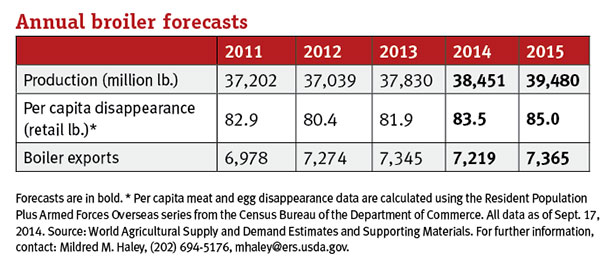
chicken industry, biofuels

We are keenly aware consumers would appreciate increased chicken production. As cattle and hog producers confront their own challenges to produce more beef and pork, many consumers increasingly find chicken a favorable alternative. When the competition provides an opportunity to better compete, it is frustrating to find yourself in the position of “we would if we could, but we can’t,” especially when we hear, “It only takes seven weeks to grow a chicken.”

Without sufficient breeder stock in the pipeline, it can take 18 months or more to rebuild breeder stock: 25 weeks for breeder stock grandparents to mature, another 25 weeks for the breeder parents to mature, then an additional 25 weeks for the breeders sold to growers to mature and become productive.

Industry analysts also point to a couple of factors that had an impact on this year’s broiler supply: some fertility issues earlier this year in breeder stock; and a very cold February 2014, coupled with a propane shortage that made it difficult to heat chicken houses. 
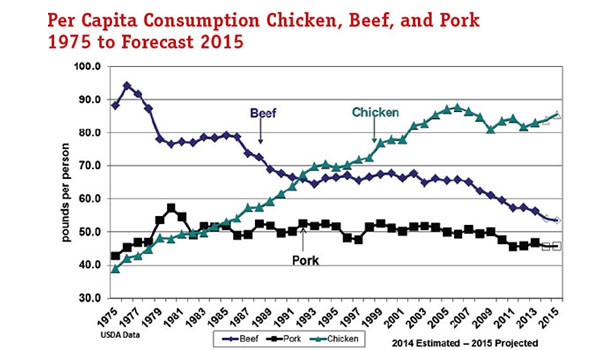
chicken consumption

The good news is demand for chicken remains strong. According to new consumer research presented at the National Chicken Council’s Marketing Seminar in July, chicken consumption is up 17 percent. Overall, the average number of meals or snacks that contained chicken eaten by survey respondents in the two weeks prior to the survey was 6.1. This is up from 5.2, or 17 percent, from the 2012 findings. Millennial respondents (ages 18 to 34) remain the most likely to eat chicken meals or snacks frequently (7.7). The 12-month outlook for the grocery segment looks promising with a net of 24 percent saying they will be eating more chicken. This is more than three times the proportion previously noted. Turning to eating out, one in five (20 percent) respondents are likely to buy more chicken at restaurants and other foodservice establishments. This indicates a net gain in purchasing among 9 percent of the population.

Market analysts have estimated it could be spring of 2015 before chicken companies will be able to produce a material increase in chicken products. As agriculture economist Chris Hurt recently explained, favorable income prospects at that time will be based on feed prices resetting to lower levels, continued reductions in drought-affected pastures, strengthening of domestic incomes, rising per capita consumption, and growing export demand.  (U.S. exports of poultry for meat are projected to reach 3.4 million tons in 2014, up from 3.1 million last year.)
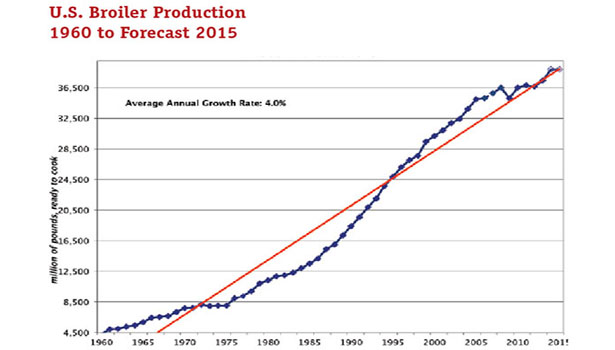
broiler production

But with 40 percent of our corn crop still mandated to be blended into our gasoline supply, we’re at the point again where one extreme weather event could be disastrous for chicken producers. 

In short, the state of the industry is good in terms of net margins, but it continues to be frustrated by the long-term effects of an inflexible renewable fuels policy and program. The often-dismissed fact, especially today as grain prices moderate, is that the RFS has inflicted deep and sustained damage to chicken production, and to consumers’ wallets. 

KEYWORDS: biofuel chicken processing renewable fuels standards state of the chicken processing industry state of the industry

Share This Story

Looking for a reprint of this article?
From high-res PDFs to custom plaques, order your copy today!


Mikebrown

President, National Chicken Council

Recommended Content

JOIN TODAY
to unlock your recommendations.

Already have an account? Sign In

  • Double Charburger

    Premiumization drives burger category

    Shoppers seek out premium meat offerings to fulfill...
    Special Reports
    By: Sammy Bredar
  • JJS Adult Pekin duck

    Poultry Report 2025: Convenience propels poultry at retail

    Despite continued economic pressures, the poultry...
    Meat and Poultry Industry News
    By: Sammy Bredar
You must login or register in order to post a comment.

Report Abusive Comment

Manage My Account
  • eMagazine Subscriptions
  • Manage My Preferences
  • Newsletters
  • Online Registration
  • Subscription Customer Service
  • Connect with The National Provisioner

More Videos

Sponsored Content

Sponsored Content is a special paid section where industry companies provide high quality, objective, non-commercial content around topics of interest to the The National Provisioner audience. All Sponsored Content is supplied by the advertising company and any opinions expressed in this article are those of the author and not necessarily reflect the views of The National Provisioner or its parent company, BNP Media. Interested in participating in our Sponsored Content section? Contact your local rep!

close
  • A smiling man carrying a grocery basket is reaching down to pick up a package of meat in a grocery store.
    Sponsored byPIC

    The Green Light: New Data Shows 12-to-1 Support for Pork from PRRS-Resistant Pigs

  • Close up of a grocery cart full of groceries, a cropped image of a couple pushing the cart and a blurred background of the vegetable aisle.
    Sponsored byPIC

    New Market Research Finds Consumers in Eight Key Pork Markets Are Likely to Purchase Pork from Gene-Edited Pigs

  • Close up of a young pig with a blurred background.
    Sponsored byPIC

    New Research Forecasts Significant Economic and Market Impacts with PRRS-Resistant Pig Adoption

Popular Stories

Spam Dog

Hormel rolls out Spam hot dog for foodservice applications

Niman Ranch Uncured Grass-Fed Beef Bacon

Niman Ranch introduces beef bacon

Various new Primal snack sticks on a table amongst pencils, apples, a pair of glasses, lunch bags and a water bottle.

Protein demand drives snacking occasions

2026 Top 100 Meat & Poultry Processors Report

Events

June 11, 2026

From Fresh to Frozen in 3 Minutes Flat: Unlocking the Secrets to Temperature Control

Join Tony Vacaro, Foods Industry Manager, and Emile Klein, Foods Market Strategy Manager at Air Products and Chemicals, Inc. , as they tackle key questions surrounding heat removal in food processing. 

January 1, 2030

Webinar Sponsorship Information

For webinar sponsorship information, visit www.bnpevents.com/webinars or email webinars@bnpmedia.com.

View All Submit An Event

Products

Food Crime: An Introduction to Deviance in the Food Industry

Food Crime: An Introduction to Deviance in the Food Industry

See More Products
From Fresh to Frozen in 3 Minutes Flat: Unlocking the Secrets to Temperature Control Webinar Sponsored by Air Products

Related Articles

  • Hardee's chicken sandwiches

    Carl's Jr. & Hardee's ramp up hand-breaded chicken menu with three brand-new, innovative sandwiches

    See More
  • The National Provisioner News Briefs

    Congressmen introduce RAMP-UP Act for small meat processors

    See More
  • IPPE logo

    International Rendering Symposium to explore impact on biofuel and food production

    See More

Related Products

See More Products
  • salmonela.jpg

    Controlling Salmonella in Poultry Production and Processing

  • Organic Meat Production and Processing

  • emerging.jpg

    Emerging Technologies in Meat Processing: Production, Processing and Technology

See More Products

Related Directories

  • HBC Holdings LLC (DBA) Sadex

    HBC Holdings LLC dba Sadex is a commercial contract electron beam irradiation service center providing Ebeam irradiation to treat meat, poultry, animal feed, pet food and treats, fresh produce, and agricultural products. Sadex operates under USDA, FSIS, APHIS, and FDA regulatory authority processing food and feed products under a HACCP program to reduce foodborne pathogens to undetectable levels, extend shelf life, and eliminate harmful pests.
×

Stay ahead of the curve. Unlock a dose of cutting-edge insights.

Receive our premium content directly to your inbox.

SIGN-UP TODAY
  • RESOURCES
    • Advertise
    • Contact Us
    • Directories
    • Store
    • Want More
  • SIGN UP TODAY
    • Create Account
    • eMagazine
    • Newsletter
    • Customer Service
    • Manage Preferences
  • SERVICES
    • Marketing Services
    • Reprints
    • Market Research
    • List Rental
    • Survey/Respondent Access
  • STAY CONNECTED
    • LinkedIn
    • Facebook
    • YouTube
    • X (Twitter)
  • PRIVACY
    • PRIVACY POLICY
    • TERMS & CONDITIONS
    • DO NOT SELL MY PERSONAL INFORMATION
    • PRIVACY REQUEST
    • ACCESSIBILITY

Copyright ©2026. All Rights Reserved BNP Media, Inc. and BNP Media II, LLC.

Design, CMS, Hosting & Web Development :: ePublishing