Provisioner logo
Provisioner logo
search
cart
facebook twitter linkedin youtube
  • Sign In
  • Create Account
  • Sign Out
  • My Account
Provisioner logo
Provisioner logo
  • NEWS
    • Industry News
    • Supplier News
    • Case Studies
    • Recalls
    • Regulations
    • New Consumer Products
  • EXCLUSIVES
    • Newsletters
    • Source Book
    • Sponsored Insights
    • Events
    • Webinars
    • Classifieds
    • White Papers
    • Provisioner Store
    • Market Research
  • MEAT PROCESSING
    • SUSTAINABILITY
    • Processing
    • Packaging
    • Ingredients
    • Formulation
    • Food Safety
    • Special Reports
    • Commentary
  • PROFILES
    • Processor Profiles
    • Processor of the Year
    • Top 100 Processors
  • MEDIA
    • Videos
    • Podcasts
  • DIRECTORY
  • MIHOF
  • INDEPENDENT PROCESSOR
  • EMAG
    • eMagazine
    • ARCHIVE ISSUES
    • Contact
    • Advertise
  • JOIN!
Meat and Poultry Processing

Processing Tech

Automation in meatpacking plants: Manual transition

Cutting, deboning and trimming techniques mainly rely on worker skill, but automation is catching up, particularly in non-beef species.
By Megan Pellegrini
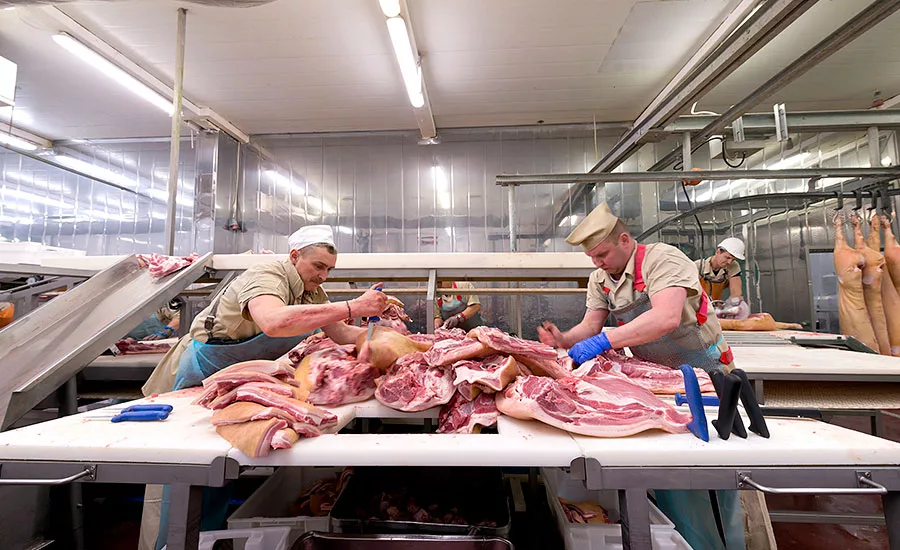
U.S. meatpacking plants still depend on worker skills for cutting, deboning and trimming.

U.S. meatpacking plants still depend on worker skills for cutting, deboning and trimming.

October 3, 2016

The job titles in a meatpacking plant — chuck boner, tender puller, back splitter, knuckle dropper, tail ripper — sound like professional wrestling moves. But they are all essential components of the meat processing system.

As other industries become more automated, U.S. meatpacking plants still depend on worker skills for cutting, deboning and trimming.

“To be profitable, companies move a tremendous amount of product through every day,” says Davey Griffin, Ph.D., professor and meat extension specialist at Texas A&M University, based in College Station, Texas.

Certainly, U.S. beef and pork plants have grown larger compared with their European counterparts.

“Cattle keeps getting bigger, as well, so there are more opportunities to look at more muscle separations and different cuts to satisfy consumers,” says Griffin.

That’s where butchers excel: skilled knife work to make more cuts, seam muscles and trim fat.

Finding the best cutting technique

Muscle profiling studies have targeted muscles for a variety of applications. A beef carcass is capable of 56 cuts of meat, after all.

In the past, carcasses used to be run through a saw for big cuts, says Griffin, but now the cuts are smaller and often follow the muscle seams, which requires more skilled knife work.

To separate the joint of meat, seam butchery techniques involve cutting along the natural seams.

“More is being done back up the chain, so the larger guys aren’t sending big cuts to stores anymore but doing them at the plant,” Griffin says.

Larger plants are upgrading their equipment or using mechanical aids to eliminate repetitive worker motions such as grabbing meat, he says.

Three-dimensional imaging and laser beams can saw evenly through meat to create sirloins, for example, that are of equal weight.

Circular knives also help reduce the repetitive motions associated with trimming pork, says Griffin.

In addition, hydraulic and pneumatic devices are being employed to make meat processing more efficient and less physically demanding, which should help with worker retention and ergonomic issues like carpal tunnel syndrome, says Griffin.  

Water-jet cutting has been around for decades, but is being used more frequently today — and with greater precision and safety — to trim beef and pork, says Dale Woerner, Ph.D., associate professor of meat safety & quality, Colorado State University, Fort Collins, Colo.

This method is also being used to trim the bone on rib-eye steaks, he says.

“Different cutting techniques work for different processes — use the best cutting technique for what you are doing,” says Gary McMurray, division chief, Food Processing Technology Division, Georgia Tech Research Institute in Atlanta.

For example, water jets also work well for cutting chicken breast fillets, but can’t penetrate the bird skeleton for shoulder cuts, he says.

“Rotary blades cut easily too but can’t discriminate between bone and meat; so static knives usually work the best for many applications,” McMurray says.

Automating cuts

High-level automation currently exists for lamb processing in Australia.

“There’s been a lot of talk of using robotics for deboning carcasses and making primal and subprimal cuts, but there haven’t been a lot of successes with beef because the uniformity of the animals — size, shape and composition — is not comparable to other animals,” Woerner says.

Processors are looking at automation to save wear and tear on their human labor — avoiding work-related injuries caused by long-term repetitive movements — not necessarily for speed, Woerner says.

“The use of laser-guided technology and robotics is the most feasible for breaking carcasses, such as with an automatic saw,” Woerner says. “Our industry would like to get there with automation, but there is not a lot of robotic implementation in beef.”

Adopting new technologies

Compared with beef, poultry is much more suitable for automatic processing systems. The product is smaller, more uniform and there are higher quantities to be slaughtered every day.

Last year, Georgia Tech Research Institute (GTRI) licensed its robotic Yield Scan Rapid Frame Analyzer, which collects and monitors meat yields in poultry cone line operations, to Gainco Inc.

“Processors want real time data on yield and technology to provide more answers,” says McMurray. “A lot of companies have come to use robotics as a solution for yield, worker safety concerns and worker availability.”

However, automation still faces challenges in poultry because it’s an unstructured process:  birds are wet, slippery and have different size specifications.

“Sensors can improve the slaughter process by identifying, locating and completing the necessary action,” says McMurray.

Robots still don’t come cheap. But the cost of technology in robotics has dramatically decreased in the last five years.

“Right now, a processor could buy a darn good robotic arm on the market for $25,000 — although not rated for food — which could probably be modified for food,” says McMurray. “There’s no way a company could build their own robotic arm for the same amount.”

Deep learning, for example, has also helped companies make strides with processing large amounts of data recently, he says.

“It’s a machine learning method that utilizes lots of data to help machines make lots of decisions,” McMurray says. “So if equipment is trying to identify the chicken breast, for example, the machine is shown thousands of pictures of parts that are labeled good or bad. The machine then learns an algorithm to help it make decisions very robustly.”

More companies are adopting new technologies from research companies, McMurray says.

“There’s more interest in technology than we’ve ever seen before,” he says. “I don’t think we’ll ever have a completely automated processing facility for poultry, but I can envision an integrated, real-time data process with robotic cells and distribution systems to optimize output.”  NP

KEYWORDS: automation cutting cutting equipment deboning

Share This Story

Looking for a reprint of this article?
From high-res PDFs to custom plaques, order your copy today!


Megan pellegrini
Megan Pellegrini is a contributing writer.

Recommended Content

JOIN TODAY
to unlock your recommendations.

Already have an account? Sign In

  • Double Charburger

    Premiumization drives burger category

    Shoppers seek out premium meat offerings to fulfill...
    Ingredients
    By: Sammy Bredar
  • JJS Adult Pekin duck

    Poultry Report 2025: Convenience propels poultry at retail

    Despite continued economic pressures, the poultry...
    Meat and Poultry Industry News
    By: Sammy Bredar
You must login or register in order to post a comment.

Report Abusive Comment

Manage My Account
  • eMagazine Subscriptions
  • Manage My Preferences
  • Newsletters
  • Online Registration
  • Subscription Customer Service
  • Connect with The National Provisioner

More Videos

Sponsored Content

Sponsored Content is a special paid section where industry companies provide high quality, objective, non-commercial content around topics of interest to the The National Provisioner audience. All Sponsored Content is supplied by the advertising company and any opinions expressed in this article are those of the author and not necessarily reflect the views of The National Provisioner or its parent company, BNP Media. Interested in participating in our Sponsored Content section? Contact your local rep!

close
  • A smiling man carrying a grocery basket is reaching down to pick up a package of meat in a grocery store.
    Sponsored byPIC

    The Green Light: New Data Shows 12-to-1 Support for Pork from PRRS-Resistant Pigs

  • Close up of a grocery cart full of groceries, a cropped image of a couple pushing the cart and a blurred background of the vegetable aisle.
    Sponsored byPIC

    New Market Research Finds Consumers in Eight Key Pork Markets Are Likely to Purchase Pork from Gene-Edited Pigs

  • Close up of a young pig with a blurred background.
    Sponsored byPIC

    New Research Forecasts Significant Economic and Market Impacts with PRRS-Resistant Pig Adoption

Popular Stories

JBS USA logo

JBS USA closing pair of processing facilities

New products include ready-to-heat proteins, flavor-forward lunchmeats and additions to the brand’s bacon portfolio.

Applegate Farms expands portfolio across deli, refrigerated and breakfast categories

New World Screwworm fly

USDA confirms presence of New World screwworm in US

2026 Top 100 Meat & Poultry Processors Report

Events

July 16, 2026

Strengthening Food Safety Plans for Modern Processing Operations

The live webinar will explore the latest technologies, emerging risks, and practical strategies shaping food safety programs across meat and poultry processing operations. Attendees will hear from industry experts on key challenges impacting processors today, along with approaches for strengthening and updating food safety plans across their facilities.

January 1, 2030

Webinar Sponsorship Information

For webinar sponsorship information, visit www.bnpevents.com/webinars or email webinars@bnpmedia.com.

View All Submit An Event

Products

Food Crime: An Introduction to Deviance in the Food Industry

Food Crime: An Introduction to Deviance in the Food Industry

See More Products
From Fresh to Frozen in 3 Minutes Flat: Unlocking the Secrets to Temperature Control Webinar Sponsored by Air Products

Related Articles

  • Jorge Izquierdo and Andy Hanacek

    Update on the transition toward robotics, automation in meat and poultry plants

    See More
  • Smoked meat

    Report sheds light on pitfalls of H-2B visa program in meatpacking

    See More
  • Plants with fixed automation systems can increase yields by at least 2 percent to 3 percent over workers

    Robotics and automation in meat and poultry plants

    See More

Related Products

See More Products
  • salmonela.jpg

    Controlling Salmonella in Poultry Production and Processing

  • emerging.jpg

    Emerging Technologies in Meat Processing: Production, Processing and Technology

  • advances.jpg

    Advances in Meat Processing Technology

See More Products

Events

View AllSubmit An Event
  • September 1, 2009

    Food Plant of the Future: Building Realistic Sustainability into Food and Beverage Plants

    On demand Using cost-effective design solutions, food and beverage processing facilities can meet the rigorous performance demands required in a processing and production environment and, at the same time, focus on sustainability.
  • September 9, 2010

    Food Plant of the Future: Surviving and Thriving with Automation

    On Demand: Hixson Architecture Engineering Interiors presents Surviving and Thriving with Automation.
View AllSubmit An Event

Related Directories

  • SPI Automation

    SPI Automation creates and integrates custom solutions for manufacturers to automate their operations. From robotics to integrated systems and the controls that power them, we design, manufacture, install, and support solutions to augment human potential.
×

Stay ahead of the curve. Unlock a dose of cutting-edge insights.

Receive our premium content directly to your inbox.

SIGN-UP TODAY
  • RESOURCES
    • Advertise
    • Contact Us
    • Directories
    • Store
    • Want More
  • SIGN UP TODAY
    • Create Account
    • eMagazine
    • Newsletter
    • Customer Service
    • Manage Preferences
  • SERVICES
    • Marketing Services
    • Reprints
    • Market Research
    • List Rental
    • Survey/Respondent Access
  • STAY CONNECTED
    • LinkedIn
    • Facebook
    • YouTube
    • X (Twitter)
  • PRIVACY
    • PRIVACY POLICY
    • TERMS & CONDITIONS
    • DO NOT SELL MY PERSONAL INFORMATION
    • PRIVACY REQUEST
    • ACCESSIBILITY

Copyright ©2026. All Rights Reserved BNP Media, Inc. and BNP Media II, LLC.

Design, CMS, Hosting & Web Development :: ePublishing