Robotics and automation in meat and poultry plants
Robotics are on course to be mainstays in meat and poultry plants as the technologies become more dynamic and cost effective.
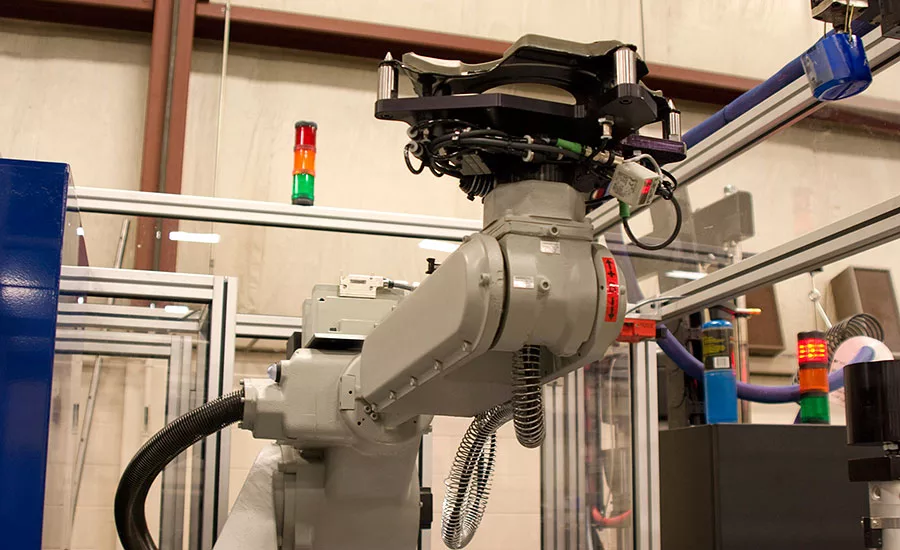
According to Georgia Institute of Technology senior research engineer, Ai-Ping Hu, plants with fixed automation systems can increase yields by at least 2 percent to 3 percent over workers.
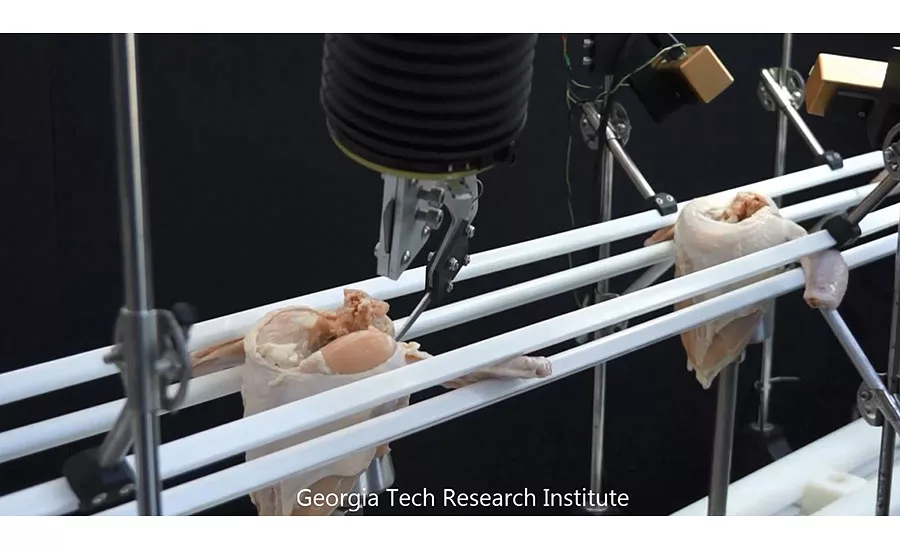
The Georgia Tech Research Institute is fine-tuning a robotic poultry deboning system that is intended to increase yields and cut plant operating expenses.
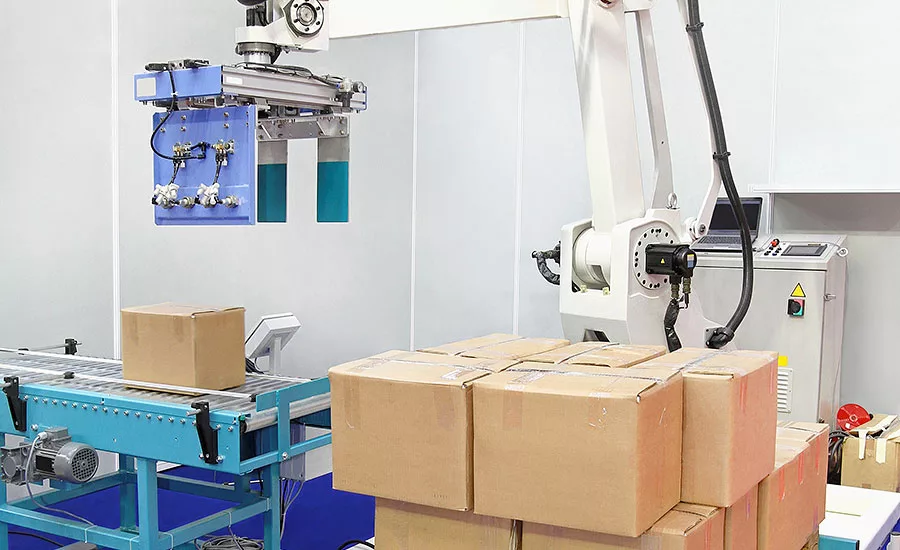
The adoption rate of robots in meat and poultry plants is likely to accelerate as the cost of the technology drops.
Efficiency is a key focus of meat and poultry producers. The ability to derive the maximum amount of meat from a carcass in the quickest time is a recipe for generating solid revenues.
The drive for optimal productivity is making automation increasingly important, and newer robotic technologies are among the machines set to play larger roles in plant operations. The devices — intended to match or exceed the speed, precision and reliability of human workers — have the advantage of being able to operate around the clock without performance lapses from fatigue, injury or motivation.
A September 2014 report by PricewaterhouseCoopers LLC, a New York-based consulting and professional services firm, notes 59 percent of manufacturers were using robotic technology at the time of the report. While just 7 percent of users were food and consumer goods companies, that is up from 3 percent in 2005.
While the firm reports that meat processors have been slow to adopt robotics, most notably because robotic components aren’t always compatible with the sanitation requirements for surfaces that come into contact with food, that could soon change. PricewaterhouseCoopers notes the U.S. Food and Drug Administration (FDA) recently approved wash-down robots and end-of-arm-tooling (EOAT) for use in direct food contact.
“These approvals have helped move robotics into the meat processing industry, where they improve food safety and sanitation by eliminating human contact with the food product,” PricewaterhouseCoopers reports.
The start of a major movement
Helping to push robotics into the spotlight is the 2015 move by the Australian unit of Sao Paulo, Brazil-based JBS SA, the world’s largest meat processor, to acquire a majority stake in Dunedin, New Zealand-based Scott Technology Ltd., a leading robotics manufacturer. A JBS spokesperson said the company cannot comment on the deal at presstime because it has not yet achieved regulatory clearance, but the message to the industry is clear.
“It always is about efficiency when replacing production lines with technology,” says Nathan Wrench, head of industrial and energy at Cambridge Consultants Ltd., a Cambridge, U.K.-based product design and development consulting firm. “It is where a cost-benefit analysis shows the greatest return.”
While robotic use in manufacturing plants began with the replacement of semi-manual machines that perform heavy lifting, evolving technologies are intended to enable robots to perform more dexterous and analytical functions that approach the abilities of humans in meat and protein operations, he says.
That includes determining the specific position of bones in carcasses before stripping off high-quality meat.
Among the most progressive developers is the Georgia Tech University Research Institute in Atlanta — the applied research and development unit of the Georgia Institute of Technology — which is working on a commercial application for its robotic technology with a major focus on deboning poultry.
The technology is currently about 95 percent accurate in locating the shoulder joint and cutting around, rather than through, bones, says Ai-Ping Hu, Georgia Tech Research Institute senior research engineer.
“There will be a lot of activity in 2016 in getting from 95 percent to 99.99 percent accuracy,” Hu says. “When cutting 40 birds a minute, 95 percent is not a good enough accuracy rate.”
Robots will be more effective in deboning poultry than fixed automation systems because of the technology’s ability to adjust the cutting path in accordance with the size of each bird, resulting in yield increases, he says.
“It goes beyond the typical ‘small,’ ‘medium’ and ‘large’ machine settings that are based on bird size,” he says. “Getting greater yield requires having more intelligence inside the machine.”
A clear vision for cutting
The Georgia Tech designs incorporate imaging technology that mimics humans’ sense of touch and vision in scrutinizing birds before cutting.
The vision technology takes a three-dimensional picture outside a carcass and deduces the internal bone structure and how a robot should proceed to get maximum meat from the carcass. The technology is applicable for different protein segments, including beef and pork, though it will have the greatest impact on poultry, Hu says.
“The smaller the animal, the harder it is to be precise in deboning because there is less room for error,” he says. “Being 1 centimeter off when working on a cow carcass still can result in a proper cut, but it can lead to cutting through bone on a chicken. That will leave meat behind and can generate a bone chip, causing a potential food safety hazard if the chip remains in the meat.”
He says the Georgia Tech technology can predict within 5 millimeters the location of a joint, which is more precise than what humans can do consistently.
Unlike most automation systems — which use a general machine setting for cutting, such as “medium,” in accordance with a bird’s weight — the Georgia Tech robotics will adjust to the specific parameters of each bird, Hu says.
“The weight doesn’t tell you about the size and the bone structure,” he says. “By not adjusting for every bird, you will not optimize cuts.”
The robotic machinery resembles a human arm and its dexterous cutting motions change after analyzing the image of each bird moving along a production line.
“Robots have the potential to revolutionize meat processing,” Hu says, noting Georgia Tech plans to have its deboning system operating in plants within a year.
The story is in the numbers
In calculating the financial advantages of replacing humans with machines, operators must go beyond the workers’ salaries and consider the differences in output, he says, noting a plant can lose $1.5 million annually from just a 1 percent decrease in yield.
Plants with fixed automation systems, meanwhile, can increase yields by at least 2 percent to 3 percent over workers, he says.
“Humans can generate really good yields at the beginning of their shifts, but their performance degrades during the course of the work day as they become tired,” Hu says. “More meat is left behind on the carcass as the shift goes on with an average of a 2 to 2 1/2 percent yield loss.”
Robots, meanwhile, can consistently generate the same yield as workers on their best days as the machines don’t become increasingly taxed or suffer injuries from performing repetitive tasks, he says.
The adoption rate of robots in meat and poultry plants is likely to accelerate as the cost of the technology drops.
While an automated cutting or deboning system can cost plants hundreds of thousands of dollars to install, Hu says he expects the price to eventually be cut in half with the development of newer systems.
“A meat laborer can cost an employer $22,000 a year, so it currently can be cheaper to use a worker instead of a machine,” Wrench says. “But as prices for robots come down there will be a stronger return on investment. The machine doesn’t get drunk and does not need health benefits.”
Wrench notes that once the price of robotics drops to three times the annual cost of supporting a worker, the switch will be a “no brainer.”
While there likely will be no major declines in the base cost of robotics over the next few years, he says functionality will improve.
Among the technical enhancements Georgia Tech is looking at is the development of a modular machine operators can wheel into place on production lines.
“The current fixed automated solutions have a huge installation cost and production has to stop if a machine is in need of repair,” Hu says. “If something goes wrong with the modular design, operators can just pull it out and the line can keep moving.”
Unlike past generation technology, the newer systems also can operate alongside workers as machines will automatically stop if contact is made with personnel, he says.
“The eventual goal is to have robots that are so safe that they can co-exist with people inside their homes,” Hu says. “We want to bring that technology to meat processing plants. Being able to easily move equipment on to lines also will reduce the need to perform expensive infrastructure and plant design changes to incorporate the machines.”
Solving a problem with people
In addition to lowering operating costs and increasing yields, replacing humans with robotics in plants also can help solve staffing problems.
“Deboning is one of the toughest jobs in a poultry operation and there often is 100 percent personnel turnover in plants over the course of a year,” Hu says. “It also is a job that also requires a several-weeks-long training period. The constant leaving and retraining of workers is a major issue, particularly as many companies have policies that prohibit the rehiring of workers after their leave their jobs.”
Wrench agrees, noting it is an ongoing challenge to find enough skilled personnel for meat and poultry production plants.
“Workers operate in high-pressure environments for low wages,” he says. “The problem for operators is getting good labor into the market space, which is why there is the interest in robotics. It is swapping a challenge for a solution.”
Meat and poultry operators are in the early stages of adopting robotics. While implementation costs are steep, evolving technologies that more closely match the functionality of humans while generating greater yields and operating efficiencies are set to become increasingly prominent in plants.
“Advancements in robotic technologies are driving changes,” Wrench says. “It is possible to do things now that were seen as science fiction 15 years ago.” NP
Looking for a reprint of this article?
From high-res PDFs to custom plaques, order your copy today!