Provisioner logo
Provisioner logo
search
cart
facebook twitter linkedin youtube
  • Sign In
  • Create Account
  • Sign Out
  • My Account
Provisioner logo
Provisioner logo
  • NEWS
    • Industry News
    • Supplier News
    • Case Studies
    • Recalls
    • Regulations
    • New Consumer Products
  • EXCLUSIVES
    • Newsletters
    • Source Book
    • Sponsored Insights
    • Events
    • Webinars
    • Classifieds
    • White Papers
    • Provisioner Store
    • Market Research
  • MEAT PROCESSING
    • SUSTAINABILITY
    • Processing
    • Packaging
    • Ingredients
    • Formulation
    • Food Safety
    • Special Reports
    • Commentary
  • PROFILES
    • Processor Profiles
    • Processor of the Year
    • Top 100 Processors
  • MEDIA
    • Videos
    • Podcasts
  • DIRECTORY
  • MIHOF
  • INDEPENDENT PROCESSOR
  • EMAG
    • eMagazine
    • ARCHIVE ISSUES
    • Contact
    • Advertise
  • JOIN!
Supplier News

Money-saving KDS sludge dewatering solves environmental and disposal issues for pork and livestock processors and food plants
By Industry News
CST Wastewater KDS
November 26, 2018

A compact and cost-efficient alternative to conventional dewatering technologies is being introduced to Australia and New Zealand to eliminate costs and OH&S hazards associated with damper and heavier output from pork processing and major food preparation operations.

The KDS Multidisc Separator system from CST Wastewater Solutions – which requires no washwater, while capturing 90-99 per cent of solids – is engineered to overcome the limitations of technologies such as screw presses, belt presses and centrifuges currently used.

Applications include small-to-medium pork, meat and livestock, poultry, fish, and dairy plants as well as large-scale food and beverage kitchens and catering facilities which face the challenge not only of handling heavy, sticky wet waste, but also the volume and  cost and OH&S hazards of transporting such unhygienic material to disposal facilities.

CST Wastewater Solutions Managing Director Mr. Michael Bambridge says benefits of particular importance to installations for the pork industry include:

  • Removal of solids from waste streams
  • Dewatering of sludges and solids
  • Screening and dewatering of pork processing wastes
  • Removal and dewatering of solids from waste waters
  • Dewatering of chemical sludges from DAF floats
  • Treatment of pig farm raw manure and sludge with cake dryness of 20-30 percent.

The largest energy-saving KDS unit can handle about 100kg DS (dry solids) an hour at 98 per cent solids capture, to produce this more hygienic and more compact output that is easier and cheaper to handle and transport, he says.

Used for dewatering of dissolved air flotation sludge – a very common application throughout waste water operations – The KDS achieves solids capture of 97 per cent thickened sludge at a dryness of 17 per cent. Waste activated sludge dryness levels are typically 15-18 per cent dryness.

The high quality, Japanese-manufactured technology:

  • Uses minimal energy, consuming as little as 0.06kW hr of electricity
  • Operates at low (63dBa) non-intrusive noise and vibration levels
  • Requires minimal daily maintenance, saving cost and enhancing OH&S performance
  • Occupies typically half the space or less of conventional dewatering plants
  • Is available as fixed compact units or skid-mounted types that can be carried on truck or trailer

This lighter, dryer waste it produces reduces the need for manual labor in cleaning and transport operations and curtails the need for staff to handle sloppy heavy waste potentially hazardous to health.

“With the KDS’ minimal water, power and space demands, it is ideally suited to both smaller-to-medium business and also to those operating in remote or environmentally sensitive situations,” said Bambridge.

How it works
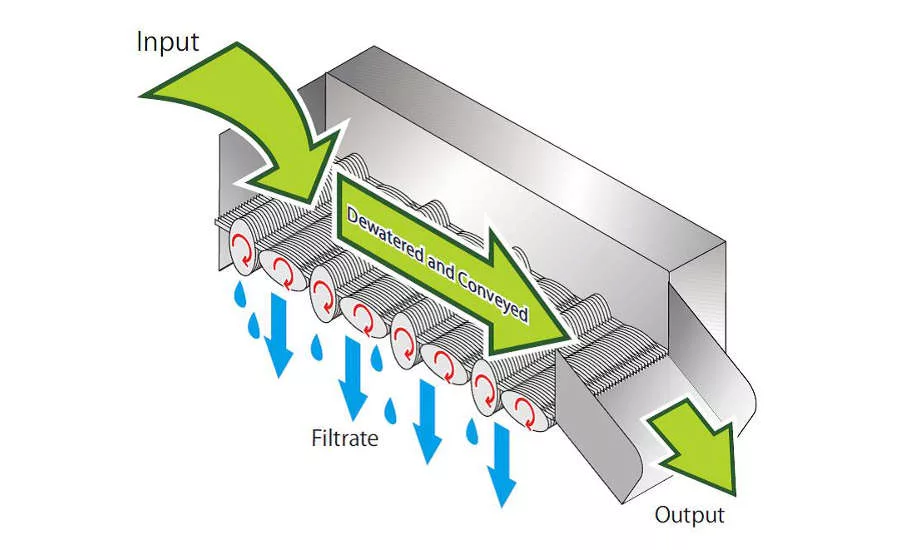
The clog-free automatic liquid-to-solid waste separator dewaters solids and conditioned sludge on a self-cleaning wedgewire belt. This static belt is cleaned by a unique set of rotating oval shape plates.

After the drainage and thickening zone, the thickened sludge passes a dewatering zone which consists of an adjustable plate, actuated manually or by pneumatic cylinder to further squeeze the solids.

The KDS’ unique self-cleaning dewatering and conveying system features an oval plate separation and transfer structure that prevents clogging and permits automatic continuous operation that handles oily and fibrous material with ease.

This simple-to-maintain separator offers a high throughput within a small body, with the smallest model being just under 350mm wide and weighing 50 kg. The compact rotational oval plate structure achieves high transportation and separation efficiencies, while the simplicity of the machine’s overall structure offers low maintenance, achieving cost and OH&S benefits through less handling being required to clear hazardous materials.

The technology involved in KDS separators, which have been proven in thousands of applications worldwide and recently specified in Australasia for use as a major element of a CST Wastewater Solutions installation on the World Heritage listed Lord Howe Island.

“The KDS separator uses a fraction of the power of a centrifuge and requires no water usage during operation, unlike a belt press or a screw press. For a relatively low investment cost, it also offers a high performance alternative to sludge drying beds and geobags, for example,” says Bambridge.

Applications for which the separator is designed include:

  • Food processing waste, including poultry and snack foods, kitchen and restaurant waste, raw wastewater (primary screening) and sludge
  • Abattoir, feedlots, and dairy farm wastewater and sludge. Cattle manure cake dryness of 25-35 per cent is typically achieved
  • Pig farm raw manure and sludge, with cake dryness of 20-30 per cent.
  • Barrel polishing water, water-based paint wastewater, grease trap waste, dyeing wastewater, waste oil, and plastic recycling.
  • Seafood processing
  • Sewage treatment, including raw wastewater (primary screening) and sludge to landfill

For more information, visit www.cstwastewater.com.

KEYWORDS: waste wastewater

Share This Story

Looking for a reprint of this article?
From high-res PDFs to custom plaques, order your copy today!


Recommended Content

JOIN TODAY
to unlock your recommendations.

Already have an account? Sign In

  • Double Charburger

    Premiumization drives burger category

    Shoppers seek out premium meat offerings to fulfill...
    Burgers
    By: Sammy Bredar
  • JJS Adult Pekin duck

    Poultry Report 2025: Convenience propels poultry at retail

    Despite continued economic pressures, the poultry...
    Chicken
    By: Sammy Bredar
You must login or register in order to post a comment.

Report Abusive Comment

Manage My Account
  • eMagazine Subscriptions
  • Manage My Preferences
  • Newsletters
  • Online Registration
  • Subscription Customer Service
  • Connect with The National Provisioner

More Videos

Sponsored Content

Sponsored Content is a special paid section where industry companies provide high quality, objective, non-commercial content around topics of interest to the The National Provisioner audience. All Sponsored Content is supplied by the advertising company and any opinions expressed in this article are those of the author and not necessarily reflect the views of The National Provisioner or its parent company, BNP Media. Interested in participating in our Sponsored Content section? Contact your local rep!

close
  • A smiling man carrying a grocery basket is reaching down to pick up a package of meat in a grocery store.
    Sponsored byPIC

    The Green Light: New Data Shows 12-to-1 Support for Pork from PRRS-Resistant Pigs

  • Close up of a grocery cart full of groceries, a cropped image of a couple pushing the cart and a blurred background of the vegetable aisle.
    Sponsored byPIC

    New Market Research Finds Consumers in Eight Key Pork Markets Are Likely to Purchase Pork from Gene-Edited Pigs

  • Close up of a young pig with a blurred background.
    Sponsored byPIC

    New Research Forecasts Significant Economic and Market Impacts with PRRS-Resistant Pig Adoption

Popular Stories

JBS USA logo

JBS USA closing pair of processing facilities

Various new Primal snack sticks on a table amongst pencils, apples, a pair of glasses, lunch bags and a water bottle.

Protein demand drives snacking occasions

Several cuts of beef, pork and chicken on a wooden board, cast iron pan and salt.

Validated thermal lethality data and a new tool for ensuring safety of RTE meats

2026 Top 100 Meat & Poultry Processors Report

Events

January 1, 2030

Webinar Sponsorship Information

For webinar sponsorship information, visit www.bnpevents.com/webinars or email webinars@bnpmedia.com.

View All Submit An Event

Products

Food Crime: An Introduction to Deviance in the Food Industry

Food Crime: An Introduction to Deviance in the Food Industry

See More Products
From Fresh to Frozen in 3 Minutes Flat: Unlocking the Secrets to Temperature Control Webinar Sponsored by Air Products

Related Articles

  • Misbranded pork and beef tortellini product

    FSIS issues alert for misbranded pork and beef tortellini product

    See More
  • The next generation food plants

    See More
  • 2020_corona_image_np.jpg

    Two Illinois food plants see outbreaks of COVID-19

    See More

Related Products

See More Products
  • meat quality.jpg

    Meat Quality: Genetic and Environmental Factors

  • food safety.jpg

    Food Safety in the Seafood Industry: A Practical Guide for ISO 22000 and FSSC 22000 Implementation

  • Food Plant Sanitation: Design, Maintenance, and Good Manufacturing Practices, Second Edition

See More Products

Events

View AllSubmit An Event
  • September 1, 2009

    Food Plant of the Future: Building Realistic Sustainability into Food and Beverage Plants

    On demand Using cost-effective design solutions, food and beverage processing facilities can meet the rigorous performance demands required in a processing and production environment and, at the same time, focus on sustainability.
View AllSubmit An Event

Related Directories

  • Shelf-Stable Food Processors Assn.

    Shelf-Stable Food Processors Association (SFPA) is a trade association representing the interests of shelf-stable food processors and their suppliers on issues affecting the industry.
×

Stay ahead of the curve. Unlock a dose of cutting-edge insights.

Receive our premium content directly to your inbox.

SIGN-UP TODAY
  • RESOURCES
    • Advertise
    • Contact Us
    • Directories
    • Store
    • Want More
  • SIGN UP TODAY
    • Create Account
    • eMagazine
    • Newsletter
    • Customer Service
    • Manage Preferences
  • SERVICES
    • Marketing Services
    • Reprints
    • Market Research
    • List Rental
    • Survey/Respondent Access
  • STAY CONNECTED
    • LinkedIn
    • Facebook
    • YouTube
    • X (Twitter)
  • PRIVACY
    • PRIVACY POLICY
    • TERMS & CONDITIONS
    • DO NOT SELL MY PERSONAL INFORMATION
    • PRIVACY REQUEST
    • ACCESSIBILITY

Copyright ©2026. All Rights Reserved BNP Media, Inc. and BNP Media II, LLC.

Design, CMS, Hosting & Web Development :: ePublishing