Food Safety
Benefits to post-packaging pasteurization
The prime benefit of post-packaging pasteurization is food safety through re-pasteurizing the surface on products that were re-exposed after cooking.
For example, most ready-to-eat (RTE) meats and poultry that are cooked in a bag are safe if sold or distributed that way after cooking, but processors remove the products from the bags after cooking to eliminate excess liquid purge, which is aesthetically unappealing, opening up the opportunity for contamination, explains Peter Muriana, professor and food microbiologist for the Robert M. Kerr Food and Agricultural Products Center and the Department of Animal and Food Sciences at Oklahoma State University in Stillwater. Processors also expose RTE meats and poultry on trays on racks, rolled into blast chillers, contributing to additional exposure after cooking and creating the opportunity for re-contamination. In addition, after chilling, RTE meats and poultry are packaged in retail-ready packaging, creating yet another opportunity for exposure, Muriana says.
In pre-package pasteurization, processors send the deli meats through a heated tunnel. For example, the conveyor belt carries the meat through red-hot coils for approximately 60 seconds, and the meat must be vacuum-packaged immediately before the surface cools down, Muriana says. This pre-package pasteurization is a U.S. Department of Agriculture (USDA)-approved post-process lethality step. Usually, a bagging operation is directly at the exit of the radiant heat oven, Muriana says.
Or, the products could be vacuum packaged first and then sent through submersed water pasteurizers for two to three minutes at 190 to 205 degrees Fahrenheit.
“The excess heat absorbed by this submersed water pasteurizer often requires the use of a blast chiller to remove the absorbed heat,” Muriana says. “The shorter duration of time in the radiant oven doesn’t need the blast chiller, but could be used. Both processes result in pasteurizing the surface of the RTE meat products that could have picked up incidental Listeria contamination during post-cook/unbagging/chilling/exposed product operations.”
Gary Acuff, president of Acuff Consulting, College Station, Texas, also believes the biggest benefit of post-packaging pasteurization is the reduction in recontamination.
“Once you’ve got the products sealed in a package, then any treatment that you would give it at that point would reduce or possibly eliminate any contamination that exists on the product,” he says. “There’d be no chance for recontamination at least until the receiver opened it whether that’s the consumer or food service.”
Additional benefits
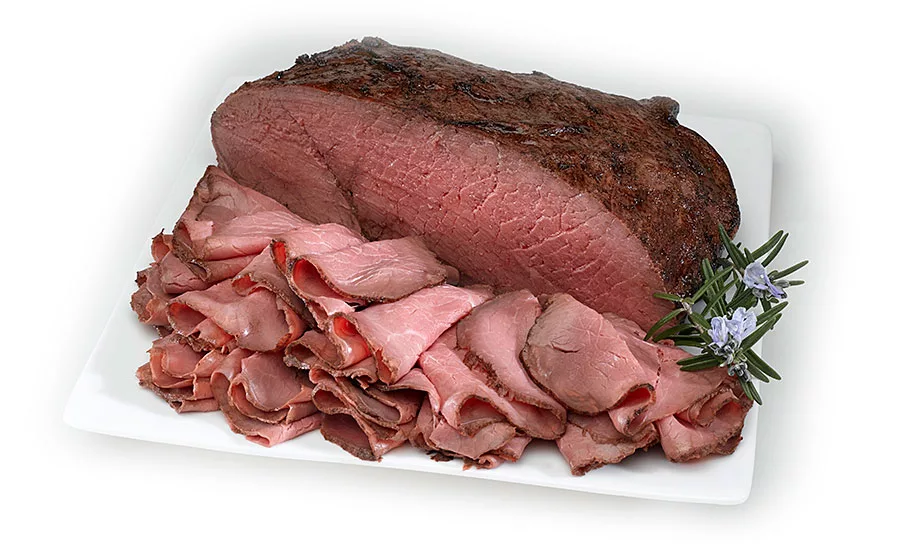
While most post-packaging pasteurization applications address food safety, shelf-life benefits also have been shown. Muriana has conducted a study on roast beef cuts, which were split in half. One half was vacuum-packaged directly, while the other half went through the radiant oven for pre-package pasteurization. The roasts were stored for eight to 10 weeks, and researchers would test several halves from the original roast at each testing period. The products that were surface pasteurized literally had baseline levels of total surface organisms (Aerobic Plate Count), while those that were simply vacuum-packaged without radiant oven surface pasteurization had increasing microbial counts during the holding period.
“This correlated with anecdotal reference by processors who were using this pasteurization process that since using it, they have had fewer returns or claims of product that was spoiled or reached unacceptable microbial counts,” Muriana says.
Muriana also thinks some of the radiant oven product looked better because of a little surface heating, i.e., slightly broiled appearance, as a product cooked in a bag is not as appealing.
“To a customer, it may be visible when looking at the intact product in a deli-display case packaged in clear wrap, but after slicing, it wouldn’t be noticeable,” he says.
Instances also have occurred when a plant had some RTE meat products that were processed through post-process pasteurization, but not all. Then the plant underwent a recall of processed meats, except for those that were post-process pasteurized, which were not recalled.
“I believe the supermarkets that were knowledgeable of the recalls but who had purchased the post-process pasteurized products were very much enamored that they weren’t involved in the recalls and reinforced the benefit of the process on that side of the issue,” Muriana says.
Personally, Muriana likes the submersed water process for post-process pasteurization because it has an even and consistent contact with product. Water also is being circulated and is kept at constant temperature.
One of the biggest problems Muriana has observed is that he would conduct a process validation for a company, which often required pre-package pasteurization times of approximately 60 to 75 seconds or post-package pasteurization of two to three minutes. For example, the product would have the stipulated safety levels only if run for that length of time in those specific processes, only later to find out that in some places, whoever was in charge didn’t understand food safety validation and shortened those running times in order to run more product through.
“They inadvertently were running outside the validated conditions,” Muriana explains.
Researchers also continue to work on new post-packaging pasteurization technologies, including high-pressure processing and a radio frequency system, which is basically a microwave shown to be effective, Acuff says.
“All of these treatments impart some sort of bacterial reduction on the final product within the package, but you have to balance that with potential damage to the product, and/or unacceptable sensory changes,” he explains. “Not all treatments are likely to work with all products. I think it’s going to end up being unique to whatever products you have and what sensory characteristics you have to preserve in it.”
For example, a processor with a low-moisture product would be concerned about oxidation. Whatever treatment is applied, the processor needs to make sure it didn’t cause oxidation of any fat in the product, Acuff says. In addition, because the product is low moisture, bacteria tend to have a higher survival rate. A processor then might have to find a post-packaging pasteurization treatment that would provide a much greater heat treatment than a processor would on a piece of meat or a piece of poultry that is in the package. “All the products are really different in terms of what works,” Acuff says.
Acuff says the greatest concern for processors is making sure it works with their specific product because suppliers will tell processors they have a silver bullet for their needs. “You’ve really got to validate it with your particular product and your processing and your packaging,” Acuff says. “It has to absolutely work with your system, and it’ll be different for everybody.”
“This is definitely where people need to be going in the future,” he adds. “I just don’t know what process will shake out as the best one.” NP
Looking for a reprint of this article?
From high-res PDFs to custom plaques, order your copy today!