Considerations for effective cleaning-in-place (CIP) systems
Maintaining hygienic — in some cases, sterile — production environments and equipment is a key requirement for modern food processing machinery.
The production of safe food and drink products is of paramount importance to producers, and maintaining hygienic — in some cases, sterile — production environments and equipment is a key requirement for modern food processing machinery. Apart from the simplest systems, most equipment today, particularly that which contains pipework, enclosed spaces and small apertures, is cleaned in situ without the need for dismantling or opening, and with minimal operator intervention — a technique which is known as cleaning-in-place (CIP).
Cleaning (or clean) in place has been around since the 1950s and can be defined as a method of automated cleaning of the interior surfaces of equipment, without major disassembly. One of the most widely quoted definitions of the term is taken from the 1990 edition of the Society of Dairy Technology (SDT) Manual "Cleaning In Place," which defines CIP as “The cleaning of complete items of plant or pipeline circuits without dismantling or opening of the equipment and with little or no manual involvement on the part of the operator. The process involves the jetting or spraying of surfaces or circulation of cleaning solutions through the plant under conditions of increased turbulence and flow velocity.”
Design considerations for CIP
The main purpose of CIP is to remove physical dirt and residues, as well as bacteria. It is commonly used for equipment such as piping, tanks and fillers. CIP employs turbulent flow or spraying and can also be accomplished with filling, soaking and agitation.
As well as ensuring that production equipment is hygienically clean and suitable for use, CIP also plays a number of other important roles. CIP systems should ensure that no cleaning fluids or contaminants remain in the equipment — ensuring food safety, and, by reducing the effort and downtime required for cleaning, they also ensure production cycles are efficient and cost-effective. Because of the automated or semi-automated nature of CIP systems, they provide improved control of the cleaning parameters to ensure consistent results, as well as automatic record keeping for traceability and due diligence purposes. Furthermore, being automatic reduces the need for human contact with potentially harmful cleaning agents or other chemicals.
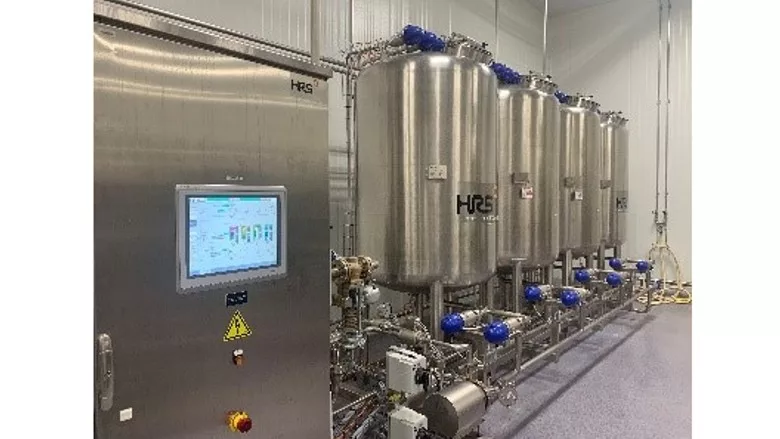
However, if CIP is to be effective, not only does the CIP system itself need to be well designed, but the production equipment itself needs to be designed with effective CIP in mind from the beginning. Equipment and machinery must be hygienically designed and easy to manage, maintain and audit. Because of the specialized and custom nature of much food and drink processing machinery, some CIP systems will be designed specifically for a particular system or piece of equipment, although with careful design it is not uncommon to install a dedicated CIP system, such as those available from HRS.
The design process must not only ensure effective cleaning, but should also be as efficient as possible in terms of water, chemical and energy use. Considerations for the equipment itself include areas such as surface roughness, clean welding and the prevention of inaccessible areas or corners where dirt and/or cleaning chemicals may build up. Reliability is also an important consideration, and CIP systems must be designed to work for as long as the working lifetime of the equipment involved. It is also important to consider how user-friendly the control systems for the CIP are. For example, are they part of the overall control interface or a separate system? Another key element of an effective system is monitoring and validation of the cleaning results for traceability and due diligence purposes, and from the beginning, the design of the equipment should allow this to be done in an effective manner.
Typical CIP processes
Most CIP employs a similar set of operations, including
- Pre-rinsing — to remove large debris and residues
- Detergent cleaning — to remove attached dirt and soiling using a caustic detergent
- Rinsing — to remove detergent and dirt
- Optional acid cleaning — if required to remove scaling or alkaline residues
- Rinsing — to remove the acidic cleaning agent
- Disinfection — heat or chemical treatment to disinfect the equipment
- Final rinse — to remove all traces of chemicals and prevent contamination
These steps may be combined or used in different ways. For example, using detergent at high temperatures may clean and disinfect equipment at the same time, or using steam may reduce the need for chemical detergents. Depending on the design of the system, and the risk of contamination, cleaning solutions may be reused multiple times or discarded immediately. There may also be differences between CIP and SIP (sterilize-in-place) systems.
While the actual cleaning regime used will depend on a number of factors, including the risk category of the food or drink product, the physical and chemical properties of the product and the design of the machinery in question, in many situations it is preferable to rely on water alone (together with temperature, pressure and agitation) rather than additional cleaning chemicals which could present a contamination risk. In general, the higher temperatures and greater kinetic energy provide more efficient cleaning, but the duration of the CIP cycle will be optimized according to the properties mentioned above.
Where detergents are required, one of the most common is caustic soda (NaOH), although many other alkali- and acid-based chemicals are available depending on the nature of the product and residues which need to be cleaned. Alkali materials are generally more effective against proteins and fats, while acids perform better where salts need to be removed. For sugars, water remains one of the most effective cleaning mediums.
HRS CIP systems
HRS offers two types of CIP (and SIP) systems. The first type is those which are integrated into other systems, such as HRS pasteurizers and sterilizers, as well as HRS' Aseptic Block Series and aseptic fillers, for example. The second is the HRS series of stand-alone CIP and SIP systems. These are available with single (ST) or multiple tanks, which are heated with an HRS K Series heat exchanger. Fully skid-mounted and modular design enables for quick and easy site installation, and the fully automated systems are supplied with a programmable logic controller (PLC) system, which can operate on its own or be integrated into the factory’s main control system.
Source: Matt Hale, International Sales & Marketing Director, HRS Heat Exchangers
Looking for a reprint of this article?
From high-res PDFs to custom plaques, order your copy today!