Provisioner logo
Provisioner logo
search
cart
facebook twitter linkedin youtube
  • Sign In
  • Create Account
  • Sign Out
  • My Account
Provisioner logo
Provisioner logo
  • NEWS
    • Industry News
    • Supplier News
    • Case Studies
    • Recalls
    • Regulations
    • New Consumer Products
  • EXCLUSIVES
    • Newsletters
    • Source Book
    • Sponsored Insights
    • Events
    • Webinars
    • Classifieds
    • White Papers
    • Provisioner Store
    • Market Research
  • MEAT PROCESSING
    • SUSTAINABILITY
    • Processing
    • Packaging
    • Ingredients
    • Formulation
    • Food Safety
    • Special Reports
    • Commentary
  • PROFILES
    • Processor Profiles
    • Processor of the Year
    • Top 100 Processors
  • MEDIA
    • Videos
    • Podcasts
  • DIRECTORY
  • MIHOF
  • INDEPENDENT PROCESSOR
  • EMAG
    • eMagazine
    • ARCHIVE ISSUES
    • Contact
    • Advertise
  • JOIN!
Meat and Poultry Industry NewsMeat and Poultry ProcessingChickenIndependent Processor

Commentary: AMSA

Intensity Ultrasonication can help to mitigate excessive hardness of Woody Breast meat in broilers

The defect compromises the sensory properties and functionality of the final product.

By Baldi, G., Gargliano, M.A., Soglia, F., D'elia, F., Laghi, L., Rocculi, P. & Petracci, M.
Grilled chicken breast, fillet, steak on wooden board
Getty Images/iStockphoto
Opening image credit: GettyImages / Mizina / iStock / Getty Images Plus
July 2, 2024

In order to satisfy the growing demand of poultry meat, selection criteria for fast-growing broilers have been addressed to improve especially the pectoralis major muscles, which represent the most valuable portion of the carcass and are used for both processed and fresh meat products.

Beside their undeniable positive implications on productive performance and meat yield, these procedures have brought the appearance of abnormalities affecting the fillets. Among them, the Woody Breast (WB) defect strongly compromises the sensory properties and functionality of the final product. Chicken breasts affected by WB abnormality show a hardened consistency (which may be restricted to some area or diffusely distributed over the whole surface of the muscle) and pale appearance. This defect not only manifest at macroscopic level but is also associated to altered features which can be observed at the microscope, including an overall re-organization of the muscle tissue in which fibers degeneration can be observed along with an excessive synthesis and deposition of connective tissue. Overall, the occurrence of this defect has a significant impact on the technological characteristics and nutritional value of breast meat, causing significant industrial economic losses, as a consequence of the downgrading and/or discarding of the affected meats.

Although in the past few years many research activities have been conducted trying to reduce the incidence of this defect or, at least, to mitigate its negative effects on meat quality, the results obtained so far did not allow to improve the functionality of WB fillets and exploit it to its maximum potential. From this perspective, a trial has been conducted to ascertain the effects of high intensity ultrasound (HIU) treatment on WB meat to evaluate its eventual ability to improve meat tenderness. HIU is an emerging technology having a wide range of applications in the meat sector. In detail, this technology is exploited in light of its potential ability to improve the functional properties of meat through cavitation-induced mechanisms that can affect biological tissues at both macroscopic and microscopic levels.
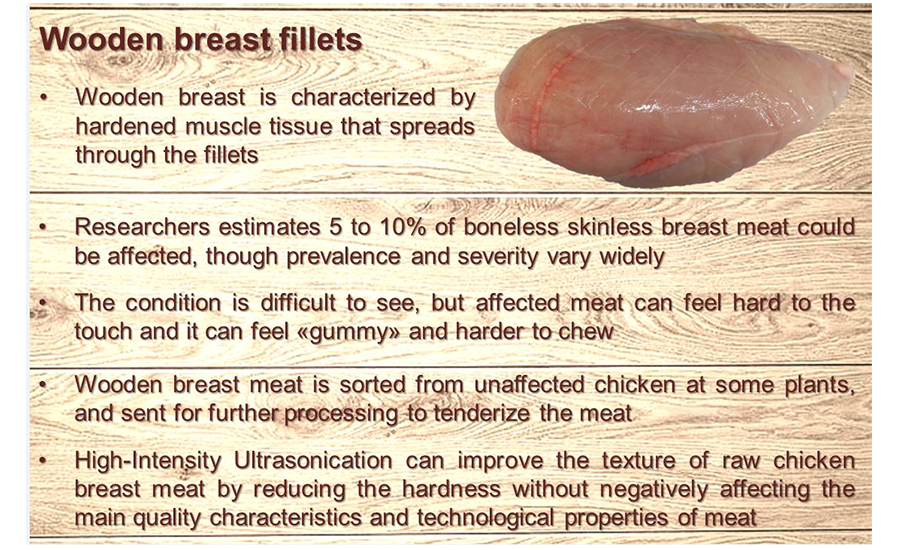
wooden breast fillets
Second image credit: AMSA

In our article, overall we proved that HIU can improve the texture of raw chicken breast meat by reducing the hardness without negatively affecting the main quality characteristics and technological properties of meat, such as color and water holding capacity, regardless of the occurrence of the WB condition. Based on the findings achieved in this study, the softening effect associated with HIU treatment seemed not to be due to a water redistribution within the muscle compartments or to a heat-induced protein denaturation as meat samples were treated at refrigerated temperatures. Rather, we hypothesize that the reduced compression forces observed in unaffected meats following HIU treatment might be due to structural changes such as the physical degradation of myofibrillar structures caused by the cavitation process itself. In this scenario, it could be speculated that the myodegenerative lesions typically occurring in WB muscles (i.e., the massive deposition of interstitial connective tissue) may have partially counteracted the mechanical effects of ultrasonic waves on muscle cells’ structures, making the elucidation of the mechanisms that lead to WB meat softening particularly complex. Therefore, we plan to carry out further studies to better elucidate whether the softening of WB muscle following HIU should be truly imputable to the physical damage of myofibrillar protein structures rather than the fragmentation of collagenous macromolecules as well as to determine if it is maintained also after meat processing and cooking operations.

KEYWORDS: American Meat Science Association (AMSA) broilers meat science poultry

Share This Story

Looking for a reprint of this article?
From high-res PDFs to custom plaques, order your copy today!


Recommended Content

JOIN TODAY
to unlock your recommendations.

Already have an account? Sign In

  • Double Charburger

    Premiumization drives burger category

    Shoppers seek out premium meat offerings to fulfill...
    Beef
    By: Sammy Bredar
  • JJS Adult Pekin duck

    Poultry Report 2025: Convenience propels poultry at retail

    Despite continued economic pressures, the poultry...
    Turkey
    By: Sammy Bredar
You must login or register in order to post a comment.

Report Abusive Comment

Manage My Account
  • eMagazine Subscriptions
  • Manage My Preferences
  • Newsletters
  • Online Registration
  • Subscription Customer Service
  • Connect with The National Provisioner

More Videos

Sponsored Content

Sponsored Content is a special paid section where industry companies provide high quality, objective, non-commercial content around topics of interest to the The National Provisioner audience. All Sponsored Content is supplied by the advertising company and any opinions expressed in this article are those of the author and not necessarily reflect the views of The National Provisioner or its parent company, BNP Media. Interested in participating in our Sponsored Content section? Contact your local rep!

close
  • A smiling man carrying a grocery basket is reaching down to pick up a package of meat in a grocery store.
    Sponsored byPIC

    The Green Light: New Data Shows 12-to-1 Support for Pork from PRRS-Resistant Pigs

  • Close up of a grocery cart full of groceries, a cropped image of a couple pushing the cart and a blurred background of the vegetable aisle.
    Sponsored byPIC

    New Market Research Finds Consumers in Eight Key Pork Markets Are Likely to Purchase Pork from Gene-Edited Pigs

  • Close up of a young pig with a blurred background.
    Sponsored byPIC

    New Research Forecasts Significant Economic and Market Impacts with PRRS-Resistant Pig Adoption

Popular Stories

Spam Dog

Hormel rolls out Spam hot dog for foodservice applications

Niman Ranch Uncured Grass-Fed Beef Bacon

Niman Ranch introduces beef bacon

Various new Primal snack sticks on a table amongst pencils, apples, a pair of glasses, lunch bags and a water bottle.

Protein demand drives snacking occasions

2026 Top 100 Meat & Poultry Processors Report

Events

June 11, 2026

From Fresh to Frozen in 3 Minutes Flat: Unlocking the Secrets to Temperature Control

Join Tony Vacaro, Foods Industry Manager, and Emile Klein, Foods Market Strategy Manager at Air Products and Chemicals, Inc. , as they tackle key questions surrounding heat removal in food processing. 

January 1, 2030

Webinar Sponsorship Information

For webinar sponsorship information, visit www.bnpevents.com/webinars or email webinars@bnpmedia.com.

View All Submit An Event

Products

Food Crime: An Introduction to Deviance in the Food Industry

Food Crime: An Introduction to Deviance in the Food Industry

See More Products
From Fresh to Frozen in 3 Minutes Flat: Unlocking the Secrets to Temperature Control Webinar Sponsored by Air Products

Related Articles

  • Seven brown and white cows

    Recent study findings can help to protect U.S. cattle against pinkeye

    See More
  • USPOULTRY logo

    Researchers address early incubation temperature effects on the development of wooden breast in broilers

    See More
  • CQ Foods Woody Breast

    CQ Foods introduces new tech device to detect major poultry industry challenge: woody breast

    See More

Related Products

See More Products
  • GlobalData_logo_blue_header.png

    Frozen Meat (Meat) Market in the United States of America - Outlook to 2023...

  • GlobalData_logo_blue_header.png

    Fresh Meat (Counter) (Meat) Market in the United States of America - Outlook to 2023...

  • GlobalData_logo_blue_header.png

    Chilled Raw Packaged Meat - Whole Cuts (Meat) Market in the United States of America - Outlook to 2023...

See More Products

Related Directories

  • Missouri Assn. of Meat Processors

    The Missouri Association of Meat Processors was founded in 1939, by a small group of meat business operators who were looking for a way to promote their products and businesses. MAMP helps members expand into new markets and learn new skills. Its dual mission of protection and education for members are enhanced by unique marketing opportunities available through the Association. MAMP provides 10 newsletters a year and provides training to keep the small processor ahead of the trends.
  • Pennsylvania Assn. of Meat Processors

    The Pennsylvania Association of Meat Processors was formed in 1939, when a group of frozen food locker owners formed a support group. Our current members range from Processors, Slaughter, Retail, Catering, Game Processing and Suppliers in the industry. PAMP is affiliated with the American Association of Meat Processors. We hold an annual convention every May with educational classes and a supplier showcase. We would love to have you join and attend our show.
×

Stay ahead of the curve. Unlock a dose of cutting-edge insights.

Receive our premium content directly to your inbox.

SIGN-UP TODAY
  • RESOURCES
    • Advertise
    • Contact Us
    • Directories
    • Store
    • Want More
  • SIGN UP TODAY
    • Create Account
    • eMagazine
    • Newsletter
    • Customer Service
    • Manage Preferences
  • SERVICES
    • Marketing Services
    • Reprints
    • Market Research
    • List Rental
    • Survey/Respondent Access
  • STAY CONNECTED
    • LinkedIn
    • Facebook
    • YouTube
    • X (Twitter)
  • PRIVACY
    • PRIVACY POLICY
    • TERMS & CONDITIONS
    • DO NOT SELL MY PERSONAL INFORMATION
    • PRIVACY REQUEST
    • ACCESSIBILITY

Copyright ©2026. All Rights Reserved BNP Media, Inc. and BNP Media II, LLC.

Design, CMS, Hosting & Web Development :: ePublishing