US cattle slaughter likely to fall further in the coming year
Fewer heifers are expected to flow into feedlots in 2026.
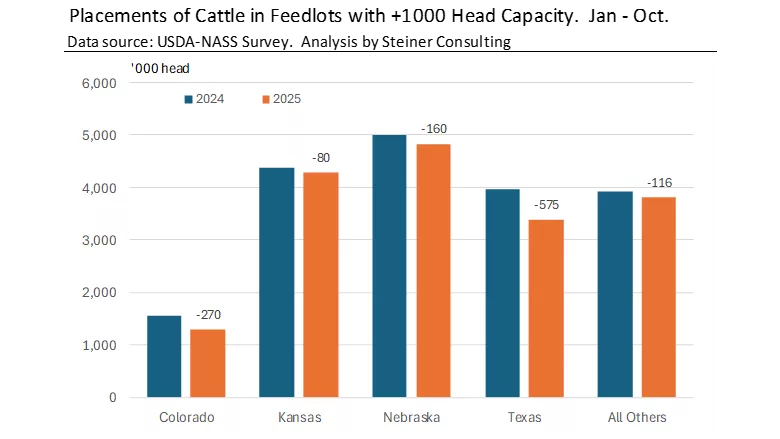
By the end of this week, USDA will publish the results of its monthly survey of feedlots with 1000+ head capacity, and it is a foregone conclusion that cattle on feed will be lower than a year ago. Between January and October, based on actual figures, feedlots with 1000+ head capacity placed 17.6 million head of cattle on feed, 1.2 million head, or 6.4%, less than a year ago.
This shortfall, combined with the increasing difficulty in finding replacement cattle, has encouraged producers to slow the pace of marketings and make up some of the decline by feeding cattle to heavier weights. The average steer weight may touch 990 pounds at some point this year.
Much of the discussion in the market has focused on the impact that the decline in the cattle herd and the resulting smaller calf crop have had on US beef supplies. However, when we step back and look at what has happened this year, it becomes clear that the suspension of feeder cattle imports from Mexico has had just as big, if not a bigger, impact. Through October, placements in Nebraska feedlots were down 160,000 head, or 3.2%, while placements in Kansas feedlots were down only 80,000 head, or 1.8%. By far the biggest reduction in cattle placements has been in Texas, down 575,000 head, or 14.5%.
We think that in November and December, Texas placements will decline by another 125,000 head. As a result, Texas alone will account for a reduction of around 700,000 head in 2025 placements, more than the combined decline in placements for the other top three cattle feeding states. The smaller calf crop was one reason for fewer placements in Texas, but the primary driver was the shortfall in Mexican cattle imports.
This is also why futures markets freaked out in late October on speculation that USDA was getting close to reopening the border to Mexican cattle. That did not happen, and in the last three weeks US fed cattle futures have gained around $26/cwt, or 13%. Mexican officials continue to track New World Screwworm infestations in the country, with some 964 active cases as of this writing. Most of these cases are concentrated in southern states of Mexico, although authorities continue to find cases within the 400-mile buffer from the US border.
We do not know when or how USDA will decide to resume trade with Mexico, but even when that happens, trade is likely to be slow given the extra screening requirements. Combined with fewer heifers expected to flow into feedlots in 2026, this is likely to further reduce US cattle slaughter next year.
Looking for a reprint of this article?
From high-res PDFs to custom plaques, order your copy today!