Provisioner logo
Provisioner logo
search
cart
facebook twitter linkedin youtube
  • Sign In
  • Create Account
  • Sign Out
  • My Account
Provisioner logo
Provisioner logo
  • NEWS
    • Industry News
    • Supplier News
    • Case Studies
    • Recalls
    • Regulations
    • New Consumer Products
  • EXCLUSIVES
    • Newsletters
    • Source Book
    • Sponsored Insights
    • Events
    • Webinars
    • Classifieds
    • White Papers
    • Provisioner Store
    • Market Research
  • MEAT PROCESSING
    • SUSTAINABILITY
    • Processing
    • Packaging
    • Ingredients
    • Formulation
    • Food Safety
    • Special Reports
    • Commentary
  • PROFILES
    • Processor Profiles
    • Processor of the Year
    • Top 100 Processors
  • MEDIA
    • Videos
    • Podcasts
  • DIRECTORY
  • MIHOF
  • INDEPENDENT PROCESSOR
  • EMAG
    • eMagazine
    • ARCHIVE ISSUES
    • Contact
    • Advertise
  • JOIN!
Meat and Poultry Industry NewsRegulations

USDA opens research lab to combat livestock pests

Knipling-Bushland US Livestock Insects Research Laboratory houses two ARS research units: the Livestock Arthropod Pest Research Unit and the Veterinary Pest Genetics Research Unit.
By Industry News
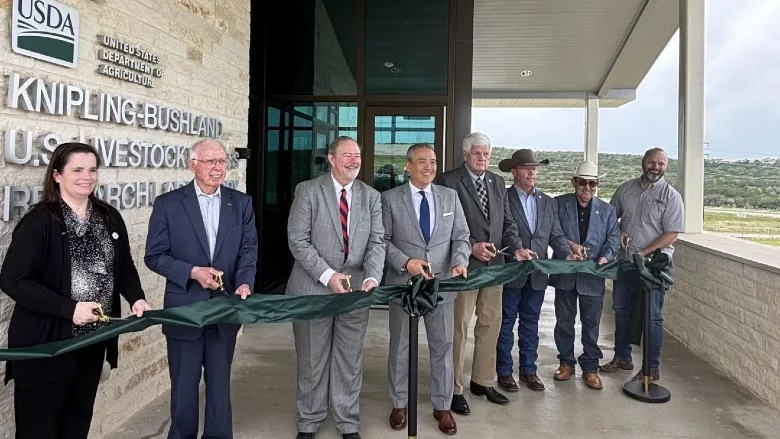
Ribbon cutting for the Knipling-Bushland US Livestock Insects Research Laboratory
Courtesy of the USDA

Ribbon cutting for the Knipling-Bushland US Livestock Insects Research Laboratory

May 29, 2026

On May 27, 2026, the US Department of Agriculture’s Agricultural Research Service (ARS) opened the Knipling-Bushland US Livestock Insects Research Laboratory, a laboratory facility designed to provide the US cattle industry with new tools and advanced technologies to manage and eliminate the invasive fly and tick pests that threaten the US cattle industry.

US Secretary of Agriculture Brooke Rollins said, “The brand new Knipling-Bushland US Livestock Insects Research Laboratory will allow us to research and find new active measures to keep current and future threats away from our borders. We have taken extraordinary actions to keep New World screwworm out of the United States and this lab will help us accelerate our offensive efforts to drive this pest further away from our borders.”

“For the last 250 years, our nation has relied on research leading to science-based innovation as a means to overcome some of America’s greatest agricultural challenges, including the exclusion of New World screwworm from the United States with novel Sterile Insect Techniques,” said USDA Under Secretary for Research, Education, and Economics Dr. Scott Hutchins. “The Knipling-Bushland US Livestock Insects Research Laboratory -- named after ARS pioneers that every entomologist and entomology student knows of through their breakthrough work -- will build on their legacy by protecting livestock health, ensuring that America’s ranches remain productive, safe, and profitable for generations to come.”

The new 52,000‑square‑foot laboratory features advanced cattle facilities, laboratory spaces and a genomics core to drive research on control technologies for the US livestock industry. Other on-site research opportunities will involve improved surveillance and trapping tools, novel insecticides and acaricides, enhanced pesticide delivery techniques for cattle and wildlife, sustainable treatments to prevent and mitigate outbreaks of invasive/quarantine arthropod species, improved approaches to combat pesticide resistance, and insect genomics to identify pest vulnerabilities.

The facility also houses two ARS research units: the Livestock Arthropod Pest Research Unit and the Veterinary Pest Genetics Research Unit. Collectively, these units aim to improve the health, sustainability, and profitability of US livestock production and protect the US food supply from devastating arthropod pests, including biting flies, ticks and the New World screwworm. On-site research also plays a role in critical research to eradicate other ticks and blood feeding flies that can harm, infect and kill cattle.

“This new laboratory will equip our researchers with advanced tools to combat the most destructive invasive insects already impacting the United States, as well as those posing future threats at our borders,” said ARS Administrator Joon Park. “The important ARS research conducted here in Kerrville will continue to play a vital role in protecting and strengthening the future of the US cattle industry.”

This is a full circle moment due to the 80 years of historic research done at previous ARS laboratory facilities in the Kerrville area. This includes:

  • Research on the biology of control of New World screwworm that led to its eradication from the United States in the 1970s.
  • Development and evaluation of novel pesticides like macrocyclic lactones for controlling biting flies and ticks on cattle and wildlife.
  • Sequencing the genome of over 25 important livestock arthropod pest species.

The laboratory is named after two influential and pioneering USDA researchers: Edward Knipling and Raymond Bushland. In 1937, Knipling first developed the theory that screwworms could be controlled using the sterile male technique. In the early 1950s, Bushland successfully demonstrated that the theory worked, that viable sterile male screwworms could be produced and used to control screwworm populations. This biocontrol technique, known as Sterile Insect Technique (SIT), became the keystone component of the strategy that eventually led to the eradication of the screwworm from the United States, Mexico, and Central America. Nearly 80 years later, SIT is still being employed to fight New World screwworm in Mexico and Central America, in an effort to keep the insect from reestablishing itself once again in the United States.

Source: USDA

KEYWORDS: laboratories livestock research USDA

Share This Story

Looking for a reprint of this article?
From high-res PDFs to custom plaques, order your copy today!


Recommended Content

JOIN TODAY
to unlock your recommendations.

Already have an account? Sign In

  • A cow eating grass and a chicken standing next to it in a field.

    The Top 100 Meat & Poultry Processors of 2026

    The 2026 Top 100 Meat & Poultry Processors highlights...
    Special Reports
    By: Fred Wilkinson
  • Breaded chicken nuggets on a white plate.

    Food safety programs prioritize prevention, verification, and traceability

    Across processing operations, food safety strategies are...
    Food Safety
    By: Sammy Bredar
  • An open double cheeseburger on a white plate, the top bun beside it, along with a side of seasoned fries.

    How convenience is driving summer grilling innovation in 2026

    Demand for high-quality, convenience-driven formats...
    Special Reports
    By: Sammy Bredar
You must login or register in order to post a comment.

Report Abusive Comment

Manage My Account
  • eMagazine Subscriptions
  • Manage My Preferences
  • Newsletters
  • Online Registration
  • Subscription Customer Service
  • Connect with The National Provisioner

More Videos

Sponsored Content

Sponsored Content is a special paid section where industry companies provide high quality, objective, non-commercial content around topics of interest to the The National Provisioner audience. All Sponsored Content is supplied by the advertising company and any opinions expressed in this article are those of the author and not necessarily reflect the views of The National Provisioner or its parent company, BNP Media. Interested in participating in our Sponsored Content section? Contact your local rep!

close
  •  two individuals standing by a farm gate
    Sponsored byPIC

    When PRRS Hits Home: The Chinn Family’s Story and a Hopeful Future

  • A smiling man carrying a grocery basket is reaching down to pick up a package of meat in a grocery store.
    Sponsored byPIC

    The Green Light: New Data Shows 12-to-1 Support for Pork from PRRS-Resistant Pigs

  • Close up of a grocery cart full of groceries, a cropped image of a couple pushing the cart and a blurred background of the vegetable aisle.
    Sponsored byPIC

    New Market Research Finds Consumers in Eight Key Pork Markets Are Likely to Purchase Pork from Gene-Edited Pigs

Popular Stories

Butchers processing hanging beef carcasses in meat processing plant

Meat Institute says meatpacking industry restructuring won’t lower beef prices

Kroger logo

Kroger to acquire Giant Eagle for $1.65B

Corporate headquarters groundbreaking

PS Seasoning and Pro Smoker reveal new parent company at headquarters groundbreaking

2026 Top 100 Meat & Poultry Processors Report

Events

July 16, 2026

Strengthening Food Safety Plans for Modern Processing Operations

The live webinar will explore the latest technologies, emerging risks, and practical strategies shaping food safety programs across meat and poultry processing operations. Attendees will hear from industry experts on key challenges impacting processors today, along with approaches for strengthening and updating food safety plans across their facilities.

January 1, 2030

Webinar Sponsorship Information

For webinar sponsorship information, visit www.bnpevents.com/webinars or email webinars@bnpmedia.com.

View All Submit An Event

Products

Food Crime: An Introduction to Deviance in the Food Industry

Food Crime: An Introduction to Deviance in the Food Industry

See More Products
The National Provisioner 2026 Food Safety Report

Related Articles

  • USDA announces funding, issues federal order to combat PEDv

    See More
  • USDA logo

    USDA builds $8.5 million Texas facility to combat New World screwworm

    See More
  • USDA Logo

    USDA opens nominations for Cattlemen’s Beef Promotion and Research Board

    See More

Related Products

See More Products
  • GlobalData_logo_blue_header.png

    Frozen Meat (Meat) Market in the United States of America - Outlook to 2023...

  • GlobalData_logo_blue_header.png

    Cooked Meats - Packaged (Meat) Market in the United States of America - Outlook to 2023

See More Products

Related Directories

  • Meat & Livestock Australia

    Meat & Livestock Australia is the marketing and research body for the Australian red meat industry. MLA's purpose is to deliver world-leading outcomes that fuel global competitiveness, sustainability and producer profitability.
  • Kansas Livestock Assn.

    The Kansas Livestock Association is a trade association representing 5,600 members on legislative and regulatory issues. KLA was formed in 1894 when a group of more than 100 Flint Hills ranchers met in Emporia to discuss cattle theft problems and unreasonable railroad freight rates.
×

Stay ahead of the curve. Unlock a dose of cutting-edge insights.

Receive our premium content directly to your inbox.

SIGN-UP TODAY
  • RESOURCES
    • Advertise
    • Contact Us
    • Directories
    • Store
    • Want More
  • SIGN UP TODAY
    • Create Account
    • eMagazine
    • Newsletter
    • Customer Service
    • Manage Preferences
  • SERVICES
    • Marketing Services
    • Reprints
    • Market Research
    • List Rental
    • Survey/Respondent Access
  • STAY CONNECTED
    • LinkedIn
    • Facebook
    • YouTube
    • X (Twitter)
  • PRIVACY
    • PRIVACY POLICY
    • TERMS & CONDITIONS
    • DO NOT SELL MY PERSONAL INFORMATION
    • PRIVACY REQUEST
    • ACCESSIBILITY

Copyright ©2026. All Rights Reserved BNP Media, Inc. and BNP Media II, LLC.

Design, CMS, Hosting & Web Development :: ePublishing