Right-sized cuts address consumer needs
|
|
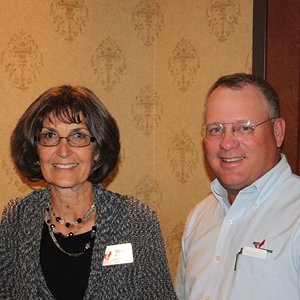
Becky Walth, a South Dakota beef producer, and David Dick, a Missouri beef producer, helped represent the Federation of State Beef Councils at the Beef Promotion Operating Committee meeting in September 2011. Photos courtesy of NCBA |
Many retailers are embracing the program because it capitalizes on the popularity and profitability of middle meats. BAM includes a complete cutting and marketing program, including retailer training materials, point-of-sale materials, recipes, cooking instructions, charts, photos and instructional cutting posters.
According to Jim Henger, executive director of channel marketing for the National Cattlemen’s Beef Association (NCBA), a Checkoff contractor, BAM is a perfect product for the times because it allows retailers to offer a product that has a new nutritional selling point, is sized to increase sales and retains the cooking quality of larger steaks. Furthermore, focus groups have shown that consumers not only like the new shapes and thicknesses of the cuts, they are not concerned about higher per-pound costs because there is a lower price per package.
Also important for the beef industry is that research shows new sales of BAM cuts take nothing away from the sales of larger beef items. That’s because many consumers who might have shied away from larger cuts, such as women purchasing meat for themselves or their children, appreciate the new sizes and nutritional profiles, and recognized the usefulness of the cuts for both weekdays and weekends.
State support
Because they are actively involved in state-level beef demand-building programs, producers who sit on state beef council boards see the value of this program and have come out to assist in its introduction. For example, the South Dakota Beef Industry Council (SDBIC) helped fund a nutrient analysis of BAM cuts that demonstrated that seven of the eight BAM cuts meet government guidelines for lean, with less fat and waste thanks to extra trimming. Consumers, in turn, perceive a greater value from the product’s leaner fat profile.
The research will be used by USDA to update its National Nutrient Database for Standard Reference, which is the gold standard of databases for nutrient composition. The National Nutrient Database for Standard Reference is used by researchers and dietitians around the world.
“The database was outdated and didn’t reflect a lot of the newly developed cuts,” according to Becky Walth, a South Dakota beef producer who sits on the SDBIC Board. “Often, obsolete information was being used by doctors, dietitians and health professionals in guiding clients to other protein selections.”
The SDBIC has also helped fund nutrient analysis on Value Cuts identified through the Beef Checkoff Program, such as the Flat Iron Steak and the Petite Tender Steak.
Walth has been active on the committee that reviews and recommends programs that address nutrition research programs. She also is a Federation of State Beef Councils director, and for the last four years has served as one of 10 Federation members on the Beef Promotion Operating Committee (BPOC). The BPOC helps determine spending of Beef Checkoff dollars. Some of those funds helped develop both the Value Cuts and BAM programs.
“BAM meets the ever-changing needs of the consumer,” says Walth, who with her husband, Allen, farms and raises cattle in north-central South Dakota. “With prices increasing, a slumping economy, and more attention being paid to nutrition, these cuts can definitely attract a new customer base. Our beef carcasses are getting larger, and these smaller cuts can fit into a tight budget. And the nutrient profile meets government guidelines for lean. This will definitely help increase demand.”
Heather Buckmaster, executive director of the Oklahoma Beef Council (OBC), agrees.
“BAM really helps consumers identify cuts they might not have purchased otherwise,” she says. “They were looking for smaller portions, and that is what the program does for them.”
OBC assisted in another aspect of the program: determining its potential profitability for retailers and cattlemen and women who fund the program. Buckmaster and her staff helped coordinate a test of the program at the Homeland Grocery chain in Oklahoma. That test showed beef sales growth of nearly $34,000 during a 14-week trial, with some stores selling as many as 863 pounds of BAM products.
According to Buckmaster, the test with Homeland helped demonstrate the value of the Federation of State Beef Councils and the partnership between national and state interests in the Beef Checkoff Program.
“The program required the participation of a retailer who is willing to try new things, so [OBC was] able to come in and provide additional dollars to the program when it was first launched,” Buckmaster says. “You have to have the right opportunity and the right retailer, and we had those ingredients in Oklahoma.”
Involving state beef councils is a benefit for national programs, according to David Dick, a beef producer from Sedalia, Mo., and chairman of the Federation of State Beef Councils.
“Sometimes they know where to look better than we do [at the national level],” says Dick. “The local focus will get you into those markets that you don’t think about or can’t focus as deeply on. With state dollars you can be more pin-point.”
Buckmaster adds, however, that the flip side is also crucial.
“We really need that expertise that comes in from the national,” she says. “They create the program, then we are able to execute them on a state level. So really having that partnership is invaluable. We’re not all re-creating the wheel. We’re all spokes in that same wheel.”
Value-added program sets example
The highly successful Value Added Cuts program for chuck cuts, which introduced such cuts as the Flat Iron Steak and the Denver Cut, increased the value of each carcass by $50-$70, according to Cattle-Fax, and a Value Added Cuts program for round cuts is expected to add another $20-$30.
The program helped set the stage for BAM by showing retailers how changes in beef marketing supported by the Beef Checkoff Program could benefit their operations. BAM takes change one step further, helping show retailers how to enhance beef sales and customer loyalty by modifying cutting and marketing within the stores.
Retailers are always looking for additional sales opportunities, so the BAM program caught their attention, even though “change is not something that’s readily accepted in channel marketing,” says Henger. Part of the acceptance, he explains, emanates from the Beef Checkoff’s track record for successfully moving the industry forward.
“We’re finding that BAM is right on track to be one of the more successful Checkoff-funded channel marketing programs,” he says.
Looking for a reprint of this article?
From high-res PDFs to custom plaques, order your copy today!