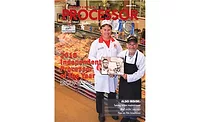
Dole & Bailey: 2015 Independent Processor of the Year
Along with a storied history, this Massachusetts purveyor is well-suited to meet the changing needs of its customers.
In a city that is filled to the brim with monuments, buildings and other pieces of American history, Faneuil Hall is one of Boston’s great treasures. Built in 1741, the building was funded by the wealthy merchant Peter Faneuil, who donated it to the city for use as an indoor marketplace and meeting hall. Several founding fathers, including Samuel Adams, gave speeches at the hall urging for American independence.
What connection does this historic building have to the meat industry? When it was used as a marketplace during the late 1800s, the interior of the building was divided into stalls, where businesses could sell their fresh food and other goods. The columns are still painted with the names of many long-gone businesses that occupied those stalls, but one still remains. Dole & Bailey is still in the business with providing quality meats and produce to customers — as it’s done since 1868.
Certainly, the historical aspect of Dole & Bailey makes it a noteworthy company. After all, not many businesses can say they got their start during the Johnson Administration — Andrew that is, not Lyndon. Dole & Bailey is much more than a historical curiosity, however. The company has maintained its founding principles of quality products and customer service, but it has also modernized and kept in touch with the latest consumer and business trends. Catering primarily to foodservice customers throughout the Northeast, Dole & Bailey can provide whatever a chef desires, from locally raised pork and beef to fresh produce and exotic spices to… yuzu juice.
In fact, Dole & Bailey offers more than 6,000 items in its product catalog, and that does not include the special requests that come from chefs looking for something new or exotic. Many of those products come from local farms and fisheries. Dole & Bailey launched two programs, Northeast Family Farms and Northeast Oceans, to help connect the region’s agriculture and aquaculture communities with restaurants looking for local foods.
Nancy Matheson-Burns, president and CEO of the company, calls the company a “farm gate” to help describe how it works with local farmers and fishermen.
“We are building food systems from the farms and the fisheries to Dole & Bailey, adding value through processes like craft whole-animal butchery, portion control and specialty aging,” she explains. “The farmer and fishermen use Dole & Bailey as a food hub to add value using the highest levels of food safety and modern processing techniques and then efficiently distribute to chefs throughout the Northeast marketplace.”
Ed Brylczyk, director of sales, explains that Dole & Bailey is continuing the process that had been lost in the Industrial Food Revolution, which modernized food production but took away a market for farmers to sell their products. For instance, the chicken component of Northeast Family Farms is Misty Knoll Farms, a Vermont farm that produces naturally raised chickens and free-range turkeys.
“When we first started with Misty Knoll Chicken, he was spending two to three days a week in a van moving his chickens to restaurants throughout New England,” Brylczyk says. “That’s not a proper use of his time as a great farmer, but he didn’t have someone to partner with who saw the value in his product.”
In the colonial era, the Northeast was the breadbasket of the country, and many of the farms that work with Dole & Bailey have been passed down for multiple generations.
“Some of these farms and fisheries haven’t really had a way, or even the initiative, to get their products into the marketplace, and we’ve invested in that system, and we’ve invested in the people and building an infrastructure to get their beautiful food into thousands of chefs hands,” Matheson-Burns adds. “Simply put its not only reviving our heritage here at Dole & Bailey, it’s also revitalizing the historic food systems of the entire Northeast.”
Thanks to the partnership with Dole & Bailey, the farmers can focus on what they do best, and Dole & Bailey can take their product and distribute it further and more efficiently than the farmers ever could by themselves. In 10 years, the company has purchased directly from close to one hundred different family-owned farms throughout the Northeast, invested over $2.5 million in processing fees with local abattoirs, and harvested over 100,000 naturally raised local animals.
Staying true to its heritage
Much has changed in the food industry since Cyrus Dole and Frank Bailey began a partnership at Boston’s Farmers Market inside Faneuil Hall. The vendors in the hall now focus on selling souvenirs to tourists instead of fresh food and produce to residents, and Dole & Bailey has taken up residence in a 51,000-square-foot facility in nearby Woburn.
Matheson-Burns, along with her husband Bill and brother Scott, represent the fourth generation of the business. Dole and Bailey passed the business on to Clyde Smith, Bailey’s nephew, and he in turn gave the reins to Bud Matheson, who attended the same church as Smith. Matheson-Burns’ office is a treasure trove of photos representing the history of meat processing in the United States. She says that visitors often donate old meat-related photos that they come across.
Despite all the history surrounding it, Dole & Bailey is very much a modern-day company, with a strong social media presence and a willingness to invest in technology and infrastructure that improves the operations.
The meat production floor has several tables, where master butchers can apply their craft by trimming and portioning beef, pork, lamb or goat. Right next to the benches, though, there is a state-of-the-art portioner that can cut up to 400 pounds of steak in an hour, to a tenth of an ounce tolerance. The addition of the machine has greatly improved yield and consistency. Brylczyk points out that the addition of the technology hasn’t replaced the craftsmanship of the butcher. The shop floor’s tenderloin expert, for instance, doesn’t have to spend all his time cutting tenderloins; now, he can focus his attention on every portion that the butchers produce.
“We’ve taken the guy who was spending all his talent on one muscle and put it over the entire cut shop,” he says.
The production floor was made even more efficient after a consultant reviewed the room and made recommendations to make it more efficient. The entire room was gutted and laid out to maximize the potential of the space and avoid any unnecessary movement. Dole & Bailey’s facility is an old Borden plant that was built in 1955, and it is located in a largely residential area. Expansion is next to impossible, so the company makes the most of its space to stay efficient.
Dole & Bailey also prides itself on low-tech, time-honored principles, such as providing the best customer service possible. Unlike much of the company’s larger competitors, customers can call the company 24 hours a day, seven days a week, and talk to a real live operator. There are no automated menus to navigate. Even after business hours, the operators are trained to take orders if necessary or take a message for a sales representative to handle the next morning. In case of a customer emergency, a system is in place to alert management.
The company will also ship product to a restaurant in custom quantities, explains Chris Williams, director of operations.
“We deliver to a lot of restaurants that are smaller, that don’t have the storage space and don’t have the need for it. They would throw away a half-case of apples or potatoes if we had to sell them that,” he says.
“It gives them the flexibility to try new things, too,” adds Matheson-Burns. “If they want to try one of this and one of that, they don’t need to experiment with a case of 24.”
Furthermore, all incoming produce is inspected before being sent out to restaurants to ensure quality, notes Chip Joyce, director of purchasing.
“A box of tomatoes goes out, [and] sometimes they’ll put something on the bottom layer that might not be as high a quality as we want. So our guys will check that. They will go through them and make sure that even the ones on the bottom are beautiful,” he says. “We take that extra step to ensure our quality.”
On the protein side, Dole & Bailey will sell a box of tenderloins, 12 pieces to a case, as the most economical solution. However, if a chef requires tenderloins that weigh 7 pounds or more, the employees will break open boxes until they find those specific pieces. If a chef needs 73 steaks, he will get 73 steaks instead of having to order in increments of 10 or 20. There is an upcharge for that service, but, as Brylczyk explains, “We can find any possible way to add value to that product for the chef, so that he can execute his culinary vision more effectively.”
Dole & Bailey also has a seafood department, where local caught, fresh, whole fish and frozen seafood are stored and further-processed if necessary. That department was added in the 1970s, Joyce says.
“When we started getting into seafood, we decided right off the bat that we would use the USDA standards for our fish operation, even though we didn’t have to,” he says. “That was what we wanted to do. I’ve always been very proud of our seafood department, because I think we have higher standards.”
Touring Dole & Bailey’s facility is like walking through the world’s largest high-end grocery store. Along with the extensive meat and seafood departments, there are also produce rooms with all manner of fruits and vegetables, a dairy department with specialty cheeses, spices, mushrooms, hors d’oeuvres, desserts (try the maple bacon ice cream) and other ingredients. An entire room is dedicated to varieties of chocolate. Those are just the stock items. Joyce points out that the sales reps get calls every day to locate or specially order items.
“A lot of them turn into stock items, because we find out we have 10 other customers who were looking for that item,” he adds.
Brylczyk recalls getting a call from a chef asking for yuzu juice, which comes from an Asian citrus fruit. After locating an importer, it cost $140 a gallon, and Dole & Bailey ended up with a case of 4 gallons. The chef bought one, and the other three were bought by three other customers practically overnight. It turned out that Bon Appetit magazine featured yuzu juice in an article, spurring the sudden popularity. It is now a stock item.
Products are selected from all those departments and brought to the staging area for shipping. Dole & Bailey has a fleet of refrigerated trucks that collect orders for all customers in a given area before setting out on the road. A truck that is heading to Maine can have anywhere from 25 to 35 stops to make before heading back to headquarters.
Dole & Bailey has a sizable customer base, with foodservice customers covering seven states throughout the Northeast, plus more than 100 specialty retail accounts and local butcher shops. Achieving that level of customer service can be tricky as well as time consuming. The customers do appreciate the human element, though.
“We’ve had more people comment about that to our sales reps, and not only that, but go out of their way to reach back out to us when a crisis is over and say that it meant so much,” Matheson-Burns says.
Along with servicing chefs, the company can help train them as well. Matheson-Burns estimates that more than 4,000 professional chefs, restaurant owners, purchasing directors and culinary students have come through the plant as part of the Visiting Chefs Program. As part of the open-door policy, professionals are invited to tour the facility, work with the company’s culinary team and learn about the different cuts of meat. Employees will even break down a carcass for attendees, prepare the cuts and have a tasting, so they leave with an education of the cuts, where they are found on the animal and how they can be used in an entrée.
“Lots of people want to see what we’re doing, and we know once chefs and decision makers tour through and meet with our passionate people, it’s very rare that they don’t want to partner with us,” she says. “So the more the merrier!”
Dole & Bailey is taking that customer service to the next level by opening a regional sales office for the state of Vermont. This pilot program adds a Vermont-based sales representative to assist the reps in Woburn. For those customers in the Green Mountain State, having that 802 area code to call will enhance the level of customer service.
Improvements through auditing
In order to meet the requirements of certain customers and to become a better company, Dole & Bailey has a number of certifications to its credit. It has been ISO 9002 certified for more than 20 years, and earlier this year became the first distributor to achieve Animal Welfare Approved certification. In 2010 it became the first USDA Certified Organic Handler and the first distributor to be Certified Humane approved. In 2014 it was named the country’s first Green Restaurant Association distributor.
“What it really does is authenticate the transparency that we are always talking about within our local programs and our regular commodity programs,” Brylczyk explains. “It demonstrates to the chefs that we deal with that we take every step possible to keep the traceability of the products, in the back door, out the front door, and to the end user.
“What’s interesting about them, too, is each one demands that we flex a little bit different muscle,” he adds. “So it really helps us get better in a lot of different areas, and each one is a little different. It’s been a fun process to go through them and learn about how we’ve improved with each one.”
Dole & Bailey does not slaughter any of its animals, but the AWA certification does help its producers who have the same certification.
“North Star Sheep Farm, which is the Northeast Family Farms lamb component, is AWA certified, so we can now sell that product as AWA process verified, and it carries that stamp all the way through,” Williams says. “If we didn’t, it would be a dead end road.”
ISO requires a collaborative approach to manage a business and solve issues. As part of the ISO certification, the company organized its management to create a clear chain of command. The steering committee is led by Matheson-Burns, her brother Scott (chief operating officer), husband Bill (vice president/administration) and John Lynch (chief financial officer). The executive committee consists of Brylczyk, Williams and Joyce. Below them are the function heads, who are the managers of each department.
The executive committee manages the day-to-day operations at Dole & Bailey, with the support of the steering committee. When they have a suggestion for a way to improve the company’s operation, they do the research and present their findings to the steering committee.
“If they want to push something through, they check with steering, and then the steering committee meets, decides if that’s what’s best for D&B, then they get the okay, and off we go,” Burns says.
Brylczyk says that if the executive committee has done its job, they never hear the word “no,” because they’ve vetted each proposal enough to know if it will be good for the company or not. One such example was last year’s addition of a patty maker to the production floor. It can make patties to the chef’s exact specifications, and the machine gently presses each ground beef puck to create a hand-pressed, custom look.
“We said we needed to expand our ground beef operation so that we can keep up with products that we’re manufacturing here in the plant,” Brylczyk says. “It was a huge investment, and steering analyzed our plan and gave us 100% support. We put this in, and our burger sales and ground beef sales have almost doubled already.”
The collaborative effort helps maintain a single company-wide focus and eliminates any friction between sales and operations. Brylczyk and Joyce have worked together for 20 years, and Williams was a customer of Dole & Bailey before he joined the company five years ago, so the executive committee has plenty of collaborative experience.
“Our goal is to have a plan in place where we’re supporting each other, because there can’t be that tension between ops and sales,” Brylczyk says. “We need to be working together. That’s the only way we’re going to grow the way we need to as an independent.” IP
Looking for a reprint of this article?
From high-res PDFs to custom plaques, order your copy today!