Traceability: Back to the source
Traceability systems can trigger greater revenue opportunities for meat and poultry operators, but cost is an adoption hurdle.

The potential benefits from leveraging traceability systems are making the technology increasingly enticing for meat and poultry operators.
With more health- and environmentally conscious consumers seeking the origins of specific proteins, and meat importing countries requiring products from the U.S. to be traceable, companies with systems are in position for greater revenue opportunities. Though implementation costs are a key impediment to widespread activity, the payback from programs may ultimately outweigh the price.
“There is a need for traceability — maybe more so now than ever,” says John Butler, chief executive officer of the Beef Marketing Group, a Manhattan, Kan.-based cooperative comprising 20 feed yards in Kansas and Nebraska. “Unlike operators in Canada and other countries, many U.S. companies are restricted from marketing internationally because they don’t have a recognized traceability system for beef. We are at a competitive disadvantage from an export standpoint.”
Nevertheless, he notes that “momentum for traceability is building as consumers both domestically and globally are becoming more aware of the food they are purchasing. Such information enhances their comfort level and trust and will influence their purchasing decisions.”
A long, hard road to rollouts
The speediest route to an industry-wide identification system will come from government mandates. Though there has been little focus on the issue from regulators, Butler notes that could change as market interest increases.
“History has shown that making revolutionary changes within an industry often takes a significant event that drives a Congressional mandate for action,” adds Kevin Keener, a professor and director of the Center for Crops Utilization Research and the BioCentury Research Farm at Iowa State University in Ames.
Such action might stem from a need to enhance food safety by enabling operators to quickly determine the source of foodborne illnesses outbreaks, he says.
“There can be up to twelve transfer points of meat products between the farm, feedlot, processing plants, distribution centers, retailers and wholesalers,” Keener says. “Each operates as an independent entity. A monitoring system can help narrow the scope in determining where an incident occurs and reduce the economic impact to an industry following an outbreak.”
Because such incidences are relatively rare, it is difficult for many operators to generate a strong business case for a traceability program, he says.
“Many of the big processors have little concern about traceability and it is not easy for them to do,” says Dan Buskirk, associate professor and beef extension specialist at Michigan State University in East Lansing. “It is difficult to track products back to the farm of origin unless most come from a single producer.”
Also affecting activity is concern about slower production rates because of the need to track the origins of different carcasses, he says.
“Plants want to know if traceability systems will yield more revenue than the cost to operate programs,” Buskirk says. “It is still a guessing game because not a lot is being done yet in the area.”
A need to find the right price
The price for implementing an age and source program for beef is typically $20 to $30 per head, Butler notes, adding that with an average herd size of fewer than 50 animals, most producers do not have the economies of scale that make it easier to invest in programs. Michigan State University, however, reports that some systems are becoming more affordable.
In a 2011 pilot program studying the process of translating information contained on a radio frequency identification (RFID) ear tag to a two-dimensional (2D) bar code label, Michigan State found that such “relatively simple traceability systems could be developed costing 1 to 2 percent of wholesale value.”
Results from the pilot — which also was looking at the potential for traceability technology to expand markets for mid-size beef producers and meet consumer demand for information about the origin and characteristics of their food — showed that the process “caused little or no disruption of the routine tasks in both the harvest and processing facilities.”
Other factors that will help drive activity include interest by producers in meeting Global Food Safety Initiative (GFSI) standards, Keener says. The GFSI is a worldwide movement to improve food management systems. Participants include retailers, manufacturers, food services companies, international organizations, governments, academia and service providers.
The start of something big
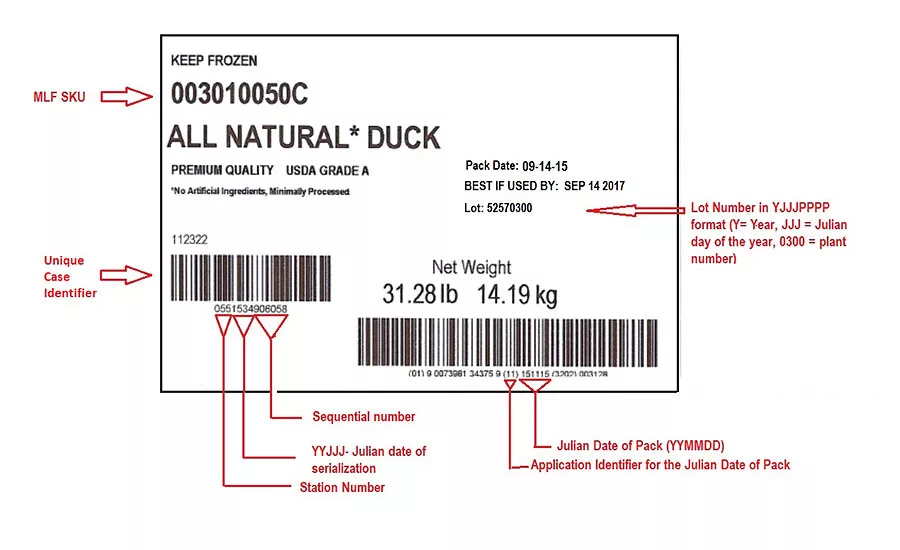
Some protein operators, however, already have extensive traceability systems. Maple Leaf Farms Inc., for instance, a Leesburg, Ind.-based duck and chicken producer, track birds from the farm to the chilling process.
In addition to recording production data on bar codes—including the day and time carcasses undergo processing—Maple Leaf Farms also tracks the raw materials and ingredients it receives from suppliers. That includes monitoring the source of the vegetables, cheeses and rice that go into its value-added products.
“Traceability is a very important aspect of our business,” says August Konie, Maple Leaf Farms vice president of quality assurance and food safety. “Electronic traceability enables us to pull up specific records in less than five minutes.” Such tracking will allow for quick alerts to consumers or corporate customers during recalls or other incidents, he says.
A major challenge in operating a pervasive traceability program is ensuring personnel from a wide variety of plant sectors have sufficient training in recording data, Konie says. That will be increasingly important as technologies inevitably become more robust and are able to store wider varieties of information, he says.
“It is our responsibility as producers to provide traceability for the sake and safety of the consumer,” Konie says. NP
Looking for a reprint of this article?
From high-res PDFs to custom plaques, order your copy today!