Cover Story
Processing renaissance: SugarCreek adds sous vide to its customer-centric capabilities
SugarCreek continues to reinvent itself and the industry after 50 years of success across a variety of proteins and distribution channels.
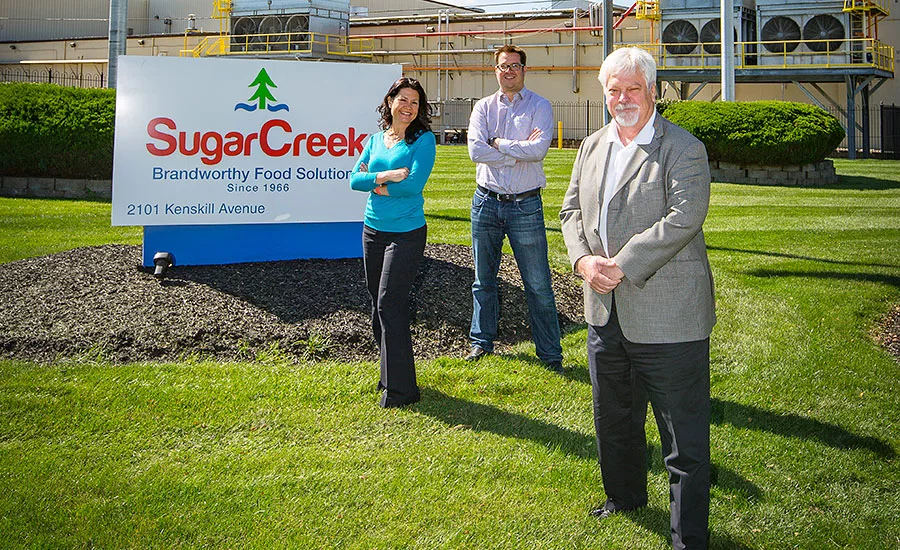
Jennifer Hutcheson, director, Sales; Michael Richardson, COO; and John G. Richardson, chairman and CEO, stand outside SugarCreek’s Washington Court House, Ohio, processing facility, where the company began its rise to success 50 years ago.
PHOTOS BY ROSS VAN PELT, RVP PHOTOGRAPHY
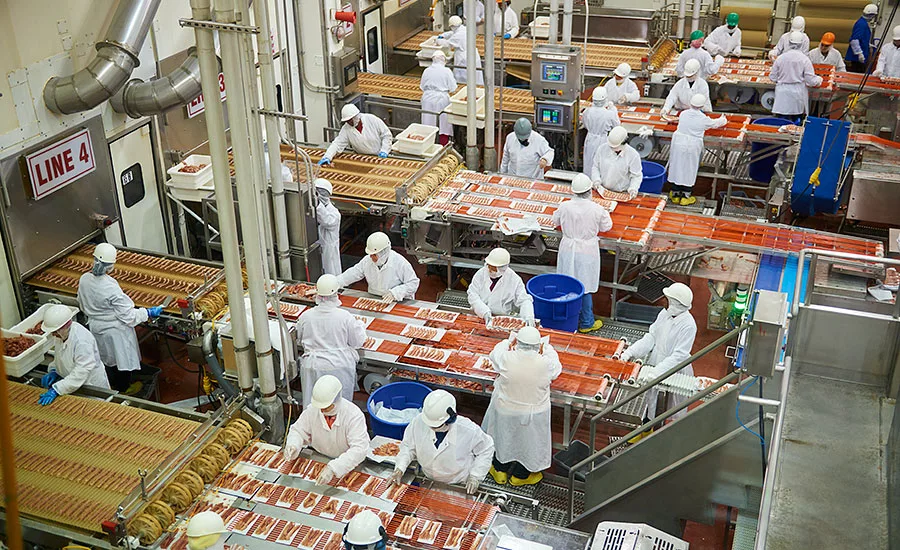
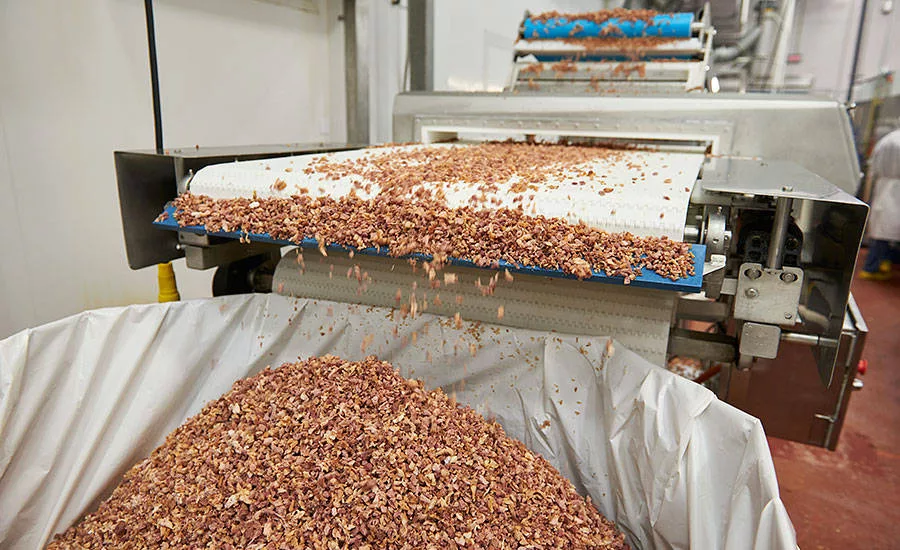
SugarCreek’s Dayton, Ohio, plant produces fully cooked bacon slices to meet a variety of customers’ flavor profiles and demands.
PHOTOS BY ROSS VAN PELT, RVP PHOTOGRAPHY
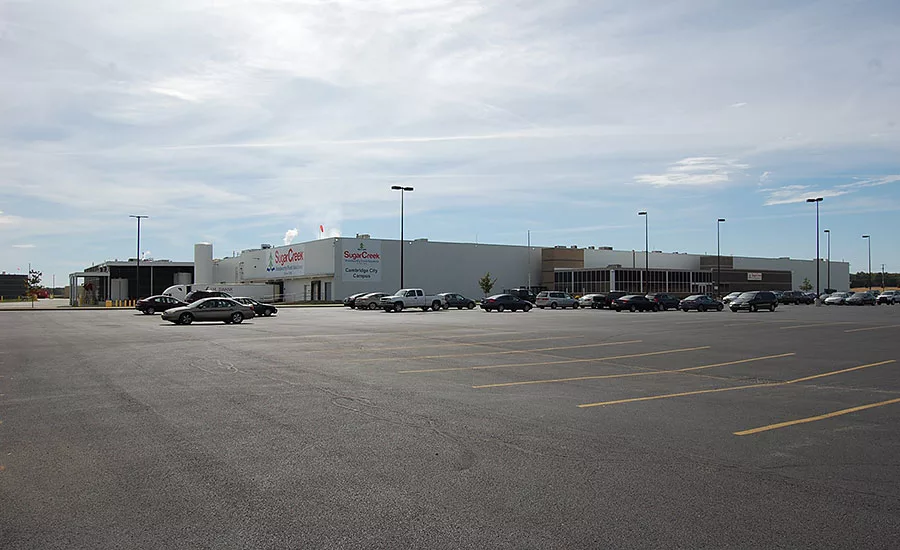
PHOTOS BY ROSS VAN PELT, RVP PHOTOGRAPHY
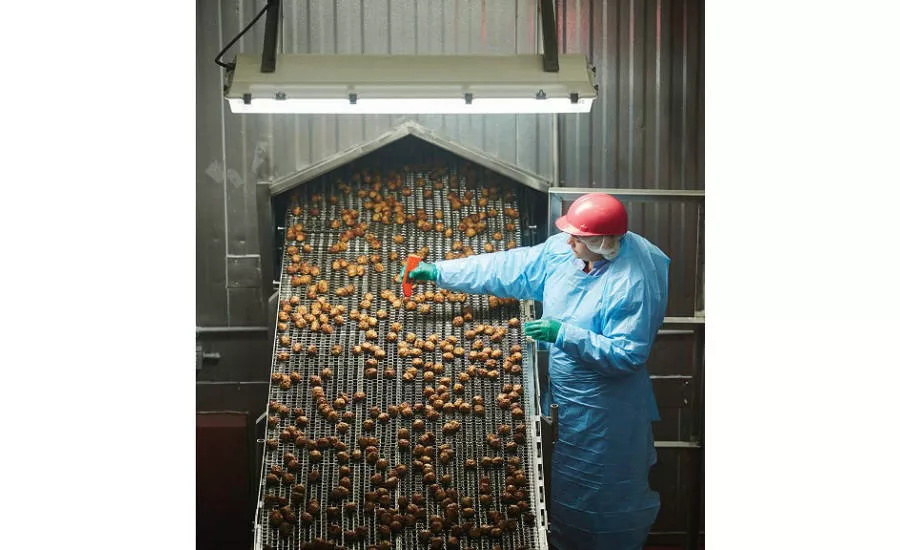
SugarCreek’s Cambridge City, Ind., plant features commercial-scale sous vide production, but it cannot be overlooked for its high-volume cooking capabilities. Here, an employee checks fully cooked meatballs on one of the cook lines.
PHOTOS BY ROSS VAN PELT, RVP PHOTOGRAPHY
Production of further-processed, value-added bacon products helped SugarCreek develop a reputation around innovation and customer service during its 50 years in business.
PHOTOS BY ROSS VAN PELT, RVP PHOTOGRAPHY
In 1966, John S. Richardson founded SugarCreek Packing Co. in Washington Court House, Ohio, opting to focus production on bacon — an accidentally prescient move that would set the company on course for long-term success during his tenure. Fifty years later, his son, John G. Richardson, has continued on that course, building SugarCreek into a vastly different operation: a customer-centric food-processing company, featuring six manufacturing facilities, each willing to incorporate innovation to help customers revolutionize the industry.
Of course, SugarCreek believed in the growth of bacon over time, as no one picks a flailing commodity upon which to base a business. However, John G., current chairman and CEO of the company, says not even his father would have predicted the culinary and pop-culture phenomenon bacon has become over the decades.
“We’d like to take a lot more credit for being the geniuses that made that pick, but the reality is, there was a lot more associated with that decision,” he explains. “[Bacon’s popularity allowed us] the luxury to just focus on the execution side, trying to respond to all the opportunities thrown our way — but as we move into the next 50 years of the company, there’s no question bacon got us here.”
In 1990, when John G. took over leadership of SugarCreek from his father (who passed away in 2011), diversification of the company’s product lines was just beginning.
“We matured as a company from raw, retail private-label products into fully cooked products: bacon, pizza toppings, bacon bits, salad toppings,” he says. “The ingredient and garnish side of the bacon business really exploded in terms of our reach into different channels from retail to foodservice, industrial sales, and the whole QSR and fast-food industry.”
Arby’s corporate chef Neville Craw discusses sous vide cooking and how Arby’s and SugarCreek have partnered to pioneer it in the QSR/fast-casual restaurant space.
Today, SugarCreek lives and thrives in a slightly less populated section of the food-processing spectrum, taking on business that’s too large for small processors to handle effectively, but too customized or complex for the mega-sized companies to incorporate into their high-speed, ultra-efficient operations.
“We try to play in niches that might be a little more difficult for the 800-pound-gorilla companies to play because there might be a lot of changeovers or a different allergen profile, or just that the risk associated with a production run was greater,” says Michael Richardson, COO and son of John G. “We gravitate more toward business that the bigger companies wouldn’t risk because it wouldn’t be as productive in their plants.”
Such a strategy has allowed SugarCreek opportunities to stay ahead of the curve by trying new technologies and helping customers launch new concepts.
“Dad always said, ‘Tell me what you can sell, and I’ll figure out how to make it,’ as opposed to, ‘Here’s what we make, now go and sell it,’” Michael says. “It sounds simple, but it’s fairly refreshing. We said yes to customers a lot and were encouraged to do so, because if you don’t swing, you’ll never get a base hit.
“So we swung a lot and ended up hitting a few that we could build the business around,” he adds. Since the mid-1990s, SugarCreek has spread its wings, producing everything from microwaveable, fully cooked bacon to RTE meatballs and sausage to fully cooked chicken products.
The key, John Richardson says, has been identifying those niche products — production runs in the five to 15 million pound range — that could be expanded and offered to multiple customers to meet their own needs.
“For some processors, a smaller production run by itself would be a pain in the neck, but for us to take that and put three or four more [customer orders] with it, we can make a viable business,” he explains. That approach has created a product portfolio (and processing capabilities) that could be viewed as completely separate entities. Indeed, John views the company today through a different categorization lens than one might expect.
“I would describe SugarCreek as maybe six $100 million companies, or three $150 million companies, rather than one $600 million company,” he says.
Had SugarCreek not listened to its customers more than a decade ago, however, the outcome might have been different. John credits customers with setting him straight as to what the future held for a company tightly focused on commodity bacon production rather than food solutions.
Jennifer Hutcheson, director, Sales, and daughter of John G., explains the company began to assess its positioning in the mid-2000s.
“Around the time we were getting interested in the larger portfolio of breakfast items, we really began thinking about being more of a food company than simply a bacon company — how do we expand the portfolio even outside of breakfast into other fully cooked proteins,” she says. “Eventually that evolved longer term into the idea behind our sous vide process today, and being a true food company in the future.”
Sparking culinary innovation
In 2015, SugarCreek took the latest step in this evolution, opening its Cambridge City, Ind., (CCI) processing facility. Although the headlines tend to focus on the breakthrough sous vide system installed there, Michael notes that the acquisition of that facility didn’t revolve around anything more than the legacy goals: being successful, independent and relevant.
“Our meatball business had reached the point where we needed space, so in some respects, Cambridge City wasn’t just about sous vide, but also about having two other halls in that plant to carry a lot of production that isn’t necessarily novel or inventive,” he says. “CCI is the culmination of the vision to scale our operations to where we are relevant in products that allow us to remain independent.”
Flexibility and efficiency in high-volume cooking applications are on display on the cooking lines at CCI, and the plant features plenty of open square footage for future expansion. However, the crown jewel of the facility is the commercial-scale sous vide processing line, the first of its kind in the United States. SugarCreek hopes, in similar fashion to its original bet on bacon 50 years ago, that sous vide products will take off in the United States as they have in European white-tablecloth settings.
John Richardson was hooked on the cooking method after a week-long trip to France, Italy and the United Kingdom, during which he immersed himself in trying the products and learning about the technique. During another visit, he spoke with twin brothers who were restaurateurs in the UK, Australia and New Zealand, who detailed the extreme challenges they faced running restaurants, designing menus and dishes, and finding and keeping good chefs. That convinced Richardson sous vide was an inevitable solution to many of these issues.
“Particularly, they told me to concentrate strictly on restaurant supply because of the issues with finding quality chefs who will work the hours and be consistent,” John says. “And we’re getting to the point now [about a year after startup], where we’re getting a lot of traction in sous vide at the QSR level.”
The art and science of sous vide was something SugarCreek’s team needed to learn in order to educate its customers on the differences of the product. Additionally, SugarCreek needed to add expertise to its culinary team to handle the increased workload the new capabilities brought.
“With a lot of sous vide products, it’s really about product preparation, flavor profiles, labeling and nutritional qualities in an innovation group [setting], so you have to speak that language,” John says. “It’s not about price; it’s a very different environment from that traditional transactional type of environment.”
The company expects to triple capacity on sous vide production down the road at CCI, as well as fill the other two cooking halls with “technologies that are relevant and make sense” in the long term, according to John. Hutcheson says the additional floorspace gives the company the ultimate flexibility when its customers come knocking on the door.
“We may see a shift toward more foodservice there, but we have options and will be able to play in multiple channels and products,” she says. So long as SugarCreek stays grounded in its focus, Michael Richardson believes CCI will fit right in.
“We don’t necessarily have to rush at filling it up,” he explains. “We can keep a longer-term focus and not be hostage to making decisions based on a quarterly return or anything like that. We certainly want to fill up the plant, but we want to do so with what makes the most sense.”
What has always made sense for SugarCreek, John adds, is responding to customer demand with speed, skill, flexibility and expertise.
“As the nation becomes a nation of food, what consumers want is much more fickle than it used to be, and we’ve got to be much more attuned to the consumers,” John says. “If we can do that, we’ll be very successful.”
With the flexibility to support potentially revolutionary ideas, SugarCreek appears poised to continue to ride the wave of success that has carried it through its five decades as a meat-centric further processor into its new identity as a food-solutions provider. NP
SugarCreek Succession
What follows are the comments of John Richardson, Michael Richardson and Jennifer Hutcheson, given to editor-in-chief Andy Hanacek after he asked about the succession plan for SugarCreek as it prepares to move from a second- to third-generation company.
John Richardson, chairman/CEO: When I got out of college, I came to work with my dad, and we worked together for 15 years. At times, even though it could be tense and it could be strenuous, we always ground through an awful lot of decision-making together. In the end it was his game, but we really studied it, and I think he was better because of me — and I know I certainly was better because of him. I’ve tried to do pretty much the same with [my children].
[My dad] was adamant about being private and having a longer-term, that if you go low and slow and keep reinvesting, at the end of your career, you’ll have something. As he got older, he needed less. I’m 65 now and kind of in the same situation. If I’m happy and healthy, I feel pretty good and life’s pretty good, those values tend to be more important than the money.
I’d like to see the company continue to remain private, independent and relevant, but it’s bigger now: It’s a lot more now — more to think about, more to worry about. The industry is truly global, and the business is very, very different — most of the major food companies are international and there are huge multiples being thrown around.
[My children got] to choose, but my father was very different than I was. Eventually, he became OK with that, embraced it and it worked out. I believed that for both of them, you have to give them enough time, and then have them come back and see [if it’s a fit].
Michael Richardson, COO: Books are written on third-, fourth-, fifth-generation companies, and I honestly don’t think this is a lot different than some of those stories. However, we were never necessarily asked or pressured to get in to the business, for which I was always thankful. But once we did sign on, much has been given, and much has been expected. We take that very seriously. It’s a family business, and it’s a lot of fun. All my friends are here, and the hope is to keep it going strong. There’s a lot of talent in the organization that certainly didn’t grow up with the family, and you have to play to your strengths but you also have to be aware of your weaknesses. My dad’s been great to help build a good team and let us go out and get more talent.
Jennifer Hutcheson, director, Sales: I’m really here to support Michael, who has been groomed from the beginning. Michael and I are very close, and I’ve had the privilege of being able to help him the last 11 years. From my perspective, it has been very rewarding to work for the two of them, and I hope we will continue to be successful and relevant and independent.
Looking for a reprint of this article?
From high-res PDFs to custom plaques, order your copy today!