Provisioner logo
Provisioner logo
search
cart
facebook twitter linkedin youtube
  • Sign In
  • Create Account
  • Sign Out
  • My Account
Provisioner logo
Provisioner logo
  • NEWS
    • Industry News
    • Supplier News
    • Case Studies
    • Recalls
    • Regulations
    • New Consumer Products
  • EXCLUSIVES
    • Newsletters
    • Source Book
    • Sponsored Insights
    • Events
    • Webinars
    • Classifieds
    • White Papers
    • Provisioner Store
    • Market Research
  • MEAT PROCESSING
    • SUSTAINABILITY
    • Processing
    • Packaging
    • Ingredients
    • Formulation
    • Food Safety
    • Special Reports
    • Commentary
  • PROFILES
    • Processor Profiles
    • Processor of the Year
    • Top 100 Processors
  • MEDIA
    • Videos
    • Podcasts
  • DIRECTORY
  • MIHOF
  • INDEPENDENT PROCESSOR
  • EMAG
    • eMagazine
    • ARCHIVE ISSUES
    • Contact
    • Advertise
  • JOIN!
Meat and Poultry Industry NewsSustainabilityBeef

Feeding cows seaweed to reduce methane emissions

Seaweed emerges as a contender for alternative livestock feed.
By Industry News
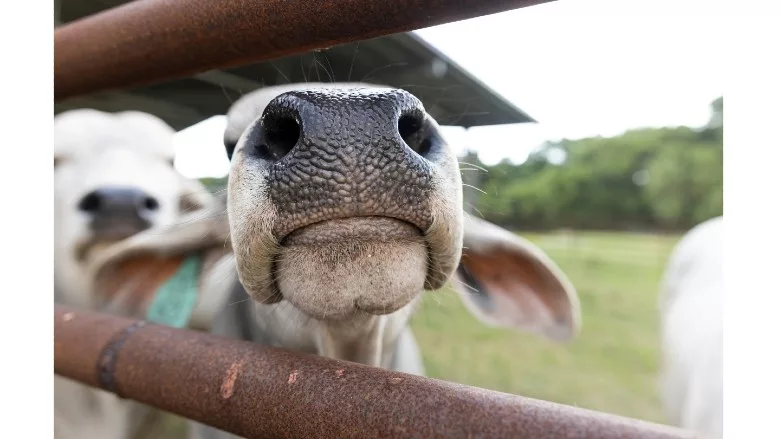
A curious cow peeks through a gate at a UF/IFAS research facility
Cat Wofford, UF/IFAS

A curious cow peeks through a gate at a UF/IFAS research facility.

Photo courtesy of Cat Wofford, UF/IFAS

May 14, 2025

As they digest grass and hay, cows produce significant amounts of methane, a greenhouse gas. In the quest to identify an alternative livestock feed, seaweed has emerged as a contender.

“There has been a steady rise in concerns among consumers over environmental sustainability, and using seaweed to reduce potent greenhouse gas emissions can be an avenue toward meeting consumer preferences for the foods they purchase,” said John Lai, assistant professor of agribusiness in the UF/IFAS food and resource economics department.

But are consumers willing to pay extra for low-emission beef?

Building on existing UF/IFAS research into seaweed’s environmental benefits, Lai and his colleagues are conducting research to test its economic viability. A recently published data illustration provides an early peek at their ongoing study of Asparagopsis armata, a species of red seaweed. The illustration, published in the Agricultural & Applied Economics Association’s Choices magazine, is a product of collaboration between Lai, his colleague Andrew Ropicki and students Emerson Searl, an undergraduate, and Meri Hambaryan, a doctoral candidate. It describes the associated pros and cons of cultivating seaweed to feed cattle.
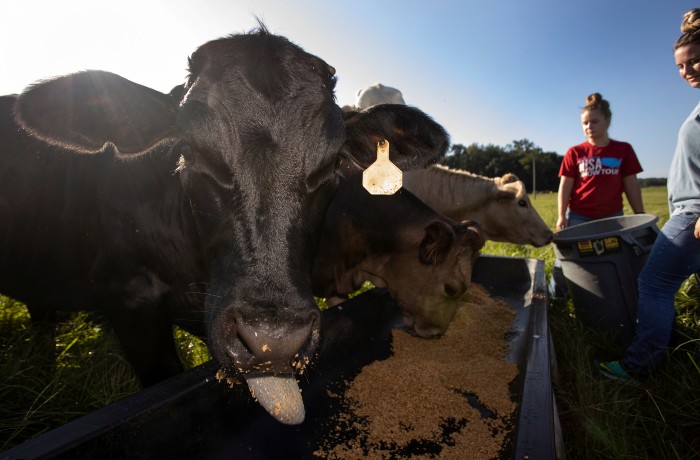
UF/IFAS animal sciences students filling a trough of cattle feedUF/IFAS animal sciences students filling a trough of cattle feed. Photo courtesy of Tyler Jones, UF/IFAS


Red seaweed reduces methane emissions because it contains high levels of bromoform, a compound that inhibits enzymes involved in the creation of methane gas, according to the illustration. Rich in protein, carbohydrates and dietary fibers, seaweed meets the dietary needs of livestock without negatively affecting the taste, smell or texture of beef or milk.

Additionally, the environmental benefits associated with seaweed cultivation extend beyond methane-emission reduction, said Ropicki, an assistant professor specializing in marine resource economics. “Relative to other methane-reducing cattle feeds, seaweed is notable for its ability to absorb nitrogen and phosphorus, which feed harmful algal blooms,” Ropicki said. “And by capturing carbon dioxide from oceans, seaweed can counteract ocean acidification and improve water quality.”

There are some downsides, however. Red seaweed can contain heavy metals, iodine and minerals that may pose health risks to animals, so continuous monitoring is required during cultivation to prevent toxicity. Other obstacles include the logistical hurdles of hauling large quantities of seaweed, energy-demanding processing requirements and high prices associated with potential seaweed shortages.

“There are challenges, but we believe they can be overcome, and there is a potential market for seaweed cow feed,” Ropicki said.

Ropicki’s positive assessment is influenced by established research indicating informed, environmentally conscious customers are willing to pay an average premium of 4.6% for low-emission beef. Another study equated an 85% reduction in carbon emissions with a $4.23-per-pound premium for beef.

The UF/IFAS researchers will soon add their own research to the canon of sustainable beef research; they plan to publish two economic studies related to seaweed-fed cattle later this year and a third in mid-2026.

Source: University of Florida Institute of Food and Agricultural Sciences

KEYWORDS: animal feed cattle environmental sustainability greenhouse gas emissions research

Share This Story

Looking for a reprint of this article?
From high-res PDFs to custom plaques, order your copy today!


Recommended Content

JOIN TODAY
to unlock your recommendations.

Already have an account? Sign In

  • Double Charburger

    Premiumization drives burger category

    Shoppers seek out premium meat offerings to fulfill...
    Ingredients
    By: Sammy Bredar
  • JJS Adult Pekin duck

    Poultry Report 2025: Convenience propels poultry at retail

    Despite continued economic pressures, the poultry...
    Turkey
    By: Sammy Bredar
You must login or register in order to post a comment.

Report Abusive Comment

Manage My Account
  • eMagazine Subscriptions
  • Manage My Preferences
  • Newsletters
  • Online Registration
  • Subscription Customer Service
  • Connect with The National Provisioner

More Videos

Sponsored Content

Sponsored Content is a special paid section where industry companies provide high quality, objective, non-commercial content around topics of interest to the The National Provisioner audience. All Sponsored Content is supplied by the advertising company and any opinions expressed in this article are those of the author and not necessarily reflect the views of The National Provisioner or its parent company, BNP Media. Interested in participating in our Sponsored Content section? Contact your local rep!

close
  • A smiling man carrying a grocery basket is reaching down to pick up a package of meat in a grocery store.
    Sponsored byPIC

    The Green Light: New Data Shows 12-to-1 Support for Pork from PRRS-Resistant Pigs

  • Close up of a grocery cart full of groceries, a cropped image of a couple pushing the cart and a blurred background of the vegetable aisle.
    Sponsored byPIC

    New Market Research Finds Consumers in Eight Key Pork Markets Are Likely to Purchase Pork from Gene-Edited Pigs

  • Close up of a young pig with a blurred background.
    Sponsored byPIC

    New Research Forecasts Significant Economic and Market Impacts with PRRS-Resistant Pig Adoption

Popular Stories

Spam Dog

Hormel rolls out Spam hot dog for foodservice applications

Various new Primal snack sticks on a table amongst pencils, apples, a pair of glasses, lunch bags and a water bottle.

Protein demand drives snacking occasions

Several cuts of beef, pork and chicken on a wooden board, cast iron pan and salt.

Validated thermal lethality data and a new tool for ensuring safety of RTE meats

2026 Top 100 Meat & Poultry Processors Report

Events

June 11, 2026

From Fresh to Frozen in 3 Minutes Flat: Unlocking the Secrets to Temperature Control

Join Tony Vacaro, Foods Industry Manager, and Emile Klein, Foods Market Strategy Manager at Air Products and Chemicals, Inc. , as they tackle key questions surrounding heat removal in food processing. 

January 1, 2030

Webinar Sponsorship Information

For webinar sponsorship information, visit www.bnpevents.com/webinars or email webinars@bnpmedia.com.

View All Submit An Event

Products

Food Crime: An Introduction to Deviance in the Food Industry

Food Crime: An Introduction to Deviance in the Food Industry

See More Products
From Fresh to Frozen in 3 Minutes Flat: Unlocking the Secrets to Temperature Control Webinar Sponsored by Air Products

Related Articles

  • Cattle

    Feeding grazing cattle seaweed cuts methane emissions by almost 40%, research suggests

    See More
  • Cattle

    Gut genes may hold key to lowering methane emissions

    See More
  • Burger King fartless burgers

    Burger King announces cows menu: an open source recipe for cows’ diet that reduces methane emissions

    See More

Related Products

See More Products
  • GlobalData_logo_blue_header.png

    Frozen Meat (Meat) Market in the United States of America - Outlook to 2023...

  • GlobalData_logo_blue_header.png

    Cooked Meats - Packaged (Meat) Market in the United States of America - Outlook to 2023

See More Products

Events

View AllSubmit An Event
  • August 23, 2016

    Feeding Quality Forums

    Don’t miss your chance to hear industry experts share current insight on market conditions, a discussion on yield grading, finish dates on cattle, antibiotic stewardship in the feed yard and external influences affecting the industry.
View AllSubmit An Event

Related Directories

  • HBC Holdings LLC (DBA) Sadex

    HBC Holdings LLC dba Sadex is a commercial contract electron beam irradiation service center providing Ebeam irradiation to treat meat, poultry, animal feed, pet food and treats, fresh produce, and agricultural products. Sadex operates under USDA, FSIS, APHIS, and FDA regulatory authority processing food and feed products under a HACCP program to reduce foodborne pathogens to undetectable levels, extend shelf life, and eliminate harmful pests.
×

Stay ahead of the curve. Unlock a dose of cutting-edge insights.

Receive our premium content directly to your inbox.

SIGN-UP TODAY
  • RESOURCES
    • Advertise
    • Contact Us
    • Directories
    • Store
    • Want More
  • SIGN UP TODAY
    • Create Account
    • eMagazine
    • Newsletter
    • Customer Service
    • Manage Preferences
  • SERVICES
    • Marketing Services
    • Reprints
    • Market Research
    • List Rental
    • Survey/Respondent Access
  • STAY CONNECTED
    • LinkedIn
    • Facebook
    • YouTube
    • X (Twitter)
  • PRIVACY
    • PRIVACY POLICY
    • TERMS & CONDITIONS
    • DO NOT SELL MY PERSONAL INFORMATION
    • PRIVACY REQUEST
    • ACCESSIBILITY

Copyright ©2026. All Rights Reserved BNP Media, Inc. and BNP Media II, LLC.

Design, CMS, Hosting & Web Development :: ePublishing